Understanding price charts is key for smart investment choices, mainly for new gold investors. Did you know gold prices can change due to many things? This includes economic signs, world events, and how people feel about the market. So, looking at price charts is both an art and a science.
Starting out in chart analysis and technical analysis might look tough. But, it’s a skill you can get better at with time and effort. By learning to understand price charts, you can spot market trends. This helps you make better choices about your investments.
Key Takeaways
- Understanding the basics of price charts is essential for new investors.
- Chart analysis and technical analysis are critical tools for making informed investment decisions.
- Practicing chart analysis can help you develop valuable skills over time.
- Staying informed about market trends can enhance your investment strategy.
- Learning to interpret price charts can give you a competitive edge in the market.
Understanding the Gold Market Fundamentals
Exploring gold investing means learning about the market basics. The gold market is shaped by many things. These include economic signs, world events, and how investors feel.
Why Gold Remains a Valuable Investment Asset
Gold is seen as a key investment because of its special traits. It acts as a safe haven when the economy is shaky. People invest in gold to spread out their risks and protect their money.
Historical Performance of Gold as a Safe Haven
Gold has done well in tough economic times. For example, in the 2008 crisis, gold prices went up. This shows gold’s value as a reliable place to keep money.
Gold’s Role in a Diversified Portfolio
Gold can help make a portfolio less risky. Its value doesn’t always move with other investments. So, adding gold to your portfolio can be a smart move.
Here are some reasons to include gold in your investments:
- It helps reduce risk by spreading out investments
- It protects against inflation and currency loss
- It acts as a shield against market ups and downs
Knowing these basics helps you make better gold investment choices. Whether you’re new or experienced, understanding the gold market is key to success.
Getting Started with Gold Price Charts
Starting your gold trading journey means learning about gold price charts. These charts show gold’s price changes over time. They help you spot trends, predict prices, and know when to buy or sell.
Essential Chart Reading Terminology
To read gold price charts well, you need to know some key terms. Let’s cover the basics.
Price Action Basics for Beginners
Price action is about gold price movements over time. It’s key to technical analysis. Knowing price action helps you see trends, patterns, and trading chances.
Understanding Chart Scales and Measurements
Gold price charts use different scales, like linear and logarithmic. A linear scale shows equal price intervals. A logarithmic scale shows percentage changes. Knowing these scales is key for good analysis.
| Scale Type | Description | Use Case |
|---|---|---|
| Linear Scale | Equal intervals between price points | Short-term analysis |
| Logarithmic Scale | Displays percentage changes | Long-term analysis |
Setting Up Your First Gold Price Chart
Now, let’s set up your first gold price chart.
Choosing a Reliable Data Source
Choosing a good data source is key for accurate charts. You can find real-time gold prices on many online platforms. Websites and trading platforms are popular choices.
Basic Chart Configuration Options
When setting up your chart, you’ll need to pick some basic options. These include the time frame, chart type, and indicators. The time frame is the period you’re looking at. Common ones are 1 hour, 1 day, 1 week, and 1 month.
Learning these basics will help you analyze gold price charts better. Remember, the more you practice, the better you’ll get. Start trying out different charts and settings today.
Types of Gold Price Charts Explained
Gold price charts come in several forms. Knowing the differences is key to successful trading. As a gold trader or investor, understanding these chart types can help you analyze market trends better. It also helps you make informed decisions.
Line Charts: The Simplest Visualization
Line charts are the most basic type of chart used in gold trading. They show the price of gold over a specific period. This makes them useful for beginners or for getting a quick overview of long-term trends.
Bar Charts: Adding More Price Information
Bar charts offer more detailed information than line charts. They show the opening, closing, high, and low prices for gold over a given period. This helps traders understand market volatility. By examining the length and direction of the bars, you can gain insights into market sentiment and potential future movements.
Candlestick Charts: The Gold Trader’s Favorite
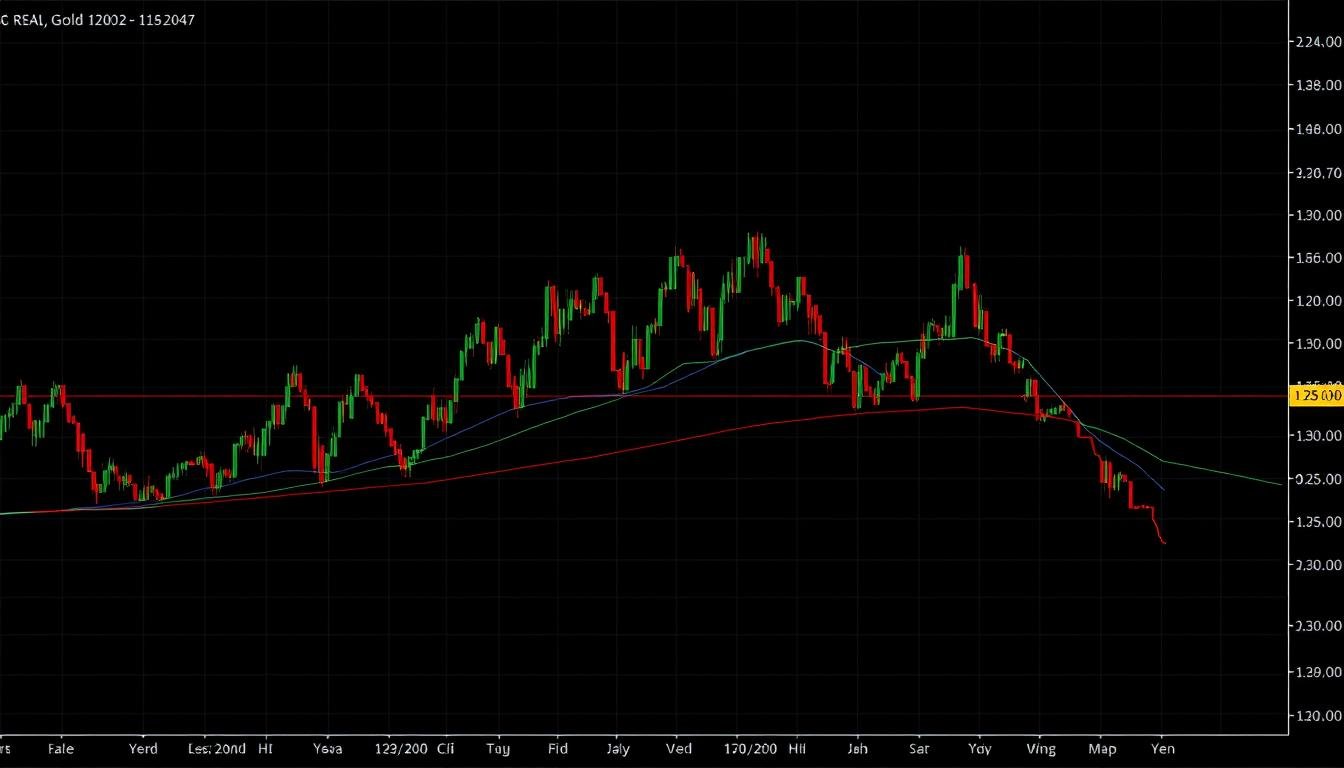
Candlestick charts are widely used in gold trading. They convey complex market information in a visually appealing way. These charts provide a rich source of data, including opening and closing prices, highs and lows, and can signal trend reversals or continuations.
Reading Individual Candlesticks
Each candlestick represents a specific time frame. It provides information about the opening, closing, high, and low prices during that period. The body of the candlestick indicates whether the closing price was higher (green or white candle) or lower (red or black candle) than the opening price.
Common Candlestick Patterns in Gold Markets
Certain candlestick patterns are significant in gold trading. Patterns like the hammer and shooting star can indicate potential trend reversals. Recognizing these patterns can give you an edge in predicting market movements.
Point and Figure Charts: Alternative Visualization
Point and figure charts offer an alternative way to visualize gold price movements. They focus on significant price changes rather than time intervals. This method helps filter out noise and can be useful for identifying support and resistance levels.
Timeframes in Gold Chart Analysis
Understanding timeframes is key for good gold chart analysis. The timeframe you pick can greatly affect your trading and investment results.
Short-term vs. Long-term Gold Analysis
When looking at gold price charts, you must choose between short-term or long-term analysis. Short-term analysis looks at gold price changes within a day. It’s great for traders aiming to make quick profits.
Intraday Gold Price Movements
Intraday analysis shows how the market acts in one day. It’s vital for those seeking fast profits from gold’s ups and downs.
Weekly and Monthly Gold Trends
Long-term analysis examines gold trends over weeks and months. It’s better for investors who focus on the big picture and don’t worry about daily changes.
Choosing the Right Timeframe for Your Goals
Picking the right timeframe depends on your trading style and goals. Whether you trade daily or invest long-term, the right timeframe is crucial.
Timeframe Selection Based on Trading Style
Your trading style affects the best timeframe for gold chart analysis. Scalpers and day traders prefer short timeframes. Swing traders and investors go for longer ones.
Multiple Timeframe Analysis Techniques
Using multiple timeframes gives a deeper look at the gold market. Analyzing different timeframes helps spot trends and patterns not seen on one timeframe alone.
By understanding and applying the right timeframe analysis, you can improve your gold trading strategy. This leads to more informed investment choices.
Essential Technical Indicators for Gold Analysis
Technical indicators are key in gold price chart analysis. They help spot trends and guide investment choices. These tools offer insights into market movements and future prices.
Moving Averages: Identifying Gold Trends
Moving averages are a top choice for gold analysis. They smooth out price data, making trends easier to see. They show the market’s direction.
Simple vs. Exponential Moving Averages
There are two main moving averages: Simple (SMA) and Exponential (EMA). SMA treats all data equally. EMA focuses more on recent prices, reacting faster to changes.
Golden Cross and Death Cross Signals
A Golden Cross happens when a short-term average crosses over a long-term one, hinting at a bullish trend. A Death Cross, on the other hand, signals a bearish trend when the short-term average falls below the long-term one.
Relative Strength Index (RSI): Measuring Gold Momentum
The Relative Strength Index (RSI) tracks price movement speed and changes. It spots when the gold market is overbought or oversold.
Overbought and Oversold Conditions
RSI values range from 0 to 100. A value over 70 means the market is overbought, possibly ready for a pullback. A value under 30 suggests oversold conditions, a good time to buy.
RSI Divergence in Gold Markets
RSI divergence happens when RSI and gold price move opposite each other. This can signal a trend change, offering valuable insights for traders.
MACD: Spotting Gold Trend Changes
The Moving Average Convergence Divergence (MACD) shows the relationship between gold price moving averages. It helps find buy and sell signals.
MACD Line and Signal Line Crossovers
The MACD line is the difference between two moving averages. A cross above the signal line is bullish. A cross below is bearish.
MACD Histogram Interpretation
The MACD histogram shows the difference between the MACD and signal lines. It helps see trend strength and potential crossovers.
Bollinger Bands: Measuring Gold Volatility
Bollinger Bands include a moving average and two standard deviations. They measure market volatility and spot potential breakouts.
Bollinger Band Squeezes and Breakouts
A Bollinger Band squeeze happens when volatility drops, bands narrow. This often precedes a big price move. A breakout occurs when price goes outside the bands, showing increased volatility.
Using Bands to Identify Potential Reversals
When gold prices hit the upper or lower band, it signals overbought or oversold. This can hint at a potential reversal.
| Indicator | Purpose | Key Signals |
|---|---|---|
| Moving Averages | Identify Trends | Golden Cross, Death Cross |
| RSI | Measure Momentum | Overbought/Oversold, Divergence |
| MACD | Spot Trend Changes | Line Crossovers, Histogram |
| Bollinger Bands | Measure Volatility | Squeeze, Breakout, Reversals |
Recognizing Key Gold Price Patterns
To understand gold trading, you must spot key price patterns. These patterns are vital for predicting gold prices and making smart trades.
Support and Resistance Levels in Gold Charts
Support and resistance levels are key in gold chart analysis. Support levels are where gold has bounced back before. Resistance levels are where gold has struggled to rise.
Identifying Historical Support and Resistance
To find historical support and resistance, look at past prices. Historical support is often at past lows. Historical resistance is at past highs.
Psychological Price Levels in Gold Markets
Round numbers like $1,800 and $2,000 can also act as support or resistance. This is because many traders place orders at these levels.
| Price Level | Type | Description |
|---|---|---|
| $1,800 | Support | Historical low |
| $2,000 | Resistance | Psychological barrier |
Trend Lines and Channels in Gold Trading
Trend lines and channels help identify gold price trends.
Drawing Effective Trend Lines
To draw good trend lines, connect significant highs or lows. An uptrend line goes through higher lows. A downtrend line goes through lower highs.
Trading Channel Breakouts
A breakout from a trading channel signals a big price move. Channel breakouts happen when prices go beyond trend lines.
Common Chart Patterns in Gold Trading
Chart patterns offer insights into gold price movements.
Reversal Patterns: Head and Shoulders, Double Tops/Bottoms
Reversal patterns like head and shoulders, double tops, and double bottoms show a trend change.
Continuation Patterns: Flags, Pennants, Triangles
Continuation patterns like flags, pennants, and triangles suggest the trend will keep going.
- Head and Shoulders: A reversal pattern indicating a potential trend change.
- Flags and Pennants: Continuation patterns that suggest the trend will continue.
Volume Analysis in Gold Trading
Volume analysis is key in gold trading. It gives us important insights into the market. It helps traders see the strength behind gold price changes. This makes it a vital tool for making smart choices.
Why Volume Matters in Gold Price Movements
Volume shows us the market’s mood. It tells us how much interest there is in gold at any time. High volume means big price changes, showing strong market action.
Volume as Confirmation of Price Trends
Volume confirms gold price trends. If prices go up and volume rises too, it’s a good sign. It means the trend might keep going.
Volume Spikes and Their Significance
Volume spikes are big market signs. For example, a big volume jump when prices fall might mean a trend change or a big market reaction.
Volume Indicators and Their Interpretation
There are many volume indicators for gold trading. Knowing them helps use volume data well.
On-Balance Volume (OBV)
OBV looks at buying and selling pressure. It compares volume on up days to down days. A rising OBV means positive pressure, likely leading to higher prices.
Volume-Price Trend Indicator (VPT)
VPT mixes price changes with volume. It shows the strength of price moves. It’s great for spotting when price and volume trends don’t match.
Using volume analysis and volume indicators like OBV and VPT can improve your gold trading. It helps make better choices.
Practical Gold Chart Analysis Techniques
Learning to analyze gold charts is key for smart investment choices in the precious metals market. A clear method for analyzing gold charts can greatly help your decision-making. By using a structured approach, you can better understand gold price changes and make better trading choices.
Step-by-Step Process for Analyzing a Gold Chart
To effectively analyze a gold chart, follow these steps:
- Establish the primary trend
- Identify key price levels
- Apply appropriate indicators
Establishing the Primary Trend
The first step is to find the primary trend. Look at long-term charts to see the gold market’s overall direction. Use long-term charts to see if gold is going up, down, or sideways.
Identifying Key Price Levels
Then, find key price levels like support and resistance. These levels are important because they show where the price has had trouble moving past. Pay attention to these levels for insights into future price movements.
Applying Appropriate Indicators
Lastly, use technical indicators like moving averages, RSI, and MACD. These tools give more insights into the gold market’s direction and speed.
Combining Multiple Indicators Effectively
When using many indicators, it’s important to avoid too much repetition. Aim for a balanced analysis.
Avoiding Indicator Redundancy
Don’t use too many similar indicators, as it can cause confusion. Instead, pick a variety of indicators that offer different views, like trend and momentum indicators.
Creating a Balanced Analytical Approach
A good approach mixes different analysis types, like technical and fundamental analysis. This gives a full view of the gold market.
Creating Your Gold Analysis Checklist
To keep your analysis consistent, make a checklist. Include the main steps and indicators you use. A consistent method improves your analysis and trading decisions.
Common Mistakes Beginners Make When Analyzing Gold Charts
When starting with gold chart analysis, beginners often make common mistakes. These can be avoided with the right guidance. Knowing these mistakes is key to a successful trading strategy.
Overcomplicating Your Analysis
One big mistake is making your analysis too complicated. Simplifying your approach can make your decisions more effective. Stick to a few key indicators that work for you.
Ignoring the Broader Market Context
Ignoring the broader market context can lead to bad trading decisions. It’s important to consider external factors that affect gold prices.
Correlation with Currency Markets
Gold prices often move with currency markets, like the US dollar. Knowing this correlation helps predict gold price changes.
Impact of Interest Rates on Gold
Interest rates also affect gold prices. Higher rates can make the dollar stronger, making gold more expensive for foreign investors.
| Factor | Impact on Gold |
|---|---|
| Strong US Dollar | Negative |
| High Interest Rates | Negative |
| Economic Uncertainty | Positive |
Emotional Decision-Making in Gold Trading
Emotional decision-making is a big pitfall for beginners. Fear and greed can lead to losses.
FOMO and Panic Selling
Fear of Missing Out (FOMO) and panic selling are common traps. Staying informed and having a clear strategy helps avoid these.
Developing Trading Discipline
Developing trading discipline is crucial to avoid emotional decisions. Stick to your strategy and learn from your experiences to improve your trading.
Tools and Resources for Gold Chart Analysis
Exploring gold chart analysis requires the right tools and resources. There are many options available, fitting different needs and budgets.
Free vs. Paid Charting Platforms
Choosing between free and paid charting platforms is a big decision. Free platforms like TradingView and Yahoo Finance offer great features for many traders. But, paid platforms like Bloomberg Terminal and MetaTrader have more advanced tools and real-time data, essential for pros.
Popular Platforms for Gold Traders
- TradingView: Known for its user-friendly interface and wide range of technical indicators.
- MetaTrader: A favorite among forex and gold traders for its automated trading capabilities.
- Bloomberg Terminal: Provides real-time data and analytics, ideal for professional traders.
Essential Features to Look For
When picking a charting platform, look for real-time data feeds, customizable charts, and technical indicators. These features are key for effective gold price chart analysis.
Educational Resources for Ongoing Learning
Improving your gold chart analysis skills requires quality educational resources. Books like “Technical Analysis of the Financial Markets” by John J. Murphy are great starting points. Online courses on Udemy and Coursera offer specialized knowledge.
Books and Online Courses
- “Technical Analysis Explained” by Martin J. Pring
- “The Disciplined Trader” by Mark Douglas
- Online courses on gold trading and technical analysis on Udemy and Coursera.
Gold Trading Communities and Forums
Joining gold trading communities and online forums is beneficial. Sites like Reddit’s r/gold and gold trading forums offer insights and support. They let you connect with other traders, share knowledge, and keep up with market trends.

Combining Technical and Fundamental Analysis for Gold
To get a full picture of the gold market, you need to mix technical and fundamental analysis. This way, you can better understand gold price changes and make smart trading choices.
Economic Indicators That Affect Gold Prices
Looking at economic indicators is key in fundamental analysis. Important factors include inflation data, central bank policies, and the US dollar’s strength.
Inflation Data and Central Bank Policies
Gold traders keep an eye on inflation rates and central bank actions. High inflation can push gold prices up as people look for safe investments. Central banks’ interest rate decisions also matter, as higher rates can make the dollar stronger and lower gold prices.
Dollar Strength and Gold Price Relationship
The US dollar’s strength and gold prices have an opposite relationship. A strong dollar makes gold more expensive for foreign buyers, which can lower prices. On the other hand, a weak dollar makes gold cheaper, which can increase demand and prices.
| Economic Indicator | Impact on Gold Prices |
|---|---|
| High Inflation | Increases |
| Strong US Dollar | Decreases |
| Central Bank Rate Hike | Decreases |
Creating a Holistic Gold Analysis Approach
For a complete view of the gold market, blend technical and fundamental analysis. This method involves timing your trades based on various factors and looking at both long-term and short-term views.
Timing Entries Based on Multiple Factors
Timing your gold trades right is crucial. Use technical tools like moving averages and RSI alongside fundamental analysis to spot the best times to buy or sell.
Long-term vs. Short-term Considerations
Consider both long-term trends and short-term changes in your analysis. Long-term views help you grasp the big picture, while short-term analysis can uncover quick profit opportunities.
By combining technical and fundamental analysis, you gain a deeper understanding of the gold market. This knowledge helps you make more informed trading decisions.
Developing Your Personal Gold Trading Strategy
Your gold trading strategy should match your investment goals and how much risk you’re willing to take. It’s key to create a plan that fits you well, as the gold market can be complex.
Defining Your Investment Goals and Risk Tolerance
First, you need to know what you want from investing in gold. Are you aiming for long-term growth or quick profits? Knowing this will guide your strategy.
Position Sizing for Gold Investments
Managing risk is crucial. It means figuring out how much gold to invest in compared to your whole portfolio. A good rule is to keep gold investments small to avoid big losses.
Setting Realistic Profit Targets
It’s important to set goals that are within reach. Look at gold’s past prices to set targets that are realistic. Don’t aim too high, as the market might not support it.
Building and Testing Your Strategy
After setting your goals and risk level, it’s time to create your strategy. Choose the right tools and methods that fit your goals.
Backtesting Your Gold Trading System
Backtesting is a must. It means testing your strategy on past data to see how it would have done. This helps find and fix any issues.
Keeping a trading journal is vital. It helps you track your progress and improve your strategy. Write down your trades, why you made them, and how they turned out. This will show you what works and what doesn’t.
By following these steps, you can craft a solid gold trading strategy that meets your goals and risk level.
Conclusion
Learning about gold price charts is key for investors. It helps you make smart trading choices. By using chart and technical analysis, you can create a solid trading plan that fits your goals.
When you analyze gold price charts, you look at market basics, spot important patterns, and use technical tools. This mix gives you a clear view of gold price changes. It helps you find chances for making money.
To get better at trading, keep learning and improving your chart skills. With time and effort, you’ll get good at analyzing gold prices. This will help you feel more confident in the markets.
Knowing how to analyze gold prices helps you adjust to market changes. It also lets you make choices that help your financial future.