In 2021, the average daily trading volume for gold was $130 billion. This shows how liquid and appealing gold is as a trading option. As a trader, you might choose gold to add variety to your portfolio and protect against market ups and downs.
To deal with the challenges of trading indicators, it’s key to know what technical indicators do. These tools help you make smart choices. They show trends and patterns that can greatly affect your trading results.
By getting good at technical indicators, you can improve your trading plan and feel more sure of yourself. Whether you’re experienced or new, learning about these indicators is a big step towards reaching your financial goals.
Key Takeaways
- Understand the importance of technical indicators in gold trading.
- Learn how to identify trends and patterns using technical indicators.
- Enhance your trading strategy with informed decision-making.
- Discover how technical indicators can empower your trading decisions.
- Improve your confidence in navigating the gold market.
The Unique Nature of Gold Markets
Gold trading analysis is not a one-size-fits-all approach. It needs a deep understanding of market dynamics. Gold, seen as a safe-haven asset, moves in price due to many factors. These include geopolitical tensions, currency changes, and how investors feel.
Why Gold Requires Specialized Technical Analysis
Gold’s value isn’t just about supply and demand. Its role as a safe-haven asset means its price goes up when the economy is shaky. This makes gold special, needing its own way of analyzing.
Niall Ferguson, a famous economic historian, said, “In times of uncertainty, investors seek safe havens.” Gold has always been one, and knowing how it acts in these times is key for traders.
Key Market Characteristics Affecting Indicator Performance
Several key market traits greatly affect how well technical indicators work in gold markets.
Safe-Haven Dynamics
When there’s geopolitical tension or an economic downturn, gold prices usually go up. Investors looking for safe assets drive this increase. This can make some indicators better, while others are less reliable.
Correlation with Dollar Strength
Gold often moves opposite to the US dollar. When the dollar weakens, gold becomes more appealing, possibly raising its price. Knowing this link is crucial for using technical indicators right.
By understanding these special market traits, you can improve your technical analysis for gold. This will help make your trading choices better.
Essential Technical Analysis Principles for Gold
Gold trading needs a special approach to technical analysis. We’re here to help you understand it. Knowing the right technical tools and how to use them can improve your trading choices.
Chart Types Most Effective for Gold Analysis
Different chart types are useful for gold analysis. You can use:
- Candlestick charts for detailed price action analysis
- Line charts for long-term trend identification
- Renko charts for filtering out market noise
Each chart type gives unique insights into gold price movements. This helps you make better trading decisions.
Timeframe Selection for Different Trading Styles
Choosing the right timeframe is key for gold trading. Your trading tools work best when they match your trading style:
Intraday Considerations
For intraday trading, focus on shorter timeframes like 15-minute or 1-hour charts. These let you catch quick market changes and make fast decisions.
Long-term Analysis Frameworks
For long-term trading, use daily, weekly, or monthly charts. These longer timeframes show major trends and help with strategic decisions.
Understanding indicator interpretation and applying technical metrics correctly across these timeframes boosts your gold trading strategy. By mastering these key technical analysis principles, you’ll be ready to navigate the gold market and reach your trading goals.
Moving Averages: The Foundation of Gold Technical Analysis
Moving averages are key in gold technical analysis. As a gold trader, you might know about them. But let’s explore how they can boost your trading strategies. They smooth out price data, making trends and patterns in the gold market clearer.
Simple Moving Averages vs. Exponential Moving Averages
There are two main types of moving averages: Simple Moving Averages (SMA) and Exponential Moving Averages (EMA). SMA gives equal weight to all data points. On the other hand, EMA focuses more on recent prices. For gold trading, EMA is often better because it reacts faster to price changes.
Choosing between SMA and EMA depends on your trading style and goals. SMA is good for long-term investors. But, if you trade short-term, EMA might be better for you.
The Golden Cross and Death Cross Signals
The Golden Cross and Death Cross are important signals in moving average analysis. The Golden Cross happens when a short-term MA crosses above a long-term MA, showing a possible bullish trend. The Death Cross occurs when a short-term MA crosses below a long-term MA, indicating a bearish trend.
These signals are very useful in gold trading. They help you understand market directions.
Multiple Moving Average Systems for Gold
Using multiple moving averages gives a deeper view of the market. By mixing different MAs, you can spot various market behaviors.
The 50-200 Day System
The 50-200 day system is a common approach. It uses the 50-day SMA and 200-day SMA. This combo shows both short-term and long-term trends. When the 50-day SMA is above the 200-day SMA, it usually means an uptrend. But, when it’s below, it signals a downtrend.
Short-term Moving Average Strategies
For short-term trading, consider using shorter MA periods like 10-day or 20-day EMAs. These help you quickly respond to market changes. But, watch out for false signals in volatile markets.
By mastering these moving average strategies, you can make better gold trading decisions. This could lead to better trading results.
Oscillators for Identifying Gold Market Momentum
Oscillators are key in gold trading. They help traders understand market trends and make smart choices. These tools spot when prices are too high or too low, showing when trends might change.
Relative Strength Index (RSI) Applications
The Relative Strength Index (RSI) tracks gold price changes. It shows if prices are too high or too low. An RSI above 70 means prices are too high, and below 30 means they’re too low.
Traders use the RSI to find buying or selling chances. A move from low to high or vice versa can signal a change in trend.
Stochastic Oscillator Settings for Gold
The Stochastic Oscillator compares gold’s closing price to its range over time. You can adjust the period to fit your trading style.
Look for crossovers between the %K and %D lines. A move from %K above %D is bullish, and from %K below %D is bearish.
MACD Signal Interpretation
The Moving Average Convergence Divergence (MACD) combines trend and momentum. It has a MACD line, signal line, and histogram. A MACD line crossing the signal line is a buying or selling signal.
Divergence Patterns Specific to Gold
Divergence patterns in the MACD and gold price are crucial. A bullish divergence shows gold’s lows are not as low as the MACD’s, hinting at a trend change. A bearish divergence shows gold’s highs are not as high as the MACD’s, hinting at a downturn.
Histogram Analysis Techniques
The MACD histogram shows the difference between the MACD and signal lines. A positive, rising histogram means bullish momentum. A negative, falling histogram means bearish momentum.
Here’s a summary of key oscillator settings and their applications:
| Oscillator | Default Setting | Application |
|---|---|---|
| RSI | 14 periods | Identifying overbought/oversold conditions |
| Stochastic Oscillator | 14 periods | %K and %D crossovers for trading signals |
| MACD | 12,26,9 | Crossovers and divergence analysis |
Understanding these oscillators can improve your gold trading. Use them with other analysis and risk management to boost your trading success.
Volatility-Based Gold Trading Indicators
Understanding volatility is key for successful gold trading. It affects price movements and trading chances. Using volatility-based indicators can improve your trading strategy and decision-making.
Bollinger Bands Settings for Gold Markets
Bollinger Bands are a well-known indicator. They include a moving average and two standard deviations above and below it. For gold, a 20-period simple moving average with two standard deviations is common.
This setup helps spot high and low volatility periods. These are key for timing trades.
Average True Range (ATR) for Position Sizing
The Average True Range (ATR) measures volatility. It shows the average price range over 14 days. Using ATR helps adjust position sizes to manage risk.
A higher ATR value means more volatility. This might mean reducing your position size to avoid big losses.
Keltner Channels vs. Bollinger Bands
Keltner Channels are like Bollinger Bands but use ATR for width. This makes them more sensitive to price changes, offering early signals. Using both Bollinger Bands and Keltner Channels can give a fuller view of volatility.
Squeeze Patterns and Breakout Signals
A “squeeze” happens when Bollinger Bands narrow, showing low volatility. This often leads to big price moves. Watching for squeeze patterns helps predict breakouts.
When bands widen, it signals a new trend. This is a great trading chance.
Volatility Cycles in Gold
Gold markets go through cycles of high and low volatility. Knowing these cycles helps adjust trading strategies. For example, low volatility might mean getting ready for a breakout.
High volatility might mean tightening stop-loss levels or reducing exposure.
Adding these indicators to your trading tools improves your ability to handle gold market changes. This leads to better trading decisions.
Volume Indicators for Gold Trading Success
Volume indicators are key for gold traders. They show how the market is moving. By looking at volume, you can see the power behind price changes. This helps you make smarter trading choices.
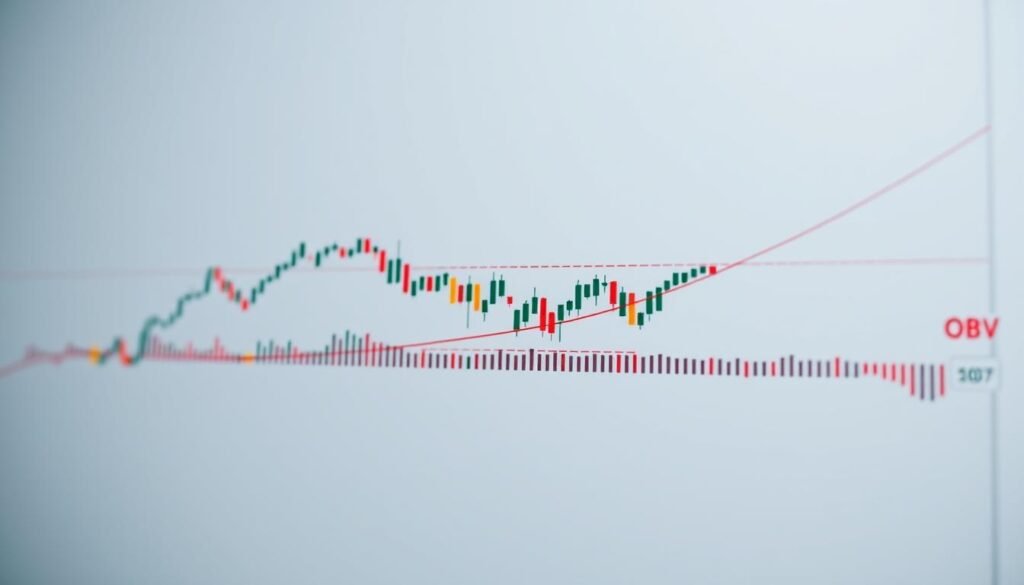
On-Balance Volume (OBV) Interpretation
On-Balance Volume (OBV) links volume to price changes. It shows if a trend is strong or weak. OBV can warn of trend changes or confirm them.
Volume Profile Analysis for Support/Resistance
Volume Profile Analysis finds key support and resistance points. It looks at volume at different prices. This helps guess where prices might move next.
Chaikin Money Flow for Gold Position Timing
Chaikin Money Flow (CMF) tracks money flow in and out of gold. It shows buying and selling pressure. CMF helps time your gold trades better.
Volume Divergence Signals
Volume divergence happens when price and volume don’t match. This can mean a trend change or continuation. Spotting volume divergence helps predict gold price shifts.
Liquidity Assessment Techniques
Liquidity is vital for gold traders. It affects how easy it is to buy or sell. By studying volume and other metrics, you can improve your trading plans.
Using these volume tools in your trading can help you understand the gold market better. You’ll make more informed decisions.
Fibonacci Tools for Gold Market Analysis
Traders often use Fibonacci tools to understand gold price changes. Fibonacci analysis is key in technical trading. It helps spot where prices might turn around or reach profit targets in gold.
Retracement Levels Specific to Gold
Fibonacci retracement levels are great for gold trading. Gold often retraces a big part of its price moves. Levels like 23.6%, 38.2%, 50%, 61.8%, and 78.6% are common. These levels often mark where gold prices might change direction or pause.
Extension Projections for Profit Targets
Fibonacci extensions help find potential profit points. In gold, levels like 127.2%, 161.8%, and 261.8% are common. These levels show where trends might keep going or where corrections might happen, helping traders plan their exits.
Fibonacci Time Analysis for Gold Cycles
Fibonacci time analysis is also useful for gold traders. It helps spot turning points based on time cycles. By looking at the time between big price moves, traders can guess when reversals might happen.
Combining Multiple Fibonacci Tools
Traders often use more than one Fibonacci tool for better analysis. For example, combining retracement levels with extension projections can make a stronger case for support or resistance. This multi-faceted approach can enhance trading decisions by providing a more comprehensive view of the market.
Historical Reliability Assessment
It’s important to check how well Fibonacci tools work in gold markets. By testing Fibonacci levels against past prices, traders can see which levels are most important for gold. This helps improve trading strategies and their accuracy.
Let’s look at how Fibonacci tools have done in gold markets over the last decade. The table below shows how different Fibonacci retracement levels have predicted gold price reversals.
| Fibonacci Level | Success Rate | Average Price Move |
|---|---|---|
| 23.6% | 55% | $20 |
| 38.2% | 65% | $35 |
| 50% | 70% | $50 |
| 61.8% | 75% | $60 |
| 78.6% | 60% | $40 |
The data shows that the 61.8% retracement level is the most reliable for gold price reversals. Knowing these trends helps traders make better decisions with Fibonacci tools today.
Advanced Pattern Recognition in Gold Charts
Learning advanced pattern recognition in gold charts can really help your trading. As a gold trader, you know the basics of chart analysis. But, diving into advanced patterns can give you an edge.
Classic Chart Patterns for Gold
Classic patterns like head and shoulders, double tops, and triangles are still key in gold trading. They help spot when trends might change or keep going. For example, a head and shoulders pattern can show a gold price trend change.
Harmonic Patterns and Their Reliability
Harmonic patterns, like Gartley and Butterfly, offer a detailed chart analysis method. They use Fibonacci ratios to guess future price moves. But, they’re complex and need careful use.
Candlestick Formations with Highest Success Rates
Candlestick patterns, like hammer and engulfing, give great insights into market mood. Patterns like the bullish engulfing candlestick are great for spotting trend reversals.
Pattern Confirmation Strategies
To make pattern recognition more reliable, use confirmation strategies. This means using several patterns together or indicators to back up your analysis.
False Pattern Identification
Not every pattern works as expected. It’s key to know how to spot false patterns to avoid big losses. Watch out for patterns that don’t fit with the bigger market picture.
By getting good at advanced pattern recognition and using confirmation strategies, you can boost your gold trading success.
Gold-Specific Ratio Indicators
Ratio indicators give a special view on gold trading. They help you decide by looking at gold’s relation to other assets.
Gold/Silver Ratio Trading Strategies
The gold/silver ratio shows how many silver ounces it takes to buy one gold ounce. It has changed a lot, from 15 to 100. If the ratio is high, it might mean silver is cheaper than gold. This could be a good time to buy silver.
Gold/Oil Ratio Market Insights
The gold/oil ratio shows how gold and oil prices relate. It can tell us about market feelings and the economy. It’s very useful when things are uncertain.
Gold/Currency Pairs as Leading Indicators
Looking at gold and currency pairs can show market trends. For example, the gold/USD pair shows the US dollar’s strength against gold.
Historical Ratio Analysis
Knowing the past of these ratios is key. By studying past trends, you can guess future moves. Here’s a table of historical gold/silver ratios:
| Year | Gold/Silver Ratio |
|---|---|
| 2010 | 60 |
| 2015 | 75 |
| 2020 | 115 |
Mean Reversion Opportunities
Mean reversion strategies look for big changes in ratios from their usual levels. This shows when to trade. Spotting these changes helps you make better trades.
Using these ratio indicators in your strategy can deepen your market understanding. It can also help you trade better.
Sentiment Indicators for Gold Market Timing
To trade gold well, you must understand sentiment indicators. They offer insights into market mood, aiding in better trading choices.
Commitment of Traders Report Analysis
The Commitment of Traders (CoT) report is weekly. It shows trader positions in futures markets. Analyzing it helps spot trader sentiment, useful for opposite strategies.
To use the CoT report effectively:
- Look at commercial and non-commercial trader net positions.
- Notice changes in positions over time.
- Watch for extreme positions that might signal market peaks or troughs.
Gold Volatility Index Signals
The Gold Volatility Index, or “fear index” for gold, shows market volatility expectations. High values mean more uncertainty, often at market bottoms. Low values suggest complacency, possibly at market tops.
To use the Gold Volatility Index in your strategy:
- Watch for extreme index readings.
- Combine it with other indicators for confirmation.
- Be alert to index and gold price divergences.
Retail Positioning Metrics
Retail positioning metrics reveal how individual traders position themselves. They help spot potential opposite opportunities.
Contrarian Trading Approaches
Contrarian trading means going against the market’s mood. Sentiment indicators help spot when most traders are too optimistic or pessimistic, signaling a market shift.
To apply a contrarian strategy:
- Track sentiment indicators for extreme levels.
- Confirm with other analysis tools.
- Be cautious of false signals and manage risk.
Sentiment Extremes Identification
Finding sentiment extremes is key for contrarian trading. It means spotting when most traders are in one direction, often before a market turn.
To find sentiment extremes:
- Use a mix of sentiment indicators.
- Watch for price action and sentiment divergences.
- Wait patiently for confirmation before trading against the trend.
By using these sentiment indicators and strategies in gold trading, you can gain an edge. Always combine these tools with other analysis and risk management.
Creating Multi-Indicator Systems for Gold Trading
Successful gold trading starts with a multi-indicator system tailored to you. By mixing different technical indicators, you craft a strong strategy. This strategy aids in making better trading choices.
Complementary Indicator Selection
Choosing the right indicators for gold trading is key. Pick ones that give different insights. For example, pair trend-following indicators like moving averages with momentum ones like the Relative Strength Index (RSI).
- Trend indicators: Moving Averages, MACD
- Momentum indicators: RSI, Stochastic Oscillator
- Volatility indicators: Bollinger Bands, Average True Range
Avoiding Redundancy and Signal Confusion
Be careful not to use too many similar indicators. Using both RSI and Stochastic Oscillator can lead to overconfidence in trades. This might cause confusion.
Best Practice: Mix indicators that offer different views on the market.
Weighting System Development
Creating a weighting system lets you prioritize indicators based on your strategy and market conditions. This makes your trading decisions more precise.
Entry Confirmation Frameworks
An entry confirmation framework sets clear conditions for starting a trade. For instance, you might need two trend indicators and one momentum indicator to align before trading.
“A well-designed entry confirmation framework can significantly reduce false signals and improve trade quality.” – Trading Expert
Exit Strategy Optimization
Optimizing your exit strategy is crucial. Use a mix of indicators to decide when to close a trade. For example, exit when a trend indicator shows a reversal or when volatility increases.
Example: Exit when the short-term MA crosses below the long-term MA, using a moving average crossover.
By refining your multi-indicator system, you can boost your gold trading strategy. This leads to better trading outcomes.
Backtesting Gold Trading Indicators
Backtesting is key to checking if your gold trading indicators work. It shows how they might do in the future by looking at past results.
Historical Performance Evaluation Methods
You can check how well your gold trading indicators did in the past. Look at return on investment (ROI), drawdown, and the Sharpe ratio. These metrics help you see how good your indicators are.
| Metric | Description | Importance |
|---|---|---|
| ROI | Return on Investment | High |
| Drawdown | Peak-to-Trough decline | High |
| Sharpe Ratio | Risk-adjusted return | Medium |
Parameter Optimization Techniques
It’s important to fine-tune your indicator’s settings for better results. Use walk-forward optimization to make sure your settings work well in all market conditions.
Avoiding Curve-Fitting Pitfalls
Curve-fitting happens when your indicator is too perfect for old data but fails in new markets. Use fresh data for testing and watch out for over-optimization.
Market Regime Testing
Testing your indicator in different market types (bull, bear, sideways) is vital. See how it does in various market conditions.
Statistical Significance Assessment
It’s important to check if your backtesting results are real or just luck. Use methods like bootstrapping to figure this out.

Real-World Gold Trading Strategies Using Technical Indicators
If you trade gold, you’re looking for top strategies with technical indicators. These tools are key for understanding gold markets and making smart trades.
Day Trading Setups with Highest Win Rates
Day trading gold needs quick thinking and precise moves. Indicators like the Relative Strength Index (RSI) and Moving Average Convergence Divergence (MACD) are great for spotting good day trades. For example, using RSI with a short-term moving average can show when gold is overbought or oversold.
- Use RSI to find overbought conditions above 70 and oversold below 30.
- Apply MACD to check trend directions and possible reversals.
Swing Trading Approaches for Gold
Swing trading means holding gold for days or weeks. Bollinger Bands and Stochastic Oscillator are good for swing trading. Bollinger Bands show volatility, and the Stochastic Oscillator signals when to switch directions.
| Indicator | Application |
|---|---|
| Bollinger Bands | Identify volatility and potential breakouts |
| Stochastic Oscillator | Signal overbought/oversold conditions and potential reversals |
Position Trading Frameworks
Position trading means holding gold for a long time. Moving averages and Fibonacci retracement levels are useful for this. They help spot long-term trends and key support or resistance levels.
Risk Management Applications
Managing risk is key to successful gold trading. Always set stop-loss orders and control your position sizes. Indicators like Average True Range (ATR) help set stop-loss levels based on market volatility.
Trade Management Guidelines
Good trade management means watching your trades and adjusting as needed. Use indicators like MACD to adjust stops and increase profits. Regularly check your trading results and tweak your strategies to stay ahead.
Common Technical Analysis Mistakes in Gold Trading
Trading gold can lead to common technical analysis traps. These traps can hurt your trading performance. Knowing these pitfalls is key to success in gold trading.
Indicator Overreliance and Analysis Paralysis
One big mistake is relying too much on indicators. While they’re useful, too many can confuse you. A wise trader advises using a few key indicators that work well together.
Ignoring Fundamental Catalysts
Technical analysis should pair with fundamental analysis. Ignoring economic data, geopolitical events, and central bank actions can lead to bad trading choices. Always look at the bigger picture when trading.
Failure to Adapt to Changing Market Conditions
Markets change, and what works today might not tomorrow. Not adjusting your analysis to these changes can cause losses. Stay ready to tweak your strategy as the market shifts.
Confirmation Bias Dangers
Confirmation bias is seeking info that backs your views. This can blind you to opposing signs. Stay open-minded and adjust your analysis with new info.
Psychological Discipline Strategies
Keeping a disciplined mindset is vital for trading success. Set clear rules, manage risks, and avoid emotional decisions. A disciplined trader can handle gold trading’s challenges.
By knowing these common mistakes and avoiding them, you can do better in gold trading. This will help you reach your trading goals.
Conclusion
Technical indicators are key in gold trading. They help you trade better. The trick is to use them well together, making a strategy that fits you.
You’ve discovered various indicators like moving averages and oscillators. These tools give you insights into market trends and price changes.
To do well in gold trading, test your strategies and adjust to market changes. This way, you can handle the gold market’s challenges and make smart trades.
Remember, knowledge is your strength. Learning about technical indicators and strategies will help you control your financial future.
The path to financial empowerment is continuous. As you use what you’ve learned, you’ll grow more confident in trading gold.