
Did you know a well-diversified portfolio can still face market crashes and economic downturns? Stress testing is key to prepare for these risks.
Simulating different market conditions, including gold, helps investors see how their portfolio holds up. This way, they can make smart choices to reduce losses.
Understanding gold simulations in stress testing can change the game. It shows how your portfolio does in various economic situations. This prepares you to deal with market ups and downs.
Key Takeaways
- Stress testing is essential for understanding portfolio resilience.
- Gold simulations play a significant role in stress testing investment portfolios.
- Understanding portfolio stress can help investors make informed decisions.
- Stress testing prepares investors for potential market downturns.
- Diversification and stress testing are key to a robust investment strategy.
The Critical Role of Stress Testing in Portfolio Management
Stress testing is key to strong portfolio management. It helps you see how your investments hold up in tough times. This way, you can protect your portfolio from sudden market changes.
Why Traditional Risk Measures Often Fall Short
Old risk measures like Value-at-Risk (VaR) or standard deviation rely on past data. They don’t always predict big, unexpected events. You need a deeper look to really understand your portfolio’s risks.
How Stress Testing Reveals Hidden Vulnerabilities
Stress testing creates extreme but possible scenarios to test your portfolio. It shows risks that usual measures miss. This helps you see potential losses and adjust your investments to stay safe.
Gold as a Strategic Asset in Portfolio Construction
Gold is a special asset in portfolio management, offering diversification benefits. It plays a key role in building a strong investment portfolio. Understanding gold’s role can help make your portfolio more resilient during market ups and downs.
Historical Performance During Market Crises
Gold has always been a safe haven during market crises. For example, in the 2008 financial crisis, gold prices went up. Investors turned to gold to escape the volatile stock markets. This shows gold’s ability to protect investments during tough times.
Adding gold to your portfolio can help reduce risk. It can also make your portfolio more resilient against market shocks.
Correlation Characteristics with Major Asset Classes
Gold’s low correlation with stocks and bonds is a big plus. This makes gold a great diversification tool. When stocks fall, gold often stays strong or goes up, balancing your portfolio.
By including gold in your strategy, you can boost returns and cut risk. The diversification benefits of gold are most valuable when the economy is uncertain.
The Fundamentals of Portfolio Stress Testing
To manage investment risk well, you need to know the basics of portfolio stress testing. It’s about checking how your investments do in extreme market situations. This helps spot weak spots and guides smart choices. Knowing the basics helps get your investments ready for sudden market changes.
Defining Key Stress Testing Parameters
Setting the right parameters is key for stress testing. You must pick the risk factors that could hit your portfolio, like interest rate changes or economic downturns. Figure out how bad these risks could be and how long they might last.
Historical vs. Hypothetical Scenarios
Stress testing can use past events or made-up scenarios. Historical scenarios look at past crises, like the 2008 crash. Hypothetical scenarios create fake stress events based on possible future risks. Both methods are useful and can be used together for a full stress test plan.
Sensitivity Analysis vs. Scenario Analysis
Sensitivity analysis changes one variable at a time to see its effect. Scenario analysis changes many variables at once to mimic complex stress scenarios. Knowing these differences helps pick the best method for your investment goals.
| Stress Testing Approach | Description | Use Case |
|---|---|---|
| Sensitivity Analysis | Analyzing the impact of changing one variable at a time. | Understanding how a specific risk factor affects your portfolio. |
| Scenario Analysis | Simulating complex stress scenarios by changing multiple variables. | Preparing for multi-faceted market crises or economic downturns. |
Why Gold Deserves Special Attention in Stress Simulations
Gold is very important in stress simulations for your investment portfolio. It has always been a safe-haven asset. Its performance during financial stress can greatly affect your portfolio’s strength.
Gold’s Performance During Previous Market Crashes
Gold has shown a unique ability to do well during market crashes. For example, in the 2008 financial crisis, gold prices went up. This is because investors look for safe assets during tough times.
This makes gold key in stress scenarios. It helps you see how your portfolio might do in future downturns.
Gold’s Response to Monetary Policy Changes
Gold also reacts to monetary policy changes. When central banks ease money or cut interest rates, gold prices can go up. But when policy tightens, gold prices might fall.
Knowing how gold reacts to these changes in your simulations is very helpful. It gives you insights into your portfolio’s performance under different economic conditions.
Building Effective Gold-Based Stress Scenarios
To create a strong stress testing framework, you must include gold simulations. These tests show how your portfolio might do in extreme market situations.
Inflation Shock Scenarios
Inflation shock scenarios check how your portfolio handles sudden inflation rises. Gold usually does well here, acting as a shield against inflation.
Geopolitical Crisis Simulations
Geopolitical crises can cause market swings, and gold benefits from being a safe haven. Running these simulations prepares you for possible market drops.
Currency Devaluation Models
Currency devaluation models look at how big currency changes affect your portfolio. Gold can protect your assets during these times.
| Scenario | Gold’s Typical Response | Portfolio Impact |
|---|---|---|
| Inflation Shock | Positive | Mitigated losses |
| Geopolitical Crisis | Positive | Reduced volatility |
| Currency Devaluation | Positive | Protected value |
Quantitative Methodologies for Stress Testing with Gold
To stress test your portfolio with gold, you need to know the tools available. Quantitative methods are key for investors to see how their portfolios hold up under stress. This is true, even more so when gold is part of the strategy.
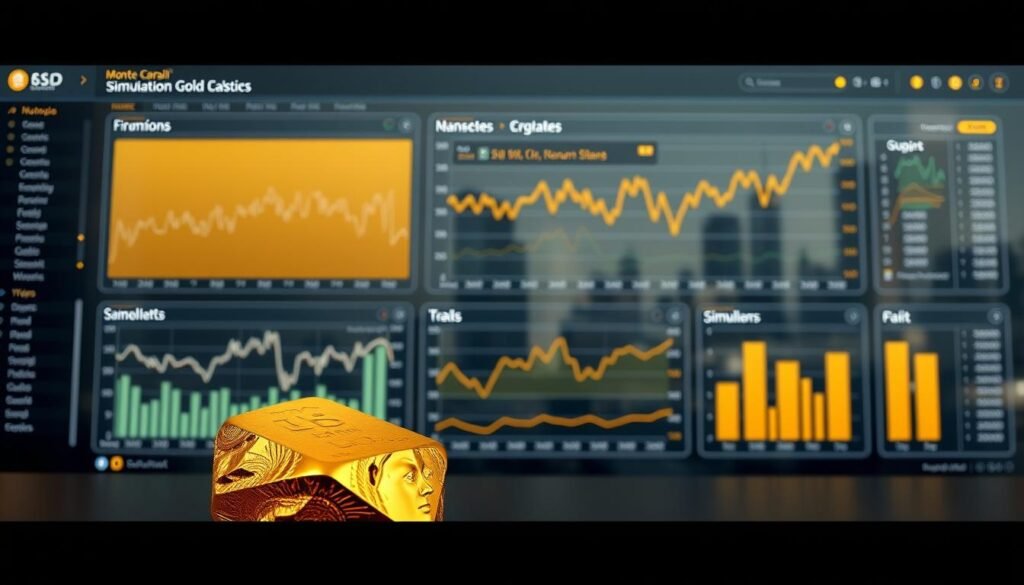
Monte Carlo Simulation Techniques
Monte Carlo simulations are a strong tool for stress testing. They let you see how your portfolio might act in many different scenarios. This method uses random samples from probability distributions to mimic various market conditions.
Setting Up Parameter Distributions
To start a Monte Carlo simulation, you must define the parameter distributions for your assets. This includes gold. You need to know about historical volatility, how assets correlate, and other important factors.
Interpreting Simulation Results
After running your Monte Carlo simulation, understanding the results is crucial. You’ll look at the distribution of outcomes to grasp the possible performance of your portfolio. This includes the worst-case scenarios.
Value-at-Risk (VaR) Models for Gold Portfolios
Value-at-Risk (VaR) models are another tool for stress testing. VaR shows the possible loss in value of your portfolio over a set time for a certain confidence level. For gold portfolios, VaR helps investors see the potential downside risk.
Let’s look at how VaR and Monte Carlo simulations work together to test a gold portfolio:
| Scenario | VaR (95% Confidence) | Monte Carlo Simulation Outcome |
|---|---|---|
| Normal Market Conditions | -5% | -4.2% |
| High Volatility | -10% | -9.5% |
| Geopolitical Crisis | -15% | -14.8% |
By using these quantitative methods together, you can better understand your portfolio’s risk. This helps you make smarter investment choices.
Implementing Gold Stress Tests in Different Portfolio Types
When you think about stress testing your portfolio, it’s important to know how gold fits into different mixes. Each type of portfolio needs its own way to test stress. Gold stress tests help you see how well your portfolio can handle tough times.
Conservative Income Portfolios
Gold stress tests for conservative income portfolios aim to keep your money safe and income steady. These portfolios usually have 5-10% in gold. They test how gold holds up under changes in interest rates or economic downturns.
Balanced Growth Portfolios
Balanced growth portfolios mix stocks and bonds. They use gold stress tests to see how it protects against market ups and downs. These tests check how gold performs in crashes and during global events.
Aggressive Growth Portfolios
Aggressive growth portfolios are mostly stocks. They use gold stress tests to reduce risks. With more than 20% in gold, it acts as a shield against big market drops. Tests simulate fast market falls and global economic crises to show gold’s protective role.
Data Requirements for Effective Gold Simulations
To do good simulation testing, you need top-notch historical data. The better your data, the more accurate your gold simulations will be.
Reliable data sources are key for strong simulation models. Historical price data is a big part of this.
Historical Price Data Sources and Quality
For great gold simulations, you need accurate and full historical price data. Here are some important points:
- Data frequency: Daily, weekly, or monthly prices
- Data duration: Long-term historical data for robust analysis
- Data sources: Reputable financial databases or gold market indices
With top-quality historical price data, you can make more precise simulation models. These models will better match real-world market conditions.
Essential Macroeconomic Indicators to Include
Adding the right macroeconomic indicators can make your simulation testing even better. Some key indicators are:
- Inflation rates
- Interest rates
- GDP growth rates
- Currency exchange rates
By adding these macroeconomic indicators to your models, you can see how economic changes might affect your gold investments.
Software Tools and Platforms for Gold-Based Stress Testing
The right software can help you understand gold-based stress testing better. It prepares you for market changes. You can pick the tool that matches your investment plan and skill level.
Professional Financial Analysis Software Options
For experts, tools like MATLAB and R are top choices. They offer detailed financial analysis, including stress testing models. These platforms have big libraries and strong community support, perfect for complex gold stress testing.
| Software | Key Features | User Base |
|---|---|---|
| MATLAB | Advanced statistical analysis, customizable models | Professional analysts, financial institutions |
| R | Extensive libraries, community-driven development | Quantitative analysts, researchers |
Accessible Tools for Individual Investors
Even individual investors can stress test their gold portfolios with easy-to-use tools. Sites like Personal Capital and Portfolio Visualizer have simple interfaces. They let you check your investments and see how gold might affect them.
When picking a software, think about what you need, your portfolio’s complexity, and your comfort with finance. Whether you’re experienced or new, there’s a tool for you to test your gold investments well.
Case Study: Portfolio Performance During the 2008 Financial Crisis
The 2008 financial crisis is a key example of how gold helps portfolios during tough times. It shows how gold can make a big difference in how well a portfolio does when markets are very unstable.
In 2008, the world’s financial markets were in chaos. The S&P 500 index dropped by over 38%. Many investors lost a lot of money. But, portfolios with gold did not do as badly.
Comparing Portfolios With and Without Gold Allocation
Imagine two portfolios: one with 10% gold and one without. The portfolio without gold lost a lot of money, just like the market. But, the portfolio with gold did better because gold’s value went up during the crisis.
Key statistics for the portfolios during the 2008 crisis:
- Portfolio without gold: Lost about 35% of its value.
- Portfolio with 10% gold allocation: Lost around 20% of its value, which helped it handle the crisis better.
Key Lessons for Future Stress Testing Models
The 2008 crisis teaches us a lot about stress testing. It shows how important it is to diversify, including using safe assets like gold. It also teaches us to use past events to improve our models. And, it reminds us to rebalance our portfolios regularly to keep them in good shape.
Investors and financial experts can use these lessons to make their stress testing better. This way, they can be ready for any future market surprises.
By learning from these lessons, investors can create stronger portfolios. These portfolios can handle extreme market situations better.
Case Study: COVID-19 Market Shock and Gold’s Role
The COVID-19 pandemic in early 2020 caused a big market shock. It tested stress testing models in real life. Investors focused on gold’s role in managing portfolios during this crisis.
Initial Market Reaction and Gold Performance
At first, investors sought safe assets as the pandemic hit. Gold prices soared as the virus spread worldwide. This showed gold’s value as a safe haven in uncertain times.
- Gold prices rose a lot at the start of the pandemic.
- The metal’s performance was affected by global economic uncertainty.
- Investor behavior showed gold’s importance in managing risk.
Recovery Phase Analysis and Implications
As markets recovered, gold’s performance changed. The recovery phase saw a complex relationship between gold and other assets. This was due to monetary policy and economies slowly opening up.
Stress testing models learned important lessons:
- They need to handle fast changes in market feelings.
- Safe-haven assets like gold are crucial in stress scenarios.
- Gold can be a hedge during recovery.
Practical Steps to Conduct Your Own Gold Portfolio Stress Test
Thinking about stress testing your gold portfolio? It’s a key step in managing risk. It’s not just for big banks; it helps individual investors too. It shows how well your portfolio can handle tough times.
Defining Your Test Parameters and Scenarios
First, set up your stress test. Identify what could shake your gold portfolio, like inflation or currency changes. Think about past events and possible future ones that might affect your investments.
Running the Simulation: Step-by-Step Guide
With your parameters set, it’s time to run the test. Use past data and models to predict how your portfolio might do under stress. You can use software or get help from financial pros.
| Stress Scenario | Potential Impact on Gold Portfolio | Mitigation Strategy |
|---|---|---|
| Inflation Surge | Positive impact as gold tends to hedge against inflation | Consider increasing gold allocation |
| Currency Devaluation | Positive impact as gold is often seen as a safe-haven asset | Maintain or increase gold allocation |
| Geopolitical Crisis | Positive impact due to increased demand for safe-haven assets | Review and adjust portfolio diversification |
Documenting and Analyzing Results
After the test, look at the results carefully. See how stress scenarios affect your portfolio. This helps you tweak your strategy to handle market ups and downs better.

Common Pitfalls in Gold-Based Stress Testing
To get the most out of gold-based stress testing, you need to know the common errors. These errors can make the testing less effective. It’s important to be aware of these pitfalls to make accurate risk assessments and informed decisions.
Overreliance on Historical Correlations
One major pitfall is relying too much on historical correlations. Historical data is useful, but assuming past trends will always hold is risky. Markets change, and correlations can shift quickly due to unexpected events.
For example, during the 2008 financial crisis, many investors were surprised by the sudden changes in asset correlations. To avoid this, use hypothetical scenarios to predict future market changes. This helps you understand how your portfolio might perform under stress.
Failing to Account for Liquidity Factors
Another big mistake is ignoring liquidity in gold-based stress testing. Liquidity can drop fast during stress times, making it hard to sell assets without big price drops. Even gold, seen as liquid, can face liquidity crises, mainly with large positions.
| Factor | Impact on Gold Liquidity | Stress Testing Consideration |
|---|---|---|
| Market Volatility | High volatility can reduce liquidity | Model scenarios with extreme price swings |
| Economic Downturn | Can lead to decreased liquidity in gold markets | Include scenarios with economic shocks |
| Geopolitical Events | Can cause sudden changes in liquidity | Test scenarios involving geopolitical crises |
By knowing these pitfalls and using more detailed stress testing, you can better protect your portfolio from future shocks.
Integrating Stress Test Results into Portfolio Strategy
Now that you have stress test results, you can improve your portfolio strategy. This means making smart investment choices based on what the stress test shows.
Tactical vs. Strategic Allocation Adjustments
Deciding between tactical and strategic adjustments is key. Tactical adjustments are quick changes made in response to current market trends. Strategic adjustments are long-term changes to your portfolio’s mix of assets, based on the stress test.
If your stress test shows your portfolio is at risk during downturns, you might add more cash temporarily. A long-term change could be to increase your gold holdings, which often do well in tough times.
Developing Rebalancing Protocols Based on Test Outcomes
Stress test results also guide your rebalancing plans. Rebalancing means adjusting your portfolio to match your desired mix of assets. By looking at the stress test results, you can set rules for when to rebalance.
For example, you might rebalance when your gold holdings are off by more than 10% from your goal. This keeps your portfolio in line with your investment aims, even when markets are shaky.
Conclusion: Building Resilient Portfolios Through Gold Simulations
You now know how stress testing is key in managing portfolios. Gold simulations help make your investment strategy stronger. They help spot weaknesses and build stronger portfolios.
Gold simulations are a great tool for investors in tough market times. They use past data and scenarios to show how gold might act in uncertain times. This helps you make smarter choices.
Now, use what you’ve learned to improve your investment plans. This will help you build a portfolio that can handle market ups and downs better.
Using gold simulations and stress testing, you can manage your investments more effectively. This leads to more confident and successful financial results.