When central banks cut interest rates, you might notice gold prices go up. This isn’t random. Rate cuts often make gold more attractive because it doesn’t earn interest.
Looking into this, you’ll see how central bank decisions affect gold prices. This is key for anyone investing. The link between Federal Reserve rate cuts and gold prices is clear and important.
Key Takeaways
- Rate cuts by central banks can significantly impact gold prices.
- Historically, rate cuts have led to an increase in gold price.
- The reduced opportunity cost of holding non-yielding assets drives gold price appreciation.
- Understanding the relationship between interest rates and gold is crucial for investors.
- Global rate cuts can be a catalyst for changes in gold performance.
The Fundamental Relationship Between Interest Rates and Gold
Interest rates change, and so does gold’s price. But the link between them is complex. You might know that interest rates affect many assets, including gold.
The Inverse Correlation Explained
Many think interest rates and gold prices move in opposite ways. But, this connection isn’t always clear-cut.
Historical Evidence of the Relationship
Gold’s price and interest rates have had different relationships over time. For example, when interest rates are low, gold often does well. But, this pattern isn’t always true.
Economic Theory Behind the Connection
Economic theories say that low interest rates make gold more attractive. This is because gold doesn’t earn interest. So, when rates drop, gold’s appeal increases, often raising its price.
Opportunity Cost Theory and Precious Metals
The opportunity cost theory is key to understanding gold. When rates are low, holding gold costs less. This makes gold more attractive, possibly increasing its price.
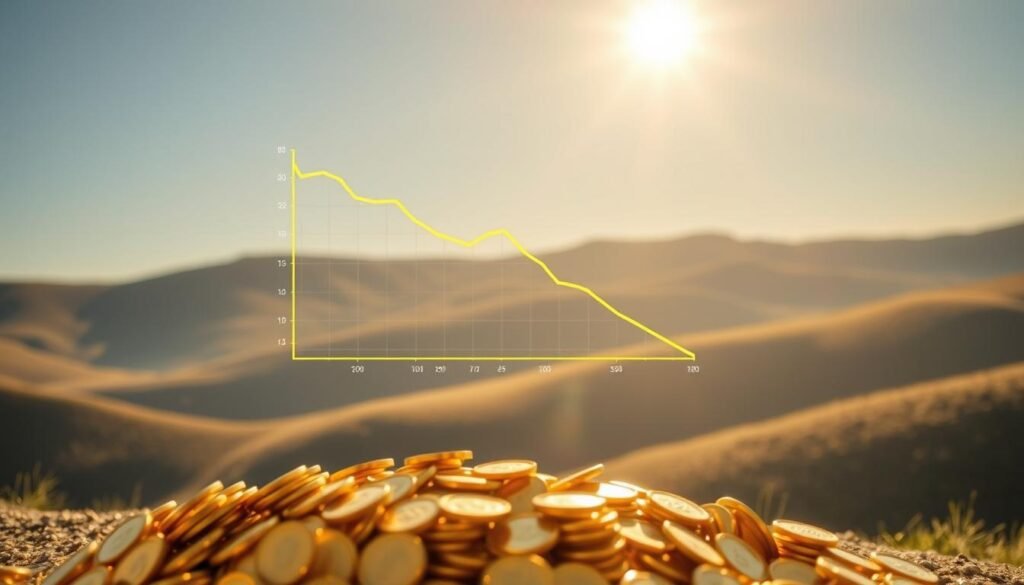
Understanding Gold as an Investment Asset
Gold’s role in investments is crucial for your financial future. It has been valuable for centuries. Its place in portfolios is changing.
Gold’s Traditional Role in Investment Portfolios
Gold is seen as a safe asset. It helps protect against market ups and downs. Adding gold to your portfolio can:
- Diversify your investments to lower risk
- Keep your wealth safe during tough economic times
- Maybe increase returns with smart gold investments
Unique Characteristics of Gold Markets
Gold markets stand out due to their unique traits. These include:
- Liquidity: Gold is easy to buy and sell
- Supply and Demand Dynamics: Gold’s price changes based on supply and demand. This can be influenced by mining, central banks, and investor interest
Liquidity Considerations
Gold’s liquidity is a big plus for investors. You can quickly turn gold into cash. This makes it a flexible part of your strategy.
Storage and Insurance Factors
Investing in physical gold means thinking about storage and insurance. Safe storage options include:
- Safe deposit boxes at banks
- Specialized precious metals storage facilities

Understanding gold’s investment aspects helps you make better choices. It can be a key part of your financial plan.
Historical Patterns: Gold Performance During Previous Rate Cut Cycles
Gold’s past performance during rate cuts shows us a lot. It tells us how different economic times have affected its price. By looking at these times, we can learn a lot about gold’s future.
1970s Stagflation Era
In the 1970s, the economy faced high inflation and slow growth. Gold prices went up as people looked for safe places to put their money. They wanted to protect themselves from inflation.
2001-2003 Dot-Com Aftermath
After the dot-com bubble burst, rate cuts were made. At first, gold didn’t move much. But as the cuts kept coming and uncertainty grew, gold started to go up.
2008-2009 Global Financial Crisis
The 2008-2009 financial crisis saw big rate cuts and money printing. Gold prices soared as investors turned to it as a safe place. They were worried about the economy.
2019-2020 Pre-Pandemic Easing
In 2019-2020, rate cuts were made before the pandemic hit. Gold prices went up, showing investors’ worries about the future.
| Period | Economic Conditions | Gold Price Change |
|---|---|---|
| 1970s | Stagflation | +200% |
| 2001-2003 | Post Dot-Com | +20% |
| 2008-2009 | Global Financial Crisis | +25% |
| 2019-2020 | Pre-Pandemic Easing | +15% |
Looking at these past times helps us guess how gold might do in the future. We must remember that the economy always changes, affecting gold’s price.
Federal Reserve Rate Cuts and Their Impact on Gold Prices
It’s key for investors to know how rate cuts by the Federal Reserve affect gold prices. When the central bank lowers borrowing costs, gold prices often rise. This is because of changes in investment appeal and economic conditions.
Immediate Market Reactions to Fed Announcements
When the Fed cuts rates, gold prices can jump quickly. Investors seek safe assets during economic uncertainty. This initial jump is driven by market sentiment and can lead to big price changes.
Long-term Price Trends Following US Rate Decisions
Long-term trends are just as important as immediate reactions. Gold usually does well after a rate cut. Lower interest rates make holding gold more attractive.
Six-Month Performance Metrics
Looking at gold’s performance six months after a rate cut shows a clear pattern. The table below shows this trend:
| Year | Rate Cut | Gold Price at Cut | Gold Price 6 Months Later | % Change |
|---|---|---|---|---|
| 2001 | Jan 2001 | $265.11 | $293.25 | +10.6% |
| 2007 | Sep 2007 | $672.60 | $800.50 | +19.0% |
| 2019 | Jul 2019 | $1414.50 | $1553.20 | +9.8% |
One-Year Performance Analysis
Looking at gold’s performance a year after a rate cut shows a positive trend. This reinforces gold’s role as a safe asset during monetary easing.
By looking at both immediate and long-term trends, you can better understand how rate cuts affect gold prices. This knowledge helps you make better investment choices.
European Central Bank Monetary Policy and Gold Valuation
Ever wondered how the European Central Bank’s moves impact your gold investments? The ECB’s monetary policy is key in shaping global markets, including gold prices. You’ll learn how ECB policies tie into gold prices as you explore this topic.
EUR/USD Exchange Rate Effects on Gold
The EUR/USD exchange rate is a crucial factor. A weaker U.S. dollar can boost gold prices because gold is priced in dollars. This makes gold cheaper for buyers outside the U.S. When the ECB changes the euro’s value against the dollar, it affects gold demand and price.
Negative Interest Rate Policies and Precious Metals
The ECB has used negative interest rates to boost the European economy. This unusual policy makes gold more appealing as an investment. It lowers the cost of holding non-yielding assets like precious metals.
Brexit and European Rate Policy Implications
Events like Brexit can greatly influence the ECB’s policies. The uncertainty around such events can cause currency value swings. This, in turn, affects gold prices. Knowing these dynamics can help you make better investment choices.
Asian Central Banks’ Rate Decisions and Regional Gold Demand
Asian central banks are key players in the global economy. Their rate decisions shape gold demand in the region. Understanding these impacts is vital for grasping the global gold market.
China’s Monetary Policy and Gold Imports
China’s monetary policy greatly affects its gold imports. When China relaxes its monetary policy, gold demand goes up. This is because gold becomes more appealing when interest rates are low.
India’s Interest Rate Environment and Cultural Gold Consumption
In India, gold consumption is deeply rooted in culture. The interest rate environment influences gold prices, affecting consumer behavior. Lower interest rates often lead to more gold purchases.
Japan’s Zero-Rate Policy Effects on Global Gold Markets
Japan’s zero-rate policy has a big impact on global gold markets. Low interest rates make gold more attractive, potentially raising its price.
Central banks’ buying patterns support gold prices, even with short-term ups and downs. The rate decisions of Asian central banks create a complex environment for global gold markets.
Emerging Markets’ Rate Cuts and Their Unique Influence on Gold
Rate cuts in emerging markets affect gold prices worldwide. It’s important to grasp these connections to trade gold wisely.
Currency Devaluation Concerns
Interest rate cuts in emerging markets can cause currency devaluation. This makes gold a safer choice for investors. A devalued currency weakens investor confidence, pushing them towards gold.
“In times of economic uncertainty, gold has historically been a reliable store of value,” experts say. This is why gold prices often rise when currencies fall.
Central Bank Gold Reserves in Developing Economies
Central banks in emerging markets are key players in gold trading. Their gold reserve decisions can change global gold prices.
Reserve Diversification Trends
Emerging markets are adding gold to their reserves. This move helps them reduce their reliance on the US dollar.
De-Dollarization Efforts
Investing in gold is part of a larger effort to reduce dollar risks. Holding more gold helps these countries manage dollar fluctuations better.
The link between rate cuts in emerging markets and gold prices is complex. Knowing these connections can guide your investment choices.
Global Rate Cuts and Their Synchronized Effect on Gold Performance
Global rate cuts have had a synchronized effect on gold performance. These cuts have led to a decrease in gold prices. This is because investors are looking for better returns in other assets.
Gold prices have seen a decline due to these rate cuts. This is because investors are shifting their focus to other assets that offer higher returns. The synchronized effect of global rate cuts has impacted gold performance significantly.
Investors are now looking for assets that can provide better returns in a low-interest rate environment. Gold, which is often seen as a safe-haven asset, has seen its prices decline as investors seek higher returns elsewhere.
Gold’s performance has been affected by the synchronized rate cuts across the globe. As interest rates have been lowered, investors have turned their attention to other assets that offer higher returns. This shift in investor sentiment has led to a decline in gold prices.
Gold’s role as a safe-haven asset has also been impacted by the synchronized rate cuts. In times of economic uncertainty, investors often turn to gold as a safe haven. With the rate cuts, investors are now seeking higher returns in other assets, leading to a decline in gold prices.
Overall, the synchronized effect of global rate cuts has had a significant impact on gold performance. As investors seek better returns in a low-interest rate environment, gold prices have declined. It is important for investors to carefully consider the impact of rate cuts on gold performance and make informed investment decisions.
Rate Cuts During Economic Recessions vs. Preventative Easing
It’s key for gold investors to know the difference between rate cuts in downturns and easing before trouble starts. These monetary policy moves can greatly affect gold prices, depending on the economic situation.
Crisis-Driven Rate Reductions and Gold Rallies
When the economy is in a recession, central banks cut rates to boost it. These moves often cause gold prices to rise as investors look for safe places to put their money. With rates falling, gold becomes more appealing because it doesn’t earn interest.
Preemptive Rate Cuts and Their Muted Gold Impact
But, rate cuts before a crisis hits don’t move gold prices as much. These cuts are seen as a way to prevent trouble, not to fix it. So, gold prices don’t swing as wildly.
Identifying True Monetary Policy Signals
To make sense of these market moves, investors need to spot real monetary policy signals. They should watch what central banks say and look at economic signs. This helps them understand why rates are being changed.
Gold Mining Stocks vs. Physical Gold During Rate Cut Environments
In a low-interest-rate environment, investors often turn to gold. But should you choose physical gold or gold mining stocks? The decision depends on your investment goals and risk tolerance.
Operational Cost Benefits for Mining Companies
When interest rates are cut, mining companies’ operational costs can decrease. This can increase their profit margins. Lower interest rates also make borrowing cheaper, allowing companies to invest in new projects or expand existing ones.
This can lead to increased gold production. This may put downward pressure on gold prices. But, the initial impact of rate cuts is often positive for gold mining stocks as investors anticipate improved economic conditions.
Stock Performance Comparison with Bullion
Historically, gold mining stocks have outperformed physical gold during certain periods of rate cuts. This is because mining stocks offer leverage to the price of gold. As gold prices rise, the stocks tend to rise more significantly.
But, they also come with higher volatility and company-specific risks.
Junior Miners vs. Major Producers in Easing Cycles
Junior miners, being more speculative, can see significant stock price increases during rate cut environments. This is if they are perceived as having high growth potential. Major producers, on the other hand, tend to be more stable and less volatile.
They offer a safer bet for investors looking for exposure to gold through mining stocks. Your choice between junior miners and major producers will depend on your risk appetite and investment strategy.
Gold ETFs and Derivative Products: Performance Following Rate Cuts
Investors are keenly interested in how gold ETFs and derivative products perform after rate cuts. Central banks’ changes in monetary policies have a big impact on these financial tools.
Fund Inflows After Rate Reduction Announcements
After rate cuts, investors often look for safe places to put their money. This leads to more interest in gold ETFs. Data shows a cautious optimism among investors about gold’s performance in low-rate times.
Contango and Backwardation in Futures Markets
The structure of gold futures markets affects gold ETFs and other derivatives. Contango, where futures prices are higher, can cause losses, while backwardation can lead to gains. It’s important for investors to understand these market conditions.
Options Strategies During Volatile Gold Markets
Gold market volatility after rate cuts can open up opportunities for investors. Strategies like straddles or strangles can help investors profit from big price swings. It’s crucial for investors to know the risks and rewards of these strategies.
Rate Cuts vs. Quantitative Easing: Differing Impacts on Gold
The link between rate cuts and gold’s performance is intricate, with quantitative easing adding complexity. It’s crucial to grasp how these monetary tools influence gold prices. This knowledge aids in making better investment choices.
Traditional Rate Reductions Compared to QE Programs
Rate cuts and quantitative easing (QE) are central bank tools to boost economies. Yet, they operate in distinct manners. Rate cuts lower borrowing costs, spurring spending and investment. On the other hand, QE injects liquidity by buying assets.
Both methods can weaken currencies, potentially lifting gold prices. Their effects, though, hinge on market expectations and economic conditions.
Gold’s Historical Response to Balance Sheet Expansions
Gold has historically reacted well to balance sheet expansions via QE. This is due to QE signaling deep monetary easing. Such actions can raise concerns about currency devaluation, boosting demand for gold.
The size and scope of QE programs affect gold’s performance. Larger programs tend to have a more significant impact.
Tapering Announcements and Gold Price Volatility
Tapering announcements, indicating a QE reduction, can cause gold price swings. As central banks plan to ease stimulus, investor expectations shift. This sometimes leads to gold price drops.
The actual effect, though, depends on the broader economic situation. It also hinges on whether tapering is viewed as a recovery sign or a move towards tighter policy.
Inflation Expectations During Rate Cut Cycles and Gold as a Hedge
Inflation expectations are key during rate cut cycles. Gold often acts as a hedge against inflation. It’s important to know how rate cuts, inflation, and gold prices interact.
Real Interest Rates and Their Predictive Value
Real interest rates, which factor in inflation, offer insights into gold’s performance. When these rates are low or negative, gold tends to do well. This is because holding gold becomes less costly compared to other assets.
TIPS Spreads as Gold Price Indicators
TIPS spreads are important indicators. They show inflation expectations and can affect gold prices. A wider TIPS spread means higher inflation expectations, which can push gold prices up.
Stagflation Scenarios and Gold Performance
Stagflation, with stagnant growth and high inflation, impacts gold prices. Gold has historically done well in such times. It acts as a hedge against inflation. Knowing about stagflation can help in gold investment decisions.
| Economic Scenario | Gold Performance | Reason |
|---|---|---|
| Low Real Interest Rates | Positive | Reduced opportunity cost |
| Widening TIPS Spreads | Positive | Increasing inflation expectations |
| Stagflation | Positive | Hedge against inflation |
Understanding the link between inflation, real interest rates, and gold prices helps in navigating rate cut cycles. It aids in making informed investment choices.
Currency Devaluation Risks Following Global Rate Cuts
Currency devaluation is a big risk after global rate cuts. It affects investors’ money. When interest rates drop, a currency’s value can fall compared to others. This drop can hurt investors, mainly those with assets in the falling currency.
Competitive Devaluation Scenarios
Competitive devaluation happens when many countries lower their currency values to win in trade. This makes the foreign exchange market very unstable. Investors often turn to gold as a safe place to put their money.
Key characteristics of competitive devaluation include:
- Multiple countries lowering interest rates at the same time
- Increased currency volatility
- Potential for trade wars
Gold as a Currency Debasement Protection Tool
Gold has always protected against currency value loss. When currencies drop in value, gold usually goes up. This helps against inflation and currency devaluation.
Historical Currency Crisis Case Studies
Looking at past currency crises can teach us about gold’s role. The table below shows how gold performed during these times.
| Currency Crisis | Gold Performance |
|---|---|
| Asian Financial Crisis (1997-1998) | Gold prices stayed relatively stable |
| Global Financial Crisis (2008-2009) | Gold prices soared as investors looked for safe places |
| Venezuela’s Economic Crisis (2013-present) | Gold was key for keeping wealth safe |
Knowing about currency devaluation risks and gold’s protective role helps you deal with global financial markets better.
Investment Strategies for Gold During Anticipated Rate Cut Periods
Rate cuts are coming, and you might wonder how to make your investment portfolio better. To succeed with gold investments during these times, knowing the right timing, managing risks, and how to mix investments is key.
Portfolio Allocation Recommendations
There are different ways to add gold to your portfolio. Percentage-based approaches mean setting a fixed amount of your portfolio for gold. This helps protect against market ups and downs.
Percentage-Based Approaches
One strategy is to put 5-10% of your portfolio in gold. This acts as a safety net during market drops but lets you explore other investment options too.
Risk-Adjusted Allocation Models
Risk-adjusted allocation models consider your risk level and goals. They help figure out the best gold share for your financial situation.
Timing Considerations for Gold Purchases
Timing is everything when buying gold during rate cuts. Use technical analysis indicators to find the best times to buy. Or, look at fundamental economic signals like inflation and currency changes.
By grasping these strategies and timing tips, you can make smart choices for your gold investments during rate cuts.
Conclusion: The Future of Gold in a Changing Rate Environment
You now understand how global rate cuts affect gold. The link between interest rates and gold prices is complex. It’s influenced by many factors like monetary policies and economic conditions.
The Federal Reserve’s rate decisions greatly impact gold prices. Rate cuts often boost gold demand. It’s crucial to consider the global context, including other central banks’ actions.
Looking ahead, gold’s future looks bright. Uncertainty in global markets and gold’s role as a safe-haven asset drive this. Remember the historical patterns and trends discussed here. Stay updated on monetary policy and economic conditions.
This way, you’ll be ready to take advantage of gold market opportunities. You’ll reach your financial goals in this changing rate environment.