
Have you heard about the overlap between London and New York trading sessions? It’s a key time for gold trading. From 13:00 to 16:00 GMT, the market is most liquid, spreads are tight, and volatility is high.
This overlap offers the best trading conditions. It’s a favorite time for traders in the XAUUSD market. Knowing the unique traits of each market is key for smart trading decisions.
Key Takeaways
- The London–New York session overlap is the best time for gold trading.
- Market liquidity is highest during this overlap.
- Tighter spreads and increased volatility make it an ideal time for traders.
- Understanding the characteristics of each market is crucial for informed decisions.
- Traders can capitalize on the optimal trading conditions during the overlap.
The Historical Evolution of Gold Markets
Exploring gold trading means looking at London and New York’s markets. These markets have shaped the global gold trade. They influence how gold is traded, stored, and regulated today.
London’s Legacy
London’s gold market started in 1732 with the London Gold Pool. This history has made London a key place for gold trading. Today, the London OTC market is about 70% of global notional trading volume. It’s the biggest gold trading center in the world.
The London Bullion Market Association (LBMA) oversees the market. They make sure trading follows high standards.
New York’s Rise to Prominence
New York became a big player in gold trading in the 20th century. The COMEX exchange was a key factor. COMEX is a top place for gold futures and options trading.
New York’s market grew because of its strong rules and status as a global financial center.

Understanding Gold Market Structures
It’s key to know how gold markets work in London and New York. These markets trade gold in different ways. This affects how traders plan and execute their strategies.
London’s OTC-Dominated Trading Environment
London’s gold market trades mostly over the counter (OTC). This means deals are made directly between parties, without an exchange watching over them.
The Role of Clearing Banks
Clearing banks are crucial in London’s OTC market. They help settle trades by acting as middlemen. This ensures trades are done efficiently and safely.
Bilateral Trading Relationships
In London, trades are usually between two parties only. This direct approach allows for more flexible and varied trading conditions.
New York’s Exchange-Based Trading Model
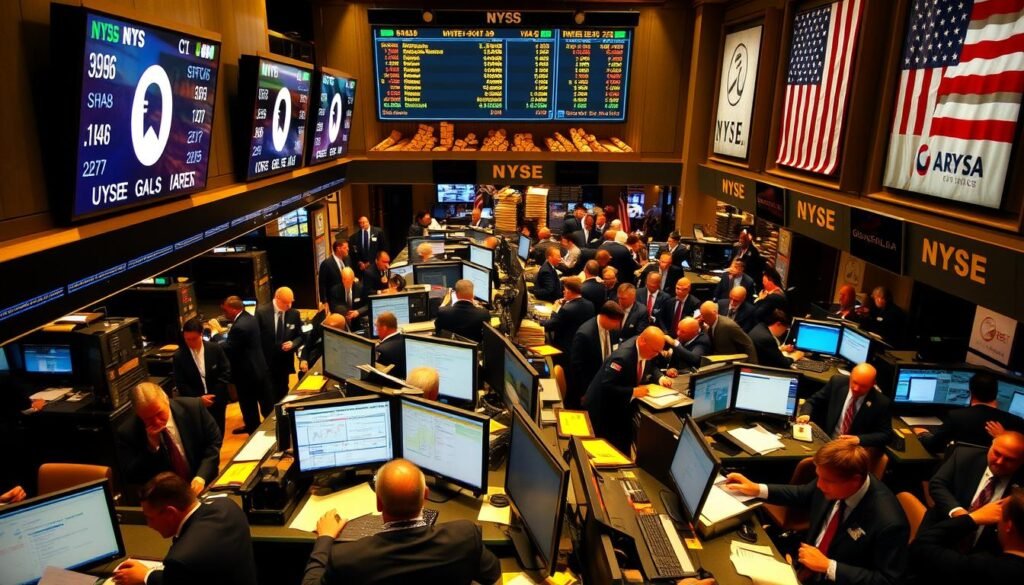 New York trades gold mainly on the COMEX exchange, part of the CME Group. This model is different from London’s OTC market.
COMEX Standardized Contracts
COMEX offers standardized gold futures contracts. These contracts are regulated and transparent. They are also very liquid, attracting traders from all over.
Central Counterparty Clearing
COMEX uses central counterparty clearing. This means the exchange is the middleman in every trade. It lowers the risk of default and makes the market more stable.
Knowing these differences helps you navigate the gold markets in London and New York. It lets you make smarter choices about your trading.
Key Players in the London vs. New York Gold Ecosystem
Knowing who’s who in the gold market is key. London and New York are hubs for gold trading. They have many players who make the market liquid and deep.
London Bullion Market Association Members
The London Bullion Market Association (LBMA) is a big deal in London’s gold market. Its members help shape the market.
Market-Making Banks
Market-making banks are vital in London’s gold market. They act as primary dealers. They quote prices for buying and selling gold. Some top banks include:
- HSBC
- Barclays
- UBS
Bullion Dealers and Brokers
Bullion dealers and brokers help connect buyers and sellers. They offer essential services like:
- Trading
- Storage
- Delivery
COMEX and Major New York Participants
In New York, COMEX is a big name in gold trading. Many players help make it work.
FCMs and Clearing Members
Futures Commission Merchants (FCMs) and clearing members are crucial on COMEX. They provide clearing services. This ensures trades are settled smoothly.
Proprietary Trading Firms
Proprietary trading firms trade gold futures on COMEX with their own money. They add a lot to market liquidity. They use smart trading strategies.
Trading Hours and Market Activity Patterns
Knowing when to trade gold in London and New York is key. Gold is traded almost all the time, but the busiest hours are when London and New York overlap.
London Trading Session Characteristics
The London session is known for its high liquidity and price movement. This is often due to European economic data releases. High liquidity during this time is great for traders who want to enter or exit positions. The London Bullion Market Association (LBMA) sets the global gold price tone.
New York Trading Hours and Volume Distribution
The New York session, during COMEX hours, has high trading volumes and volatility. This is because of US macroeconomic indicators. Traders need to watch for key economic data releases that can cause big price changes. The overlap between London and New York is the best time for trading.
| Session | Trading Hours | Characteristics |
|---|---|---|
| London | 08:00-16:30 GMT | High liquidity, driven by European economic data |
| New York | 13:00-20:00 EST | High volatility, influenced by US macroeconomic indicators |
| Overlap | 13:00-16:30 GMT/EST overlap | Highest trading volumes and significant price movements |
Gold Price Discovery: London vs. New York Mechanisms
The way gold prices are set differs between London and New York. Each place has its own way of adding to the global gold market. Knowing these differences is key for investors and market players.
LBMA Gold Price Auction Process
The London Bullion Market Association (LBMA) sets a twice-daily gold price. This price is found through an electronic auction with banks. The auction aims to be clear and fair, showing a true market value.
Key features of the LBMA Gold Price auction include:
- Twice-daily auctions at 10:30 am and 3:00 pm London time
- Electronic auction platform for transparency
- Participation by major bullion banks
- Benchmark for gold pricing globally
COMEX Futures Price Formation Dynamics
The COMEX gold futures market is key in setting prices. Its trading affects gold prices worldwide. The price on COMEX is shaped by futures contracts, showing market hopes and fears.
The dynamics of COMEX futures price formation include:
| Factor | Description | Impact on Price |
|---|---|---|
| Market Sentiment | Investor attitudes towards gold | Influences demand and supply |
| Trading Volume | Activity level in COMEX gold futures | Higher volume = greater price discovery |
| Economic Indicators | Release of economic data | Can affect gold price |
Both the LBMA Gold Price and COMEX futures help set global gold prices. The LBMA gives a benchmark, while COMEX adds depth and liquidity. Together, they shape gold prices around the world.
Regulatory Frameworks Governing Gold Markets
The gold markets in London and New York have their own regulatory frameworks. These rules shape how trading works. Knowing these rules is key for those in the market to follow laws and manage risks.
UK Financial Conduct Authority and PRA Oversight
In the UK, the Financial Conduct Authority (FCA) and the Prudential Regulation Authority (PRA) watch over the London gold market. The FCA makes sure financial firms act right, keeping the market fair. The PRA checks if financial institutions are strong and stable. They work together to help the London Bullion Market Association (LBMA) and its members.
CFTC and SEC Regulation in the US Market
In the US, the Commodity Futures Trading Commission (CFTC) and the Securities and Exchange Commission (SEC) are key. The CFTC looks after commodity futures, like gold futures on COMEX. The SEC checks on gold-related investment products, like ETFs. This team makes sure the US gold market is open and fair.
Knowing the regulatory frameworks in London and New York helps traders. It lets them make smart choices in the gold market.
Physical Gold Trading Practices in the Both Centers
Knowing how physical gold trading works in London and New York is key for gold investors. Both cities are big players in the gold market. But, they handle physical gold differently.
London’s Allocated and Unallocated Gold Accounts
London’s gold market offers flexibility with allocated and unallocated accounts. Allocated accounts mean gold bars are stored in a vault. Unallocated accounts are claims on the total gold held by the custodian.
Vault Management Systems
London’s vault systems are top-notch for security and efficiency. They keep gold safe with strict access controls and regular audits.
Chain of Custody Protocols
London’s chain of custody keeps gold’s integrity during storage and transfer. It uses detailed records and verification to ensure proper handling and storage.
New York’s Delivery and Warehousing Systems
New York’s gold market, backed by COMEX, focuses on delivery and warehousing. COMEX-approved vaults are key for secure storage and efficient delivery.
COMEX Approved Vaults
COMEX-approved vaults are vital for New York’s gold delivery. They follow strict regulations and regular inspections for compliance and security.
Delivery Process and Logistics
The delivery process in New York involves transferring gold, aided by COMEX’s logistics and inspection rules. This ensures gold is delivered safely and on time, meeting exchange standards.
In summary, London and New York have advanced systems for physical gold trading, each with its own features. It’s important for investors to understand these practices to make smart choices.
Market Liquidity: London vs. New York Gold Trading
Market liquidity is key in gold trading, mainly in London and New York. Knowing the liquidity landscape is vital for traders to do well.
Interbank Market Depth in London
London’s interbank market is deep, boosting gold market liquidity. The London Bullion Market Association (LBMA) helps with this trading. It makes sure there’s always a market for gold.
COMEX Futures Liquidity Metrics and Analysis
New York’s COMEX futures market looks at liquidity through volume and open interest. High liquidity means a strong market with many players. This makes it easier to buy or sell.
COMEX’s liquidity metrics show how active the market is and what traders think.
Knowing these liquidity details helps traders make smart choices in London and New York’s gold markets.
Gold Trading Instruments Comparison
It’s important to know the differences in gold trading between London and New York. Both cities have various financial products for different trading strategies and investor tastes.
London Good Delivery Bars and OTC Products
London’s gold market is famous for its Good Delivery bars, the top choice for physical gold. It also has over-the-counter (OTC) products for more flexible trading.
Spot Gold Transactions
Spot gold deals happen right away at the current market price. They’re popular for buying or selling physical gold.
Forward Contracts and Swaps
Forward contracts and swaps help manage risks or speculate on future prices. They’re great for handling market volatility.
New York’s Futures, Options, and ETFs
New York’s gold market, mainly through the COMEX exchange, offers futures, options, and ETFs. These financial derivatives are key for trading.
GC Futures Contract Specifications
The GC futures contract is a deal to buy or sell gold at a set price on a certain date. These contracts are liquid and used for speculation and risk management.
Gold ETF Structure and Trading
Gold ETFs let investors get into gold without owning it physically. They’re traded on exchanges, making transactions easy and flexible.
| Instrument | London | New York |
|---|---|---|
| Physical Gold | Good Delivery Bars | Allocated Accounts |
| Derivatives | OTC Products (Forwards, Swaps) | Futures, Options |
| Investment Products | Allocated and Unallocated Accounts | Gold ETFs |
Technology Infrastructure Powering Gold Markets
The backbone of modern gold trading in London and New York is their technology. This tech makes transactions fast and secure. Let’s look at how both cities support their gold markets with strong systems.
London’s Electronic Trading and Matching Systems
London’s gold market uses electronic systems for efficient trading. Key platforms include:
- Intercontinental Exchange (ICE)
- London Bullion Market Association (LBMA) electronic trading systems
- Other proprietary systems used by major market participants
These systems allow for trading gold in different ways. This includes spot, forwards, and options. The use of these platforms has made the market more liquid and faster.
CME Globex and New York’s Digital Infrastructure
New York’s gold market relies on CME Globex for trading. CME Globex offers:
- 24-hour trading capabilities
- High-speed execution
- Advanced risk management tools
CME Globex has changed how gold is traded. It provides a smooth experience for traders around the world. Its reliability and speed are key to New York’s gold trading.
| Feature | London | New York (COMEX) |
|---|---|---|
| Primary Trading Platform | Various electronic systems | CME Globex |
| Trading Hours | Flexible, varies by platform | 24-hour trading |
| Key Features | Spot, forwards, options trading | Futures, options trading |
Both London and New York have invested in their tech to meet gold trading needs. Knowing these systems is key to understanding the gold market.
Market Access: Pathways to London and New York Trading
To trade gold, knowing how to get into London and New York markets is key. Both cities have their own ways to get into the game. But, the paths to these markets are different.
Requirements for London Bullion Market Participation
To join the London Bullion Market, you need to meet certain rules. Market participants must be approved by the London Bullion Market Association (LBMA). This means going through a strict check to make sure you follow the market’s rules.
To get an LBMA membership, companies must show they are trustworthy. They need strong risk management and follow the LBMA’s Code of Conduct. This keeps the London gold market stable and reliable.
Brokerage and Direct Market Access in New York
New York has different ways to get into the market, like brokerage services and direct market access (DMA). Traders can pick from many brokers who are part of the COMEX exchange. This gives them the tools to trade gold futures and options.
For a more hands-on approach, DMA lets traders connect directly to the exchange. This can mean faster trades and more control over your actions.
Knowing how to get into the gold markets in London and New York is vital. By picking the right way in, traders can improve their strategies. They can also handle the challenges of these big gold trading centers better.
Trading Costs and Fee Structures Compared
Gold trading costs vary between London and New York. Knowing these costs helps you manage your expenses better.
London’s Pricing Model, Spreads, and Financing Costs
In London, gold trading costs are mainly spreads and financing. The London Bullion Market Association (LBMA) sets gold prices. Financing costs depend on interest rates and trade size when holding overnight.
COMEX Commission Schedule and Exchange Fees
New York’s COMEX exchange has a commission schedule and exchange fees. These costs change based on your account type and trade volume. Exchange fees are per contract, and you can negotiate with your broker.
| Market | Primary Costs | Additional Fees |
|---|---|---|
| London | Spreads, Financing Costs | Overnight Financing Charges |
| New York (COMEX) | Commission per Contract | Exchange Fees, Clearing Fees |
Understanding these differences helps you make better trading decisions. It’s key to knowing where and how to trade gold.
Risk Management Approaches in Gold Trading Centers
When you start trading gold, knowing how London and New York handle risks is key. These cities are big players in gold trading. They have strong systems to keep their markets safe and sound.
London Clearing House Procedures
London’s clearing houses are key in managing risks. They set high margin requirements and use smart clearing processes. Margin calls help make sure traders can handle losses. This keeps the market safe.
The London Clearing House also uses top-notch risk models. These models watch and control risks as they happen.
CME Clearing and Margin Requirements
In New York, the CME Clearing House is all about managing risk. They have strict margin rules and clearing steps. Initial and variation margins are taken from members to cover losses. This keeps the market stable.
The CME also has a strong risk management plan. It helps reduce risks and keeps the market fair.
It’s important for traders to know about these risk management steps. They help traders deal with risks in London and New York. By using these methods, traders can handle risks better and make smart choices.
Cultural and Operational Differences in Trading Practices
When you explore the gold trading world, knowing the cultural differences between London and New York is vital. The trading of gold in these two financial centers is influenced by their histories, laws, and tech advancements.
London’s Relationship-Based Trading Culture
London’s gold trading is all about trust and relationships. Established connections and personal networks are key in making trades. The London Bullion Market Association (LBMA) has helped create a space where members value personal interactions over technology.
New York’s Technology-Driven Trading Environment
New York, on the other hand, relies heavily on technology for gold trading. Advanced electronic platforms and algorithmic trading strategies are common. The COMEX exchange, part of the CME Group, leads in using the latest tech for gold trading, attracting advanced traders and investors.
To succeed in gold trading in London and New York, understanding these differences is crucial. By knowing what makes each market unique, you can tailor your trading strategies to fit the local scene.
The Future of Gold Trading: London and New York Perspectives
The gold trading scene in London and New York is about to change a lot. New tech and market shifts will change how gold is traded and seen by investors. It’s important for you to keep up with these changes to move well in the changing market.
Blockchain and Digital Gold Initiatives
Blockchain tech is entering the gold trading world. digital gold tokens and blockchain-based gold trading platforms are becoming popular. They aim to make gold trading clearer, faster, and more open to more investors. Some benefits include:
- Increased security through immutable ledger technology
- Improved liquidity through fractional ownership
- Enhanced transparency in trading and ownership
Evolving Market Structure and Competitive Dynamics
The competition between London and New York will grow as they adopt new tech and meet market needs. Expect more innovation in trading platforms, clearing systems, and data analytics. The main drivers of this change are:
- Technological advancements in trading infrastructure
- Regulatory changes that impact market access and trading practices
- Shifts in global demand for gold and investment products
As the gold trading scene evolves, knowing these trends is key for investors and market players. By keeping up with London and New York’s developments, you can navigate the gold market better and make smarter investment choices.
Conclusion: Navigating Gold Trading Across London and New York Markets
Exploring gold trading means knowing the differences between London and New York markets. Each has its own unique traits, from market structure to trading practices. This knowledge helps you craft strategies that work best for each place.
Understanding London’s OTC market and New York’s exchange-based model is key. These differences offer both chances and hurdles. Knowing them lets you make smart choices and tailor your trading to each market’s needs.
To do well in gold trading, keep up with market news and be ready to change your plans. As you move forward, using what you’ve learned about both markets will help you reach your goals.