
Divorce is complex and emotionally tough, even when dividing assets. You might be surprised to learn that nearly 40% of married couples own some form of precious metals. Gold is a valuable and often contested asset.
When couples decide to divorce, knowing how to handle gold division is key for a fair settlement. Gold can be in many forms, like jewelry, coins, or bullion. Each form presents unique challenges in divorce gold negotiations.
Key Takeaways
- Understand the different forms of gold and their value.
- Learn how to appraise gold assets accurately.
- Discover strategies for dividing gold in a divorce.
- Find out how to negotiate a fair settlement.
- Know your rights regarding gold assets in a divorce.
The Unique Challenges of Gold in Divorce Settlements
Dividing gold in a divorce is tricky. It’s seen as both a financial asset and a sentimental item. You must think about its value and the feelings it holds.
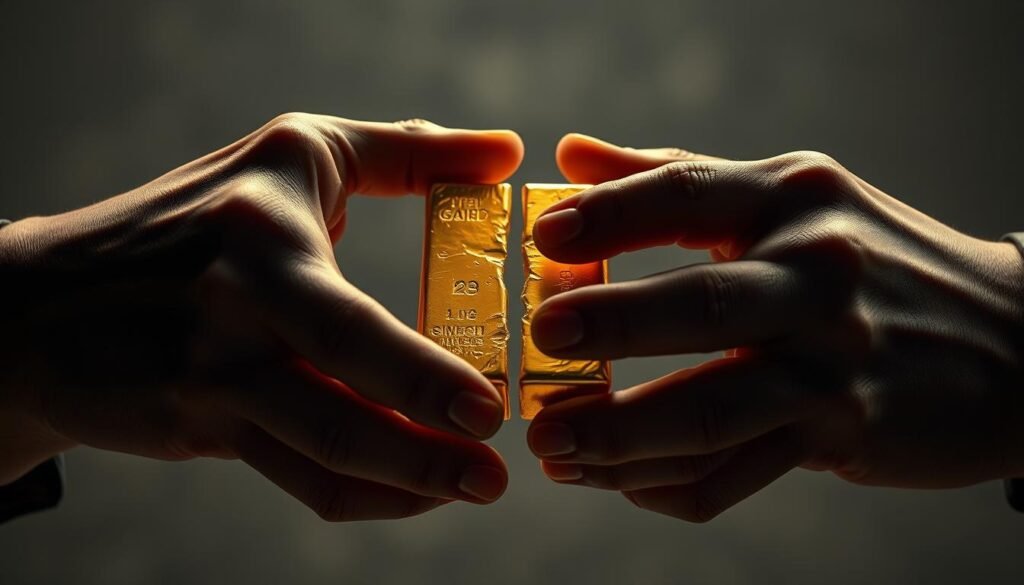
Why Gold Creates Special Division Problems
Gold poses unique challenges because of its tangible nature and the ability to be concealed or misrepresented. Unlike other assets, gold’s value can change and it can be hidden. This makes dividing it fairly hard.
- Physical gold, such as jewelry, coins, and bullion, can be easily concealed.
- The value of gold can fluctuate, making its valuation critical and sometimes contentious.
- Gold often holds sentimental value, complicating its division.
The Emotional and Financial Value Balance
It’s important to balance gold’s emotional and financial value. The financial side is key, but the emotional value of items like family heirlooms or wedding rings is also significant. You need to weigh both to divide fairly.
To find this balance, consider these steps:
- Identify and separate items of high emotional value.
- Appraise the financial value of gold items to ensure a fair division.
- Negotiate the division based on both emotional and financial values.
Understanding Different Types of Gold Assets
Gold assets come in many forms. Knowing these differences is crucial for a fair split in divorce cases. It’s important to understand how gold can be held to ensure it’s divided fairly.
Physical Gold: Jewelry, Coins, and Bullion
Physical gold includes things like jewelry, coins, and bullion. These items have both emotional and financial value. For example, family heirlooms or rare coins may hold sentimental value. On the other hand, bullion bars are mainly valued for their gold content.

Paper Gold: ETFs, Stocks, and Funds
Paper gold refers to investments backed by gold but don’t require physical ownership. Examples include gold ETFs, stocks in gold mining companies, and gold mutual funds. These investments are often more liquid than physical gold and may offer extra financial benefits.
Gold in Retirement Accounts
Gold can also be found in retirement accounts, like Gold IRAs or 401(k) plans with gold investments. These accounts have their own rules and tax implications that need to be considered during divorce.
Understanding the different types of gold assets helps you navigate the division process better. This way, all assets are accounted for and divided fairly.
Legal Classification of Gold in Marriage
Knowing how gold is classified in your marriage is key during divorce. Whether gold is seen as separate or marital property depends on several things. These include how it was bought and managed during your marriage.
Separate Property Gold
Gold you got before you married or as a gift or inheritance is usually separate property. But, if you mix it with marital assets, its status might change. For example, if you put inherited gold coins in a joint bank account, it could be seen as marital property.
| Characteristics | Separate Property Gold | Marital Property Gold |
|---|---|---|
| Acquisition Time | Before marriage or received as gift/inheritance | During the marriage |
| Management | Kept separate from marital assets | Commingled with marital assets |
| Examples | Inherited gold jewelry, pre-marital gold coins | Gold bought during marriage, joint gold investments |
Marital Property Gold
Gold bought during your marriage is usually seen as marital property. This includes gold investments, jewelry bought with shared money, and other gold assets acquired together. The main thing is that marital property gold was bought with marital funds or through joint efforts.
To keep your separate property gold safe, it’s important to keep it apart from your marital assets. Also, make sure to document its origin and value clearly.
How US Divorce Laws Affect Gold Division
The way gold is divided in a divorce depends a lot on your state’s laws. It’s key to understand these laws to handle the complex process of dividing assets.
Community Property States Approach
In community property states, assets are split equally between spouses. Gold bought during the marriage is seen as a marital asset and is divided equally. Community property states include Arizona, California, Idaho, Louisiana, Nevada, New Mexico, Texas, Washington, and Wisconsin. When dividing gold, it’s important to value it and make sure both get an equal share.
This equal split makes things simpler but might not always be fair. For example, gold inherited before marriage might not be divided.
Equitable Distribution States Approach
In equitable distribution states, assets are divided fairly, not just equally. The court looks at the marriage’s length, each spouse’s income, and their contributions to the assets. Gold bought during the marriage may be divided based on these factors.
Here, the court has more freedom to adjust the gold division based on each case’s unique details. For instance, if one spouse has more money, the court might give more gold to the other to balance things out.
Valuation Methods for Gold Assets
Valuing gold assets needs careful thought and skill. When dividing assets in a divorce, knowing the value of your gold is key.
Professional Appraisal Processes
To get a precise value, hire a gold asset appraiser. They’ll check the gold’s purity, weight, and market price. Choose appraisers with certifications from trusted groups for a trustworthy evaluation.
- Look for certifications like GIA or ISA
- Make sure they have gold asset experience
- Ask for a detailed report of their valuation process
Market Timing Considerations
Gold’s value can change due to market shifts. Timing is crucial for gold valuation. Keep an eye on current prices and trends to find the best time to value your gold.
- Stay updated on gold market trends
- Know what affects gold prices
- Seek advice from financial experts if needed
Documentation Requirements
Good documentation is vital for a smooth valuation. Keep all your gold asset records in order, including receipts and certificates.
- Store your documents safely
- Make sure all documents are current and correct
- Have digital copies for extra security
By following these steps and considering professional appraisals, market timing, and proper documentation, you can ensure a fair and accurate valuation of your gold assets during divorce proceedings.
Gold Jewelry Division Strategies
When dividing gold jewelry in a divorce, it’s important to separate family heirlooms, investment pieces, and personal items. Each category has its own considerations. You’ll need to weigh their emotional and financial value.
Handling Family Heirlooms
Family heirlooms hold deep emotional value. When dividing them, think about their history and the feelings they evoke. You might want to create a shared list of these items and their importance. This can help in your discussions.
Investment vs. Personal Pieces
It’s key to tell apart investment pieces and personal jewelry. Investment items, like gold coins, should be appraised accurately. Personal jewelry, though, may hold more sentimental value. Getting an appraisal for valuable items can ensure a fair split.
Creative Division Solutions
For a fair split, think about creative solutions. You could trade other marital assets for gold jewelry or share ownership of special pieces. You might also auction off some items and split the money. These ideas can lead to a solution both sides can agree on.
Understanding the different types of gold jewelry and using creative solutions can make dividing it easier and fairer.
Dividing Gold Bullion and Rare Coins
Dividing gold bullion and rare coins in a divorce is tricky. They are physical items with collector value. You must think about their monetary worth and any sentimental or historical value they hold.
Physical Division Challenges
Dividing physical gold assets is hard because they are tangible. You might decide to sell them and split the money. Or, you could give them to one person and adjust other assets.
- Consider the difficulty of dividing physical assets without losing value.
- Think about the logistics of storing and securing these assets.
- Evaluate the potential for one party to buy out the other’s share.
Liquidation Approaches
Selling gold bullion and rare coins is a way to divide them. This means selling them and splitting the money. Knowing the market and selling costs is important.
Key considerations include:
- Market demand and the current price of gold.
- Fees associated with selling rare coins or bullion.
- The potential for getting a better price through a specialized dealer.
Collector Value Considerations
Rare coins often have more value to collectors than their melt value. Getting a professional appraisal is crucial. This can greatly affect how they are divided.
Remember to:
- Get a professional appraisal to understand the collector value.
- Consider the rarity and condition of the coins.
- Factor in any historical or sentimental value.
Gold Investment Accounts in Divorce
Going through a divorce means you need to know how to split gold investment accounts. These assets come with their own set of challenges and opportunities.
Gold investment accounts, like Gold IRAs, are often part of divorce settlements. It’s key to grasp the rules for these accounts to divide them fairly.
Gold IRAs and Qualified Plans
Gold IRAs and other qualified plans hold gold or gold-related investments. They have specific rules for when you can take money out.
- Learn about your Gold IRA or qualified plan’s terms.
- Find out the current value of your gold investments.
- Think about the tax effects of splitting these assets.
Using QDROs for Gold-Based Retirement Assets
A Qualified Domestic Relations Order (QDRO) is a court order for retirement account splits. It tells the plan administrator to give a part of the account to an alternate payee, often a former spouse.
- Check if a QDRO is needed for your gold-based retirement assets.
- Get help from a financial expert to make sure the QDRO is done right.
- Understand how the QDRO will impact your gold investment division.
By following these division tips and knowing about QDROs, you can divide your gold investment accounts fairly and equally.
Hidden Gold: Detection and Recovery Tactics
Hidden gold can greatly affect a divorce settlement. It’s important to know about the possibility of hidden gold during a divorce.
Common Concealment Methods
Spoiler may hide gold in many ways. They might use safe deposit boxes, hidden safes, or give it to trusted friends or family. They could also buy gold as coins or jewelry and keep it hidden.
| Concealment Method | Description |
|---|---|
| Safe Deposit Boxes | Gold stored in bank vaults under the spouse’s name or a third party. |
| Hidden Safes | Gold kept in hidden safes within the home. |
| Third-Party Holding | Gold given to friends or family for safekeeping. |
Working with Forensic Financial Experts
Forensic financial experts are key in finding hidden gold. They use financial analysis and tracing transactions to spot hidden assets. Working with these experts helps ensure gold is divided fairly.
Legal Remedies for Undisclosed Gold
If you think your spouse has hidden gold, there are legal steps you can take. You can ask the court to make them reveal their financial info. Or, you can ask for a forensic check of their financial records. The court might also punish the spouse for not revealing the gold.
Tax Implications of Gold Division
Dividing gold in a divorce is more than just splitting things up. It’s about understanding the tax side of things too. When you split gold, you’re not just deciding who gets what. You’re also dealing with a complex tax world that can really affect your money in the future.
Capital Gains Considerations
When you divide gold, it can lead to capital gains tax. For example, if you give gold to your spouse, the IRS might see it as taxable. A financial expert says, “The tax side of dividing gold can be big.” Knowing how capital gains tax works is key to avoiding big tax bills.
Tax-Efficient Transfer Strategies
To cut down on taxes, use smart transfer strategies. One good way is to use a Qualified Domestic Relations Order (QDRO) for retirement accounts with gold. This can help move assets without paying taxes right away, keeping more of your wealth for later.
IRS Reporting Requirements
It’s important to follow IRS rules when dividing gold. You might have to report gold transfers on your taxes. Not doing this could lead to fines. Make sure you know what forms and documents you need for gold division to stay out of trouble.
Knowing the tax side of gold division can help you make better choices in your divorce. This knowledge can protect your money and reduce taxes, helping you deal with divorce’s financial challenges.
Negotiation and Mediation for Gold Assets
Negotiation and mediation are great ways to split gold assets in a divorce. They let you and your spouse work together to find a fair solution. This can save time, money, and reduce stress.
Collaborative Approaches
Collaborative divorce uses experts like financial advisors and lawyers. They help you talk things through and find solutions. This way, you can divide gold assets like jewelry and coins fairly.
When Litigation Becomes Necessary
Not all cases can be solved through talking. If you can’t agree, a court might step in. Knowing what could happen in court helps you make better choices.
Working with Gold Experts During Your Divorce
Going through a divorce can be tough. Working with gold experts can help make sure you get a fair share of your gold. Divorce is complex, and dividing gold assets needs special knowledge.
Finding Qualified Appraisers
To get your gold valued right, you need a good appraiser. Look for someone with gold assets experience, like jewelry or coins. Check for ASA or CAPP certifications to know they’re trustworthy.
The Role of Financial Advisors
Financial advisors are key in managing your gold during and after divorce. They help with taxes, investments, and planning for the future. Choose an advisor with asset gold and divorce experience to fit your needs.
| Expert | Role in Divorce | Qualifications to Look For |
|---|---|---|
| Appraiser | Accurate valuation of gold assets | ASA, CAPP certifications |
| Financial Advisor | Management of gold assets, tax planning | Experience with asset gold and divorce cases |
Protecting Your Gold Before and During Divorce
Going through a divorce can be tough, and thinking about your gold is key. You need to plan how it will be split and keep it safe. Without a good plan, your gold could be in danger.
Prenuptial and Postnuptial Agreements
Prenuptial or postnuptial agreements can help with dividing gold in a divorce. They let you and your spouse decide how your gold will be split. It’s important to talk and agree on these terms with your spouse.
| Agreement Type | Purpose | Benefits |
|---|---|---|
| Prenuptial Agreement | Outlines asset division before marriage | Clarity on gold asset division |
| Postnuptial Agreement | Outlines asset division during marriage | Flexibility to adjust terms as needed |
Documentation and Inventory Best Practices
Keeping detailed records of your gold is crucial. This includes purchase records, appraisals, and more. Organized records make dividing your gold easier. Here are some tips:
- Keep receipts and certificates of authenticity
- Document the condition and description of each item
- Store your documents in a safe and accessible location
By following these steps, you can protect your gold and ensure it’s divided fairly during your divorce.
Post-Divorce Gold Investment Strategies
After your divorce, rebuilding your investment portfolio is key to financial stability. You might need to look at your gold investments again. Think about new ways to make your portfolio work better.
Rebuilding Your Portfolio
Rebuilding your gold investment portfolio after divorce requires careful thought. You should:
- Check how your gold is doing now.
- Think about spreading out your gold investments to reduce risk.
- Look into new gold investment choices, like gold ETFs or mining stocks.
By planning carefully, you can build a stronger financial base.
New Protection Mechanisms
Adding new protection steps can keep your gold safe. You might want to:
- Create a trust to guard your gold investments.
- Choose safe places to store your physical gold.
- Keep checking and updating your investment portfolio.
These steps can give you peace of mind and help you secure your financial future.
Real-World Gold Division Case Studies
Real-world examples show us how gold is divided in divorces. Looking at cases with high-net-worth individuals teaches us a lot. It helps us understand how to handle complex divisions.
High-Net-Worth Examples
In divorces with lots of wealth, dividing gold is tricky. Let’s say a couple has a big gold investment. The process might include:
- Valuing the gold at today’s prices
- Figuring out how much gold is shared property
- Deciding if to sell the gold or keep it
These choices need careful thought. They involve taxes, market changes, and future financial plans.
Lessons from Complex Divisions
Complex gold divisions teach us important lessons. For example, the value of:
- Accurate valuation: Making sure gold is valued right at division time.
- Tax planning: Thinking about taxes when dividing gold.
- Long-term planning: Seeing how gold division fits into future finances.
By studying these cases, we learn how to deal with gold division in divorce. This helps us secure a better financial future.
Conclusion: Securing Your Golden Future After Divorce
Divorce can be tough, but you can still secure your financial future. Managing your gold assets well is key to a stable financial life after divorce. Knowing how to handle the division process and protect your interests helps you feel confident.
As we’ve discussed, dividing gold assets involves many factors. These include legal classifications, how to value them, and tax issues. Using this knowledge, you can make smart choices about your gold during the divorce.
To protect your financial future, think about updating your investment plans. You might want to work with financial advisors to rebuild your portfolio. This ensures it fits your new financial goals after divorce. Taking these steps can turn divorce challenges into chances for growth and financial strength.
In the end, securing your financial future after divorce means making smart choices and taking charge of your money. With the right information and support, you can handle asset division well. This way, you come out stronger and more financially stable.