
Artificial intelligence (AI) is changing many industries, including finance. AI trading is changing how investors look at traditional assets like gold.
Imagine being able to look at huge amounts of market data at the same time. You could make smart choices based on patterns that are hard to see. This is now possible with algorithmic trading in the gold market.
As we dive into this exciting area, you’ll see how AI is making gold trading better and more based on data. We’re on the edge of a big change in how we invest. Knowing about these changes can help you make better choices.
Key Takeaways
- AI is changing traditional gold trading by making it more data-driven.
- Algorithmic trading allows for real-time analysis of vast market data.
- The integration of AI in gold trading is increasing efficiency.
- Understanding AI trading can empower investors to make informed decisions.
- The future of gold trading is likely to be heavily influenced by AI and machine learning.
The Evolution of Gold Trading in the Digital Age
The world of gold trading has changed a lot with digital tech. Now, you can trade gold from anywhere, anytime. This is thanks to online trading platforms.
From Physical Trading to Digital Platforms
Before, gold trading was done face-to-face. But now, digital platforms have made it easier and faster. Digital platforms let you trade gold online, cutting down on storage needs and speeding up deals.
Digital trading in gold has many perks. It offers:
- Real-time pricing and market data
- Easy access to global markets
- Reduced transaction costs
- Increased security through digital authentication

The Emergence of Algorithmic Trading in Precious Metals
Algorithmic trading, or automated trading, is big in gold now. It uses computer programs to make trades based on set rules. This way, traders can make quick, smart choices. Algorithmic trading helps them make the most of market changes.
| Feature | Traditional Trading | Algorithmic Trading |
|---|---|---|
| Execution Speed | Manual, slower | Automated, faster |
| Decision Making | Based on human judgment | Based on predefined algorithms |
| Market Reaction | Slower reaction to market changes | Faster reaction to market changes |
Digital tech and algorithmic trading have really changed gold trading. These changes have made it more open, efficient, and profitable.
Understanding the Gold Market Dynamics
Exploring gold trading means knowing the gold market’s dynamics. This market is complex, influenced by many factors. It’s key to understand these to make smart trading choices.
Key Factors Influencing Gold Prices
Several factors affect gold prices. Economic indicators are crucial. These include:
- Inflation rates
- Interest rates
- GDP growth
Geopolitical events also play a big role. Events like political instability and wars can make investors seek gold as a safe asset.
Economic Indicators and Gold Valuation
Economic indicators show an economy’s health, impacting gold prices. For example, high inflation can push gold prices up as investors protect their assets.
Geopolitical Events and Market Reactions
Geopolitical tensions can cause gold prices to swing. Investors often buy gold in uncertain times, increasing demand and prices.
Market Participants and Their Strategies
The gold market has many players. These include:
- Investors
- Traders
- Central banks
- Jewelry manufacturers
Each group has its own approach, from long-term investment to short-term trading. These strategies shape gold prices in different ways.
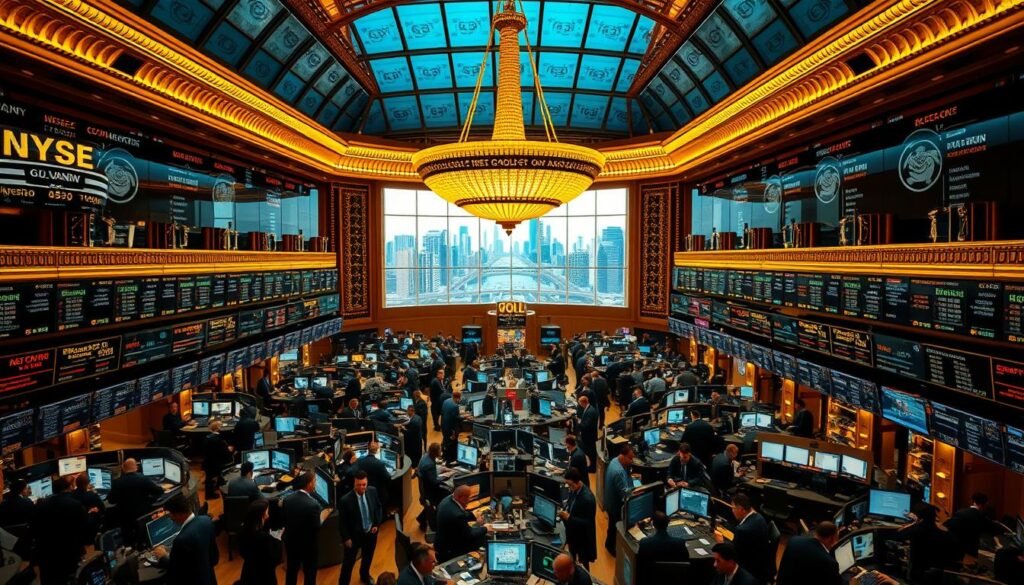
Knowing about these dynamics and the roles of market players can help you better understand the gold market.
The Fundamentals of Algorithmic Trading
As a trader, you might know about algorithmic trading. But let’s explore its basics. It uses computer programs to make trading decisions automatically. This makes trades faster and more precise.
How Algorithms Work in Financial Markets
Algorithms in finance look at lots of data, find patterns, and predict what will happen next. They follow rules based on technical indicators, statistical models, or machine learning. This automation lets algorithms respond quickly to market changes, giving traders an edge.
Types of Trading Algorithms
There are many trading algorithms, each with its own strategy. Let’s look at some common ones:
Trend-Following Algorithms
These algorithms track market trends. They use tools like moving averages and RSI to see the trend’s strength and direction.
Mean-Reversion Strategies
Mean-reversion algorithms believe that asset prices will return to their usual levels over time. They spot when prices are too high or too low and predict a change.
Arbitrage and Market-Making Algorithms
- Arbitrage algorithms find and use price differences in different markets or instruments.
- Market-making algorithms offer liquidity by setting both buy and sell prices. They make money from the difference between these prices.
Knowing about these algorithms can help you pick the best strategy for your trading goals and how much risk you’re willing to take.
Artificial Intelligence in Modern Gold Trading
AI plays a big role in modern gold trading. It uses machine learning and natural language processing. These tools help predict gold prices and understand market feelings.
Machine Learning Applications for Gold Price Prediction
Machine learning helps predict gold prices. It looks at lots of data, finds patterns, and makes predictions. This is faster and more accurate than humans.
Techniques like regression models, decision trees, and neural networks are used. Each has its own strengths for different trading strategies.
| Machine Learning Technique | Application in Gold Trading | Key Benefit |
|---|---|---|
| Regression Models | Predicting gold prices based on historical trends | High accuracy in trend analysis |
| Decision Trees | Identifying factors influencing gold prices | Easy to interpret and understand |
| Neural Networks | Complex pattern recognition in gold price data | Ability to learn from large datasets |
Natural Language Processing for Market Sentiment Analysis
Natural Language Processing (NLP) is changing gold trading. It looks at news and social media to see how people feel about gold. This helps predict gold prices.
News Analysis and Its Impact on Gold Prices
News analysis looks at articles to see their impact on gold. It helps traders make smart choices.
Social Media Sentiment Tracking
Social media tracking looks at posts to see what people think about gold. It gives clues about market changes.
Together, machine learning and NLP give traders a deep understanding of gold markets. This helps make better predictions and manage risks.
Key AI Technologies Transforming Gold Trading
The gold trading world is changing fast thanks to AI. As a trader, you know how important data is in making smart choices. AI brings advanced tools to spot complex patterns and guide your trading.
Deep Learning Models for Pattern Recognition
Deep learning models are changing how we see patterns in gold trading. These smart algorithms dig through lots of data to find patterns humans might miss. They help you understand market trends better and predict prices more accurately.
Deep learning in gold trading offers many benefits:
- It spots patterns better than humans
- It predicts price changes with high accuracy
- It can handle big data fast
| Feature | Traditional Analysis | Deep Learning Analysis |
|---|---|---|
| Pattern Recognition | Limited by human capacity | Advanced, complex pattern identification |
| Data Processing | Manual, time-consuming | Automated, rapid processing |
| Prediction Accuracy | Dependent on human expertise | Enhanced by machine learning capabilities |
Reinforcement Learning in Trading Strategy Development
Reinforcement learning is also changing gold trading. It trains algorithms to learn from rewards or penalties. This way, they find the best trading strategies through trial and error. It helps create trading systems that adapt quickly to market changes.
The main benefits of reinforcement learning in gold trading are:
- It adapts to market changes
- It develops top trading strategies
- It can lead to better trading results over time
By using these AI technologies, you can lead in the gold trading market. You’ll make smarter, data-driven choices.
Gold Trading Strategies Enhanced by AI Algorithms
AI is changing gold trading for the better. It makes strategies more effective and efficient. AI algorithms help traders understand market trends better, leading to smarter decisions.
Technical Analysis Approaches Enhanced by AI
AI boosts technical analysis in gold trading. AI algorithms can analyze huge amounts of data to spot trends humans might miss. This helps traders predict price changes more accurately.
For example, AI tools can quickly process big datasets. They give traders timely insights to guide their decisions.
Fundamental Analysis Using Machine Learning
Fundamental analysis looks at economic data to forecast gold prices. Machine learning, a part of AI, improves this process. It digs into complex data to find what affects gold prices.
This includes looking at global events, economic signs, and market mood. Machine learning helps traders understand these factors better.
Hybrid Models for Comprehensive Market Analysis
Hybrid models mix technical and fundamental analysis. They use AI and machine learning to analyze everything. This gives traders a full picture of the gold market.
By combining data from past prices to economic indicators, hybrid models predict gold prices more accurately. This helps traders create better strategies.
Implementing Algorithmic Gold Trading Systems
To start algorithmic gold trading, you must know the basics. It’s key to understand the tech that makes these systems work.
Required Infrastructure and Technologies
Algorithmic gold trading systems need a lot of parts to work well. You have to think about a few main things:
Hardware Requirements
Good hardware is a must for algorithmic trading. You’ll need fast servers, reliable storage, and quick networks. Choose a strong server or cloud setup for high trading volumes.
Software and API Considerations
The software part is just as important. It includes trading algorithms, risk tools, and data connections. Look for software that fits your strategy and connects well with APIs. Python libraries and trading platforms with APIs are good options.
Data Feed Management
Having the right data is key for trading. You must manage your data feeds well. This means picking good data providers and using strong data systems.
Integration with Existing Trading Platforms
Connecting your system to trading platforms is crucial. Look for platforms with API or FIX support. This lets your algorithm send trades quickly and reliably.
Knowing the tech and integrating with platforms helps build a strong algorithmic gold trading system.
Risk Management in AI-Powered Gold Trading
Effective risk management is key to success in AI-powered gold trading. It’s important to use strong risk management techniques to keep your investments safe.
Volatility Assessment and Position Sizing
Understanding market volatility is crucial in AI-powered gold trading. You can use past data and AI to figure out how volatile the market is. Then, you can adjust how much you invest to reduce losses and increase gains.
- Analyze historical price movements to understand volatility patterns.
- Use machine learning models to predict future volatility.
- Adjust your position sizes based on the assessed volatility to manage risk.
This way, your trading strategy can handle market changes well.
Automated Risk Controls and Circuit Breakers
Automated risk controls and circuit breakers are vital for avoiding big losses in AI-powered gold trading. These systems stop trading when risks get too high, preventing big losses.
Circuit breakers are great in unstable markets. They pause trading to give you time to rethink your strategy.
- Implement stop-loss orders to limit potential losses.
- Use circuit breakers to temporarily halt trading during extreme volatility.
- Regularly review and adjust your risk controls to ensure they remain effective.
By using these risk management strategies, you can make your AI-powered gold trading more stable and effective.
Understanding theDetailedNote: In this section, we will explore the backtesting and optimization of gold trading algorithms, including historical data analysis methodologies. You will learn about performance metrics and evaluation criteria, such as the Sharpe ratio and drawdown analysis. We will provide insights into how to optimize your trading algorithms for better performance.
To improve your gold trading strategy, it’s key to grasp backtesting and optimization. Backtesting checks how a trading algorithm does with past data. Optimization tweaks the algorithm to make it better for the future.
Historical Data Analysis Methodologies are key for backtesting. You can use past data to see how your algorithm would have done in various market scenarios. This spotlights weaknesses and areas for betterment.
For performance metrics and evaluation criteria, several important indicators are used. The Sharpe ratio is a top metric that looks at risk-adjusted returns. It shows if returns come from smart choices or too much risk.
Drawdown analysis is also crucial. It shows the biggest drop in your algorithm’s value, giving insight into its risk level. By studying drawdowns, you can tweak your algorithm to cut down on losses.
To make your trading algorithms better, focus on a few key areas:
- Adjusting parameters to boost performance
- Adding risk management strategies
- Keeping an eye on and updating your algorithm
By taking these steps and using the right metrics, you can greatly improve your gold trading algorithm’s success and earnings.
Comparing Traditional vs. AI-Driven Gold Trading Approaches
When you dive into gold trading, you face a big choice. Do you stick with old methods or try AI-driven ones? Each has its good and bad sides. Knowing these differences helps you pick what fits your trading goals and how much risk you can take.
Performance Benchmarks and Success Rates
Looking at how well traditional and AI-driven gold trading do is important. Old methods depend on human insight and feelings, which can be hit-or-miss. But AI uses smart algorithms and learns from lots of data. This might make it better at predicting and performing consistently.
| Criteria | Traditional Trading | AI-Driven Trading |
|---|---|---|
| Analysis Method | Human analysis and judgment | Algorithmic and machine learning |
| Speed of Execution | Manual, potentially slower | Automated, rapid execution |
| Emotional Influence | High | Low |
Cost-Benefit Analysis for Different Trader Profiles
Doing a cost-benefit analysis is key when choosing between traditional and AI-driven gold trading. Beginners might find AI too expensive and complex, making old methods better. But, seasoned traders might see AI as a smart investment for its potential to earn more and reduce stress.
Key considerations include:
- Initial setup costs and ongoing fees
- The complexity of the trading system
- Potential returns on investment
- Risk management capabilities
By thinking about these points, you can choose wisely based on your trading style and financial aims.
Regulatory Considerations for Algorithmic Gold Trading
To succeed in algorithmic gold trading, you must know the rules. This field is governed by different laws in each place.
Compliance Requirements in the United States
In the U.S., several groups watch over algorithmic gold trading. The Commodity Futures Trading Commission (CFTC) and the Securities and Exchange Commission (SEC) are key. You must follow rules like the Dodd-Frank Act to keep markets fair and open.
Key compliance areas include:
- Registration requirements for trading firms and individuals
- Record-keeping and reporting obligations
- Risk management practices
Ethical Implications of Automated Trading Systems
Automated trading systems can cause problems. They might manipulate markets or make them too volatile. It’s important to think about how your actions affect others and to use algorithms that are fair.
Best practices include:
- Implementing robust risk controls
- Monitoring algorithm performance regularly
- Ensuring transparency in your trading operations
By following the rules and being ethical, you can create a good algorithmic gold trading plan.
Getting Started with AI Gold Trading: A Beginner’s Roadmap
Starting your AI gold trading journey might seem tough, but with the right help, you’ll make smart choices quickly. It’s key to know that starting with AI gold trading mixes learning and using the right tools.
Educational Resources and Learning Paths
To kick off, you need top-notch educational resources. Online courses and webinars are great for learning the basics of gold trading and AI algorithms. Also, check out trading communities and forums where pros share their tips and stories.
- Online courses on platforms like Coursera and Udemy
- Webinars hosted by financial institutions and trading platforms
- Trading forums and communities on platforms like Reddit and Discord
Starting with Simple Algorithms
When you’re ready to trade, start with simple algorithms. These might include basic moving average or momentum-based strategies. The goal is to start simple and grow to more complex systems.
Scaling Up: From Basic to Advanced Systems
As you get more confident, move to more advanced AI techniques. This could mean adding machine learning models or natural language processing to your trading. Remember, becoming good at AI gold trading takes time and continuous learning.
“The key to success in AI gold trading is not just about the technology; it’s about understanding the market and making informed decisions.”
Conclusion: Harnessing AI for Strategic Gold Trading
AI is changing the gold trading world. It helps you make better choices and improve your trading plans. AI uses machine learning and natural language processing to analyze markets and predict prices.
Think about how you can use these ideas in your gold trading. AI tools can help both new and experienced traders. Keeping up with AI and algorithmic trading news is key to doing well.
The future of gold trading is linked to AI’s growth. By using these technologies, you can succeed in this changing market. You can lead the way, making smart gold trading decisions with AI.