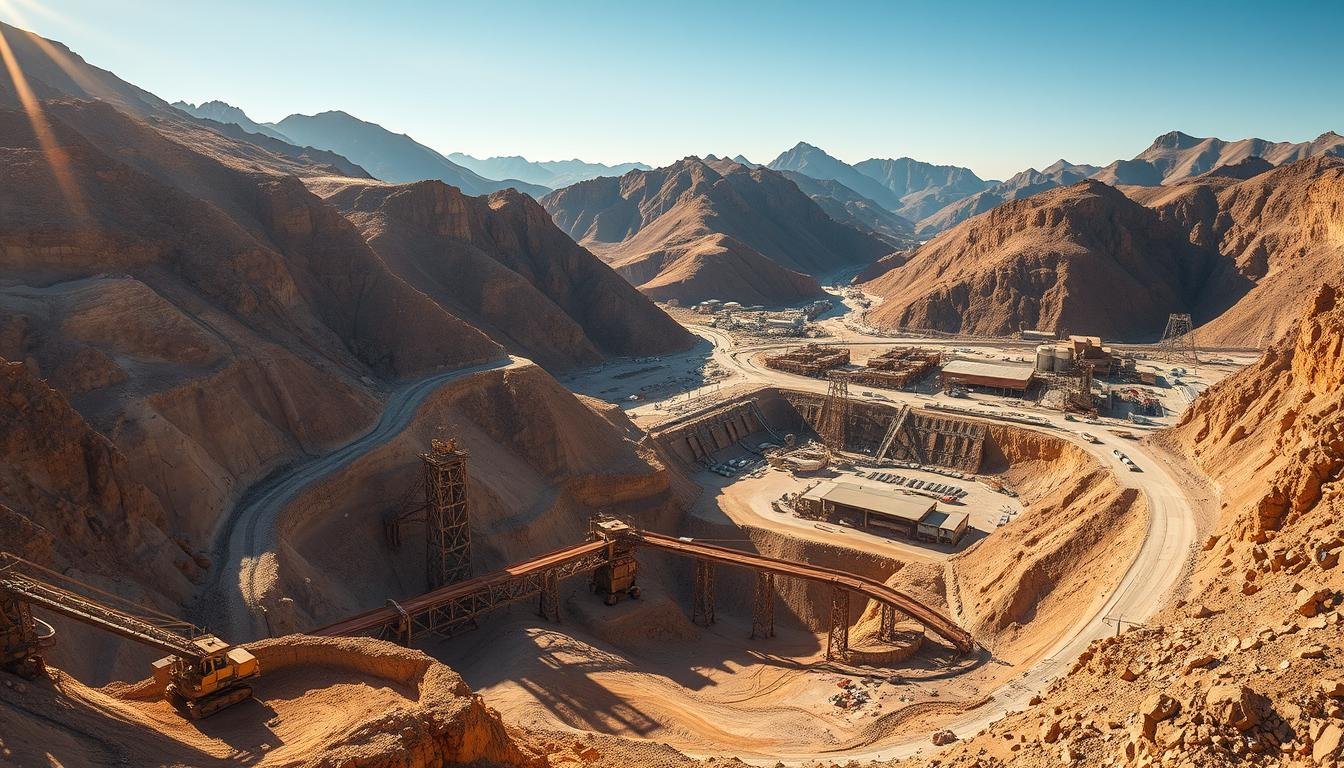
As record gold prices push the mining industry to new levels, it’s key for investors to know the basics of gold mining. The Fed’s rate cut and central banks’ buying have boosted the surge. Miners are set for big growth.
Boost your investment plan by learning the mining investment basics and the current market. The industry is thriving on high margins, better access to capital, and smart growth. Knowing this will help you seize this chance.
Key Takeaways
- Understand the impact of record gold prices on the mining industry.
- Learn how central banks’ buying and the Fed’s rate cut influence mining growth.
- Discover the importance of mining investment fundamentals.
- Gain insights into the current mining market overview.
- Elevate your investment strategy with informed decisions.
The Global Gold Mining Industry Overview
Exploring the gold mining world means understanding the global scene. This is key for smart investment choices. The industry is shaped by many things like economic trends, world events, and new tech.
Historical Context of Gold Mining
Gold mining has a long history, going back centuries. It has changed a lot, from ancient times to today. Events like gold rushes have played a big role in shaping it.
Current State of the Gold Mining Market
The gold mining market is seeing big changes. Central banks are buying gold like never before since 2022. This has pushed gold prices up and changed how mines work. The industry is now focusing on being more efficient and cost-effective.
Major Gold Producing Regions
Some countries are big players in gold mining. They have lots of gold and big mines. Knowing about these places and their economic and political situations is important for investors.
By understanding history, the current market, and where gold is mined, you can make better investment choices. This helps you navigate the gold mining world more easily.
Understanding the Gold Value Chain
Investors need to grasp the gold value chain to make the most of gold mining. It covers key steps from raw gold deposits to refined gold products.
Exploration and Discovery Process
The first step is exploration. Mining companies use different methods to find gold deposits. They do geological surveys, sampling, and drilling to check for gold.
Effective exploration is crucial for the mining process.
Mine Development and Construction
After finding gold, the next step is mine development. This includes getting permits, designing the mine, and building roads and facilities. Mine development is complex and expensive and needs careful planning.
Production, Processing, and Refining
The last stage is production. Gold ore is extracted and turned into gold bullion. This involves crushing, milling, and chemical processing to separate gold.
The gold is then refined to high purity levels. Monitoring production metrics like gold grades and costs is important for mining performance.
Types of Gold Mining Operations
The gold mining industry uses many methods to get gold. Each method has its own benefits and problems. Learning about these techniques can help you understand the industry better.
Open-Pit Mining Methods
Open-pit mining digs up soil and rock to find gold-bearing ore. It’s used when gold is near the surface. Open-pit mining is often cheaper and lets miners get more ore.
Underground Mining Techniques
Underground mining digs into the earth to find gold deep down. It’s more complex and expensive but needed for deep gold deposits.
Placer Mining Operations
Placer mining gets gold from river and beach deposits. It uses water to separate gold from soil. Placer mining is simpler and cheaper than other methods.
Heap Leaching and Other Processing Methods
Heap leaching crushes ore and piles it into heaps. A solution dissolves the gold, which is then collected. This method works well for large amounts of low-grade ore.
Knowing about these gold mining methods is key for investors and professionals. Each method has its own benefits and challenges. The choice depends on the gold deposit and environmental factors.
Key Gold Mining Economics
Gold mining economics is key for investors in the gold market. The success of gold mining depends on several factors. These include the costs to start, the ongoing expenses, and how much money is made, all affected by gold prices.
Capital Expenditure Requirements
Starting a gold mine needs a lot of money upfront. Costs include buying land, equipment, and building infrastructure. For example, starting a new mine can cost hundreds of millions of dollars. Managing this money well is essential for the mine’s success.
Operating Cost Structures
After a mine starts, managing costs is the main focus. Costs include labor, energy, and maintenance. These can change based on the mine’s location and how complex the ore is. Keeping costs low is crucial for making a profit. Costs are often measured by how much it costs to produce one ounce of gold.
Revenue Models and Gold Price Sensitivity
Gold mining companies make money by selling gold. The price of gold directly affects their revenue. When gold prices go up, so does the company’s earnings. Investors need to watch gold prices closely because they can change a company’s financial health. Important things to look at include:
- The average gold price the company gets
- How the company uses hedging strategies
- The company’s ability to stay profitable even when gold prices drop
Knowing these economic factors helps investors make smarter choices about gold mining investments.
Essential Gold Mining Metrics for Investors
Investors need to know the key metrics for gold mining to make smart choices. It’s important to understand how gold mining companies perform. This includes looking at production, costs, and how profitable they are.
Production Metrics: Ounces and Grades
Production metrics are key to judging a gold mining company’s success. The number of ounces produced and the ore’s grade are crucial. More ounces and better grades mean a company is likely to make more money. Look for companies that hit their targets and have high-quality resources.
Cost Metrics: AISC and Cash Costs
Cost metrics are also vital for gold mining investments. All-In Sustaining Costs (AISC) and cash costs are important. AISC covers all costs to keep a mine running, while cash costs are direct costs of gold production. Lower costs mean a company is more efficient and profitable. Companies with lower costs can handle price changes better.
Profitability Metrics: Margins and Returns
Profitability metrics show a company’s financial health. Look at profit margins and returns on investment. Higher margins and returns mean a better investment. Analyzing these with production and cost metrics gives a full picture of a company’s success.
By understanding these gold mining metrics, investors can make better choices. This can help increase their returns in the gold mining sector.
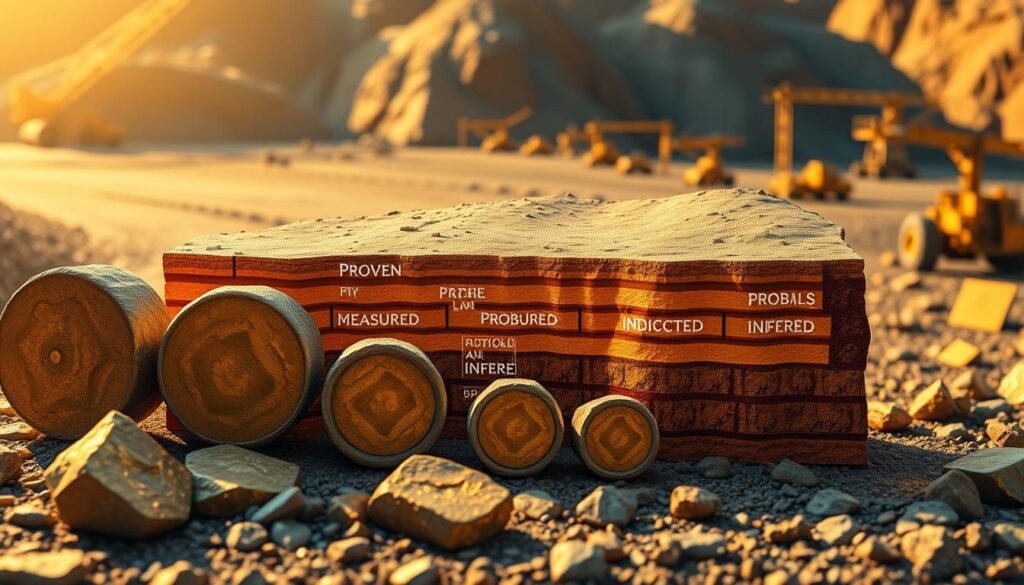
Gold Reserve and Resource Classification
Gold reserve and resource classification are key for investors to understand. They help assess the potential of gold mining operations. Knowing these classifications is vital for evaluating the viability and potential return on investment of gold mining projects.
Proven and Probable Reserves
Proven and probable reserves are important for investors to know. Proven reserves are known with a high degree of certainty. This is based on detailed exploration and feasibility studies. Probable reserves are less certain but still have a reasonable basis for their estimation.
Measured, Indicated, and Inferred Resources
Gold resources are categorized into measured, indicated, and inferred resources. Measured resources have a high level of confidence. Indicated resources are less certain but still have a reasonable basis. Inferred resources are the least certain, often requiring further exploration.
How to Interpret Reserve Statements
When interpreting reserve statements, investors should consider several factors. These include the classification categories, the methodology used for estimation, and any potential risks or uncertainties. A detailed table can help summarize the key information:
| Category | Description | Certainty Level |
|---|---|---|
| Proven Reserves | Known with high certainty | High |
| Probable Reserves | Less certain, reasonable basis | Moderate |
| Measured Resources | High confidence | High |
| Indicated Resources | Reasonable basis | Moderate |
| Inferred Resources | Least certain, requires further exploration | Low |
Evaluating Gold Mining Companies
When you look into gold mining companies, it’s important to analyze many key points. You need to understand what makes these companies strong and what might hold them back. This helps you make smart choices when investing.
Production Profiles and Growth Potential
Checking a company’s production is a must. Look at how much gold they mine, the quality of the ore, and if they can grow. Companies that mine a lot and plan to grow more are usually more appealing to investors.
Balance Sheet Analysis
Examining a company’s balance sheet is crucial. You should look at their debt, cash, and overall financial health. A company with a solid balance sheet can handle market ups and downs better and invest in new projects.
Management Team Assessment
The team running the company is very important. You should learn about the experience and skills of the top executives. A good team can make a big difference in a company’s success.
Jurisdiction and Political Risk
The place where a company mines can affect its risk level. You need to think about the political stability, laws, and possible risks like nationalization. Companies in safer places are often seen as better investments.
Here’s a comparison of key metrics for major gold mining companies:
| Company | Production (oz) | AISC ($/oz) | Growth Potential |
|---|---|---|---|
| Barrick Gold | 4.5 million | $900 | High |
| Newmont Goldcorp | 5.2 million | $950 | Medium |
| Agnico Eagle | 1.7 million | $850 | High |
“The quality of a company’s management team is often the most critical factor in determining its long-term success.”
Gold Mining Investment Vehicles
The gold mining sector offers many investment options. These options suit various risk levels and goals. You can invest in gold mining through different channels, each with its own benefits.
Major Gold Mining Companies
Major gold mining companies are big and well-known. They have a lot of production and operate in many places. Examples include Barrick Gold and Newmont Corporation. Investing in these companies can give you a stable way to invest in gold mining.
Mid-Tier and Junior Miners
Mid-tier and junior miners are smaller but might grow faster. They often focus on specific projects or areas. Mid-tier miners have some production, while junior miners are still exploring or developing. They offer a chance for higher returns with more risk.
Exploration Companies
Exploration companies look for new gold deposits. They are high-risk but could offer big rewards. Investing in these companies can give you a chance to be part of future gold discoveries.
Gold Mining ETFs and Funds
Gold mining ETFs and funds let you invest in many gold mining companies at once. They offer diversification and are easy to invest in. Examples include ETFs that follow gold mining indexes or funds that actively pick gold mining stocks.
Knowing about these investment options helps you decide how to include gold mining in your portfolio.
The Role of Gold in Investment Portfolios
Gold plays a key role in investment portfolios, offering stability and growth. It’s important to understand the benefits and how to invest in gold.
Gold has been a reliable asset for centuries. It remains important in today’s investment world. You can invest in gold in different ways, each with its own benefits.
Gold Mining Stocks vs. Physical Gold
You can invest in gold physically or through gold mining stocks. Physical gold acts as a direct hedge against inflation and market ups and downs. On the other hand, gold mining stocks can offer higher returns because they are tied to gold prices.
- Physical Gold: Offers a direct hedge against market downturns and inflation.
- Gold Mining Stocks: Provides potential for higher returns through operational leverage.
When choosing between physical gold and gold mining stocks, think about your investment goals and risk level. A good strategy might be to mix both physical gold and gold mining stocks.
Portfolio Diversification Benefits
Adding gold to your portfolio can make it more diversified, reducing risk. Gold’s performance isn’t tied to other assets like stocks or bonds. This makes it a great diversifier.
“Gold is often seen as a safe-haven asset, attracting investors during times of economic uncertainty.”
By adding gold, you can:
- Reduce portfolio volatility
- Enhance returns through diversification
- Protect against inflation and currency devaluation
As you plan your investment strategy, think about how gold can help achieve your financial goals.
Environmental, Social, and Governance (ESG) Factors in Gold Mining
When you think about investing in gold mining, it’s key to know about ESG factors. These factors are changing the gold mining world. They affect how companies operate and their future success.
Environmental Impact and Mitigation Strategies
Gold mining harms the environment, like forests, water, and homes of animals. To fix this, companies use sustainable mining practices. They do things like clean up after mining, manage water, and use less energy.
Some mines are turning to green technologies and renewable energy. This helps them reduce their carbon footprint. Good environmental care also helps them stay in good standing with the community.
Social License to Operate
The Social License to Operate means the community accepts a mining project. Gold mining companies need to work well with local people. They must listen to their needs, pay fairly, and help the community grow.
This builds trust and makes sure mining can continue for a long time. It’s all about being open and fair.
Governance and Transparency Issues
Governance and transparency are very important in gold mining. They help stop corruption and make sure rules are followed. Companies need strong leaders and clear reporting.
Investors should look for companies that are open and honest. They should report on their finances, how they care for the environment, and how they work with the community.
Gold Mining Risk Factors
Understanding the risks of gold mining is key to smart investing. Before you invest in gold mining, know the different risks that can affect your money.
Operational Risks
Gold mining faces risks like equipment failures, natural disasters, and labor disputes. These can cause big financial losses and lower mine productivity. For example, a mining consultancy found that equipment failure is a major risk.
- Equipment failure
- Natural disasters
- Labor disputes
Commodity Price Volatility
Gold price changes are a big risk. When gold prices go up, mines make money. But when prices fall, some mines can’t stay profitable.
Geopolitical and Regulatory Risks
Geopolitical and regulatory risks are also important. Changes in government rules or political issues can hurt mining. For instance, stricter mining laws can make mines less profitable.
Resource Depletion and Replacement Challenges
Depleting resources and finding new ones are big challenges. Mines need to find new resources as old ones run out. This is hard, mainly in areas where finding new gold is unlikely.
| Risk Factor | Description | Impact |
|---|---|---|
| Operational Risks | Equipment failures, natural disasters, labor disputes | Financial losses, productivity impact |
| Commodity Price Volatility | Fluctuations in gold prices | Profitability impact |
| Geopolitical and Regulatory Risks | Changes in government policies, regulations, political instability | Operational impact, profitability |
| Resource Depletion | Depletion of reserves, challenges in finding new resources | Production levels, sustainability |
Technological Innovations in Gold Mining
Gold mining is changing thanks to new technology. This makes mining more efficient, safer, and better for the environment. You’re seeing a big change in how gold is mined, processed, and sold.
Automation and Digitalization
Automation and digitalization lead this change. Mines are getting smarter, with systems that control drilling and hauling. This boosts productivity and safety by cutting down on human risk in dangerous areas.
With digital tools like data analytics and IoT, mines get real-time updates. This helps make better decisions faster.
Advanced Exploration Technologies
New tech is changing how we find gold. Remote sensing, geophysical surveys, and advanced drilling are making exploration better. These tools help find gold deposits more accurately and quickly.
This means less cost and risk in finding gold.
Processing Innovations
New ways to process gold are also important. Technologies like better leaching and new lixiviants are being developed. These improve gold extraction and lower environmental harm.
As gold mining grows, using new tech is crucial. Expect more in automation, exploration, and processing. This will shape gold mining’s future.
Gold Mining Industry Trends and Outlook
The gold mining future is shaped by several trends and outlook. Knowing these trends is key for smart investments in this sector.
Consolidation and M&A Activity
Consolidation and M&A are big in gold mining. Big companies want to grow their reserves and work better by buying others. This trend will keep going as companies aim to be stronger in the market.
Production Forecasts
Gold mining production forecasts show both challenges and chances. Some mines are ending, but new ones are starting. Technology helps keep production steady.
| Region | 2023 Production (Tonnes) | 2024 Forecast (Tonnes) |
|---|---|---|
| North America | 150 | 160 |
| South America | 120 | 125 |
| Africa | 180 | 185 |
Emerging Market Developments
New markets offer chances for gold mining companies. Countries with lots of gold are drawing investors. Rules and building better infrastructure affect where investors put their money.
Building a Gold Mining Investment Strategy
Starting a gold mining investment strategy means looking at your goals and how much risk you can take. This helps decide when to invest, how much to put in, and how to manage risks. It shapes your whole investment plan.
Timing Considerations and Market Cycles
Knowing the market cycles is key for smart gold mining investments. It’s important to know where the market is and how it might affect your money. Investing early in a bull market can be very profitable. Look at past trends and current signs to pick the best time to invest.
Portfolio Allocation Approaches
Finding the right mix of investments is crucial for balancing risk and reward. Spread your money across big gold mining companies, smaller ones, and explorers. A mix of investments can lower the risk of losing money. Decide how much of your money to put into gold mining based on how much risk you can handle and your financial goals.
Risk Management Techniques
Managing risk is key to keeping your investments safe. Use stop-loss orders, diversify, and check your investments often to adjust to market changes. Hedging can also help protect against losses. A good risk plan helps you deal with the ups and downs of gold mining.
| Risk Management Technique | Description | Benefit |
|---|---|---|
| Diversification | Spread investments across various assets | Reduces exposure to individual stock risk |
| Stop-Loss Orders | Automatically sell stocks when they fall below a certain price | Limits potential losses |
| Hedging | Invest in assets that offset potential losses | Protects against market volatility |
By thinking about timing, how to mix your investments, and managing risks, you can build a strong gold mining strategy. It should match your financial goals and how much risk you’re willing to take.
Conclusion: Mastering Gold Mining Investments
You now know a lot about the gold mining industry and how to invest in it. Learning about gold mining is key, and you’ve started by understanding the basics.
This knowledge helps you make better investment choices. Remember, getting better at investing is an ongoing journey. Keep up with new things in gold mining and improve your knowledge to succeed.
With what you’ve learned, you can handle gold mining investments with confidence. Whether you’re experienced or new, knowing about gold mining investments can help your portfolio grow.
Think about how you can use what you’ve learned to reach your financial goals. With the right knowledge and plan, you can make the most of gold mining investments and improve your portfolio.