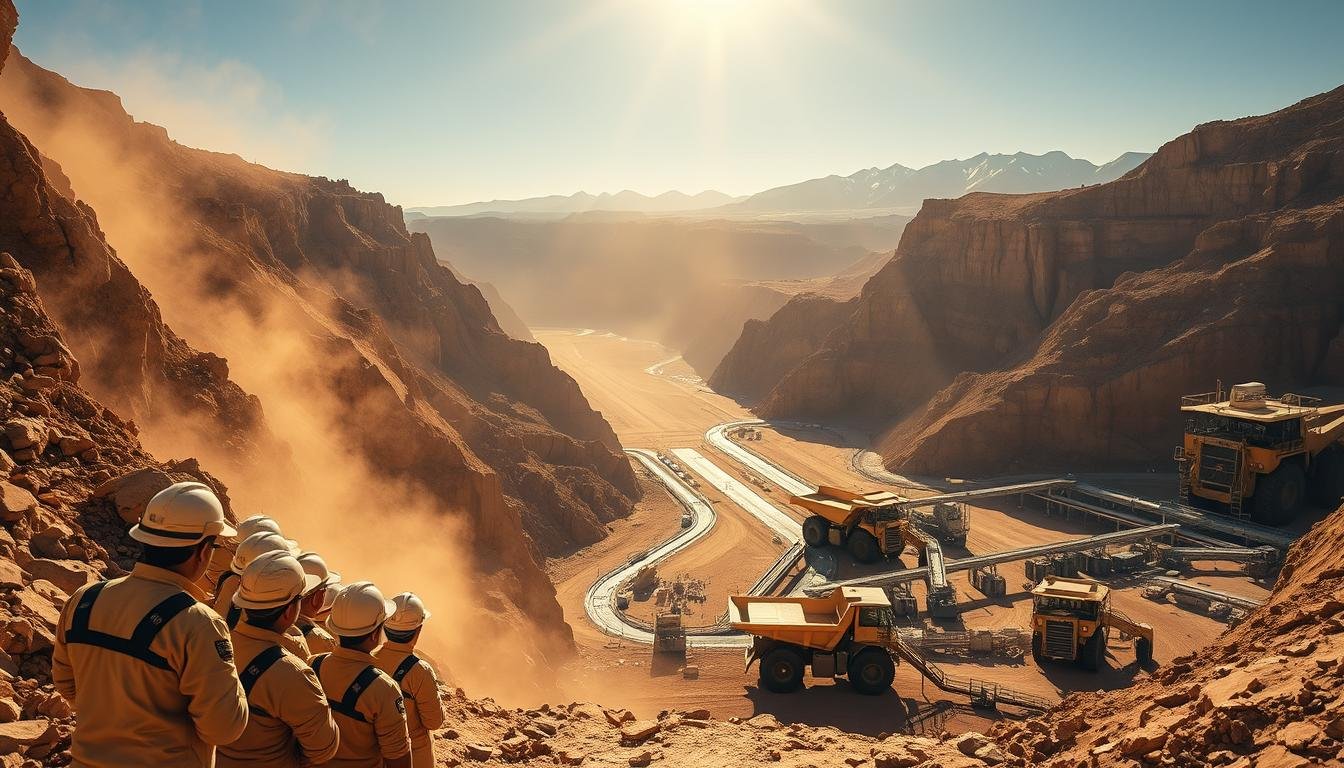
You’ve probably seen that gold prices have surged. This is due to economic uncertainty and hopes for a Federal Reserve rate cut. By September, gold had risen about 35% for the year. Spot gold was near $3,600 an ounce. This makes it a good time to think about investing in gold.
To make smart choices, you must know the basics of mining fundamentals. Gold mining includes exploration, extraction, and refining. It’s a complex process that needs a good understanding of the industry and how to evaluate companies.
Key Takeaways
- Understand the gold mining process from exploration to refining.
- Learn about the industry structure and key players.
- Discover key metrics for evaluating gold mining companies.
- Gain insights into the impact of economic factors on gold prices.
- Explore strategies for investing in gold mining.
The Enduring Value of Gold in Investment Portfolios
In times of financial trouble, gold is often seen as a safe choice. It’s a key part of diversifying your investments. This makes it a reliable addition to any portfolio.
Historical Performance as a Safe Haven Asset
Gold’s value goes up when the economy is shaky. This makes it a great choice for a diversified portfolio. Its history shows it performs well during tough times.
Gold During Economic Crises
Gold has always been a good choice during economic downturns. For example, in 2008, gold prices went up as people looked for safe investments. Gold has been a trusted way to protect against economic uncertainty for centuries.
Inflation Hedging Properties
Gold also helps protect against inflation. When inflation rises, the value of money can drop, but gold’s value goes up. Central banks are buying gold at record levels, which supports its value.

“Gold is a unique asset that provides a level of security and stability in times of economic uncertainty.”
This makes it a crucial part of a well-diversified investment portfolio.
Learning about the fundamentals of gold and its role in mining investing can guide your investment choices. Adding gold to your portfolio is a smart move. It helps reduce risk and could increase your returns.
Understanding the Gold Mining Industry Structure
Knowing the gold mining industry’s structure is key for smart investments. As an investor, it’s important to grasp how the industry is set up and the roles of different companies.
Major Players vs. Junior Miners
The gold mining world is mainly split between big players and junior miners. Big names like Newmont and Barrick Gold lead as top gold producers. They have the funds for big mining projects and are seen as safer bets.
Top Global Gold Producers
Top gold producers are big companies with lots of experience and resources. They control the market and can handle ups and downs well. They are known for:
- Large-scale operations
- Significant financial resources
- Established track records
Emerging Junior Mining Companies
Junior miners, on the other hand, focus on finding and developing new mines. They are usually smaller and riskier but have big growth potential. They are known for:
- Focus on exploration and development
- Smaller scale operations
- Higher risk, higher potential reward
When looking at mining operations, knowing the difference between big players and junior miners is crucial. Understanding their roles and characteristics helps you navigate the gold mining world better.
The Gold Mining Process Explained
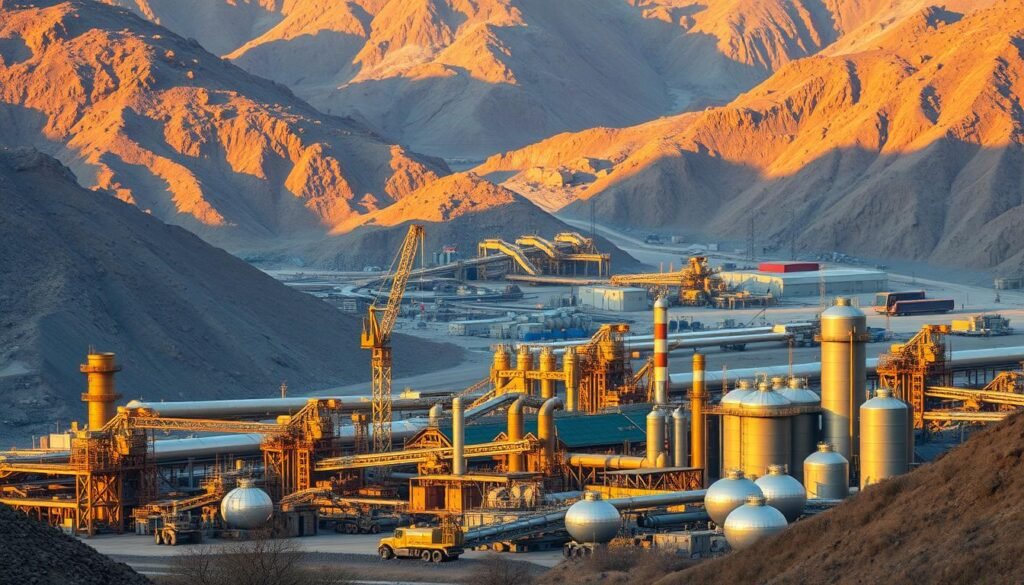
Understanding gold mining is key for investors. It involves stages from finding gold to extracting it. Knowing these steps helps you see how efficient and costly mining can be.
Exploration and Discovery
The first step is finding gold. This stage is crucial. It shows if a mining project can work.
Geological Survey Methods
Geological surveys find gold deposits. They use different methods, like:
- Geophysical surveys to find underground structures
- Geochemical sampling to check soil and rock
- Drilling to get core samples for analysis
Mining Methods and Extraction Techniques
After finding gold, the next step is to get the gold ore. The right mining method is used for this.
Open-Pit vs. Underground Mining
There are two main mining ways: open-pit and underground. Open-pit mining is for surface deposits. Underground mining is for deeper ones. Each has its own costs and environmental effects.
Knowing these steps is important for fundamentals analysis. It helps you make smart choices in gold mining investments. By understanding the details of gold mining, you can judge mining companies better.
Key Metrics for Evaluating Gold Mining Companies
To invest wisely in gold mining, you must look at key performance indicators. It’s important to understand a company’s efficiency, financial health, and growth potential. The mining industry is complex, and knowing the fundamentals basics is key to success.
Reserve and Resource Calculations
Reserve and resource calculations are crucial for evaluating gold mining companies. These numbers show how much gold a company has and how much it can produce in the future. Reserves are gold that can be mined profitably, while resources include both reserves and other deposits.
Production Costs: AISC vs. Cash Costs
Knowing production costs is essential for judging a gold mining company’s profit. Two important metrics are All-In Sustaining Costs (AISC) and cash costs. Cash costs cover direct gold production costs, while AISC includes additional expenses like capital and exploration.
Understanding All-In Sustaining Costs
AISC gives a full picture of a gold mine’s costs. It includes cash costs, capital, and other expenses. By comparing AISC, you can see how efficient and cost-effective different companies are.
| Metric | Description | Importance |
|---|---|---|
| Reserves | Gold that can be economically extracted | Indicates future production potential |
| Resources | Includes reserves and other gold deposits | Provides a broader view of a company’s gold holdings |
| Cash Costs | Direct costs of producing gold | Impacts short-term profitability |
| AISC | Total costs of maintaining and operating a mine | Reflects overall operational efficiency |
By examining these metrics, you can understand a gold mining company’s financial and operational health. This knowledge is vital for making smart investment choices in the gold mining sector.
Gold Reserves and Resources Classification
Knowing how gold reserves and resources are classified is key for gold mining investments. It helps you see the potential and risks of gold mining companies.
Proven vs. Probable Reserves
Gold reserves are split into proven and probable based on certainty and economic value. Proven reserves are very certain and profitable. Probable reserves are also profitable but less certain than proven.
This split is important for investors. It affects how much a gold mining company is worth.
Measured, Indicated, and Inferred Resources
Gold deposits are also grouped into measured, indicated, and inferred resources. Measured resources are well-studied and known. Indicated resources are estimated with some certainty. Inferred resources are less certain but still valuable.
| Category | Level of Certainty | Economic Viability |
|---|---|---|
| Proven Reserves | High | Economically Viable |
| Probable Reserves | Moderate | Economically Viable |
| Measured Resources | High | Potentially Economically Viable |
| Indicated Resources | Moderate | Potentially Economically Viable |
| Inferred Resources | Low | Potentially Economically Viable |
The Importance of Grade in Gold Deposits
The grade of gold deposits is crucial. It shows how much gold is in the ore. A higher grade means more gold per ton, making the deposit more valuable.
High-Grade vs. Low-Grade Operations
High-grade mines are more profitable because they have more gold per ton. Low-grade mines need to process more ore to get the same amount of gold. This can raise costs.
Understanding gold reserves and resources, and the role of grade, helps you make better investment choices in gold mining.
Economics of Gold Mining Operations
To make smart investment choices in gold mining, you need to understand the economics. Gold mining companies face big financial hurdles. These include the costs of starting up and running the operation.
Capital Expenditure Requirements
Gold mining needs a lot of money to start and keep going. Knowing these costs helps you see if a company is financially strong.
Mine Development Costs
Setting up a mine costs a lot. This includes building the mine, buying equipment, and setting up the needed infrastructure. These costs are big and often need a lot of money upfront.
| Cost Category | Description | Estimated Cost Range |
|---|---|---|
| Mine Construction | Building the mine infrastructure | $50M – $500M |
| Equipment Acquisition | Purchasing mining equipment | $20M – $200M |
| Infrastructure Development | Developing necessary infrastructure | $30M – $300M |
Operating Cost Structures
Gold mining has ongoing costs that affect profit. These include labor, energy, and equipment costs.
Labor, Energy, and Equipment Expenses
Labor costs are for the wages and benefits of the mining team. Energy costs are for powering the equipment and operations. Equipment costs cover maintenance and replacing mining machinery.
Understanding gold mining economics helps you see if a company is financially stable and profitable. This knowledge is key for making smart investment choices in gold mining.
Environmental, Social, and Governance (ESG) Factors in Gold Mining
Investing in gold mining means knowing about ESG factors. These factors can greatly impact a company’s success over time. You should understand how companies handle their environmental impact, community relations, and governance.
Environmental Impact and Mitigation Strategies
Gold mining companies must lessen their environmental impact. This is key to keep their social license to operate. They need to manage waste well, cut down on emissions, and fix mined land.
Water Management and Tailings Disposal
Gold mining needs to manage water and dispose of tailings properly. This is crucial for environmental care. Companies must make sure their operations don’t harm local water or ecosystems.
| Environmental Aspect | Mitigation Strategy | Benefit |
|---|---|---|
| Water Pollution | Tailings dams and water treatment | Protection of local water sources |
| Land Degradation | Rehabilitation and reforestation | Restoration of ecosystems |
| Air Emissions | Use of cleaner energy sources | Reduction in greenhouse gas emissions |
Community Relations and Social License to Operate
Good community relations are crucial for gold mining companies. They must engage with local communities, respect their rights, and help their economic growth.
Governance Best Practices in Mining Companies
Good governance is key for ethical and responsible gold mining. This means clear reporting, ethical practices, and a strong, independent board.
Understanding ESG factors helps you make better investment choices in gold mining.
Gold Price Dynamics and Market Influences
Knowing how gold prices move is key for smart investments in the gold mining world. It’s important to understand what affects gold prices to do well in this market.
Supply and Demand Fundamentals
Gold prices are mainly shaped by supply and demand. On the supply side, new discoveries, production levels, and central bank reserves matter a lot. On the demand side, jewelry needs, investment interest, and central bank buying are important.
For example, when central banks buy more gold, prices often go up because demand increases. But, if gold production rises and demand stays the same, prices might drop.
Macroeconomic Factors Affecting Gold Prices
Big economic factors also play a big role in gold prices. These include inflation, interest rates, and how currencies move.
Interest Rates and Currency Movements
Interest rates, like in the US, can change gold prices. If rates go up, the dollar gets stronger, making gold more expensive for foreign buyers and possibly lowering prices. But, if rates fall, the dollar weakens, making gold cheaper for foreign buyers and possibly raising prices.
Also, how the US dollar changes value affects gold prices. A weaker dollar makes gold cheaper for investors with other currencies, which can push prices up.
| Macroeconomic Factor | Impact on Gold Prices |
|---|---|
| Higher Interest Rates | Potentially Lower Gold Prices due to a stronger dollar |
| Lower Interest Rates | Potentially Higher Gold Prices due to a weaker dollar |
| Weaker US Dollar | Potentially Higher Gold Prices |
| Stronger US Dollar | Potentially Lower Gold Prices |
By getting these dynamics, you can better handle the gold market’s complexities. This helps you make smarter investment choices.
Risk Assessment in Gold Mining Investments
Investing in gold mining comes with risks. You’re not just looking at gold prices. You’re also considering the mining company’s skills and where they operate.
Operational Risks
Operational risks can hurt a mining company’s profits. These risks include technical problems and production stops.
Technical Challenges and Production Disruptions
Technical issues can come from hard-to-extract minerals, broken equipment, or poor planning. Production stops can cause extra costs and less output.
| Operational Risk | Potential Impact | Mitigation Strategies |
|---|---|---|
| Technical Challenges | Delays, increased costs | Regular equipment maintenance, advanced geological surveys |
| Production Disruptions | Loss of revenue, increased costs | Contingency planning, diversified production sites |
Political and Jurisdictional Risks
Political and jurisdictional risks are also key. Changes in mining laws, taxes, or rules can hurt profits.
Mining Codes and Taxation Changes
Government changes in mining laws or taxes can affect profits. Keeping up with political news in mining areas is vital.
Knowing these risks helps you make better investment choices. It’s about weighing the potential gains against the risks.
Investment Vehicles for Gold Mining Exposure
The gold mining industry offers many investment options. You can choose the one that fits your financial goals best. There are various ways to invest in gold mining, each with its own benefits.
Direct Stock Ownership
Investing directly in gold mining companies gives you control. It also offers the chance for big returns. But, you need to do your homework on the companies. Look at their financial health, management, and how they operate.
For more info on picking gold mining companies, check our services page.
ETFs and Mutual Funds
Investing in gold mining ETFs or mutual funds is a diversified option. These funds combine your money with others to invest in many gold mining stocks. This can spread out the risk and lessen the impact of one company’s performance.
Popular Gold Mining Funds Analysis
Some well-known gold mining ETFs and mutual funds track specific indices or focus on junior miners. When looking at these funds, consider:
- What stocks they hold and how diverse they are
- The fees and expenses of the fund
- The fund’s past performance and if it meets your goals
Knowing the different ways to invest in gold mining helps you make smart choices. These choices should match your investment strategy and how much risk you’re willing to take.
Technical Analysis of Gold Mining Stocks
Investors can learn a lot from gold mining stocks by using technical analysis. This method looks at past market data to guess future prices.
Key Chart Patterns for Mining Stocks
Chart patterns are key in technical analysis. They help spot trends and possible changes. Look out for head and shoulders, double tops, or wedges. These patterns guide your buy or sell decisions.
Some common chart patterns include:
- Trend lines show if prices are going up or down
- Reversal patterns signal a market direction change
- Continuation patterns suggest the trend will keep going
Volume Analysis and Momentum Indicators
Volume and momentum indicators are also important. Volume shows the strength of price moves. Momentum indicators like RSI and MACD track price changes’ speed.
Using RSI and MACD for Mining Stocks
The RSI checks recent price changes for overbought or oversold signs. The MACD shows how two moving averages relate, helping spot buy or sell signals.
| Indicator | Purpose | Signal |
|---|---|---|
| RSI | Measures price change magnitude | Overbought (>70) or Oversold ( |
| MACD | Shows relationship between moving averages | Buy when MACD crosses above signal line |
Fundamental Analysis of Gold Mining Companies
To really get what gold mining companies are worth, investors need to do a deep dive into their finances. They should look at the company’s financial reports, who’s running the show, the trends in the industry, and how they stack up against others.
Balance Sheet Evaluation
Looking at a company’s balance sheet is key. This document shows what the company owns, owes, and what it’s worth. When checking out gold mining companies, focus on:
- Asset valuation: Make sure the company’s gold and other assets are priced right.
- Debt levels: Too much debt can be risky, even more so in a shaky gold market.
Debt Levels and Liquidity Ratios
It’s important to know how much debt a company has and its liquidity. Too much debt can signal trouble. But, a company with plenty of cash is better at handling ups and downs. Look at the current and quick ratios to see if a company can pay its bills on time.
Cash Flow Analysis
Cash flow analysis is also crucial. It shows if a company can make money, invest in new projects, and give back to shareholders.
Free Cash Flow Generation
Free cash flow (FCF) is super important for gold mining companies. It’s the cash left over after spending on new projects. A positive FCF means a company can grow, pay dividends, or pay off debt. Look at the FCF’s value and trend to see if the company is financially healthy and running smoothly.
By diving into balance sheets and cash flow, you can really understand a gold mining company’s financial health and investment value. This detailed analysis is vital for smart choices in the gold mining world.
The Exploration-to-Production Timeline
Understanding the journey of gold mining companies from exploration to production is crucial for investors. It’s key to know the stages involved in making a gold deposit ready for production when investing in gold mining.
Early Stage Exploration Investments
Early-stage exploration is risky but can be rewarding. At this stage, companies aim to find new gold deposits. Investing in early-stage explorers can be highly speculative, but finding a deposit can lead to big returns.
Risk-Reward Profile of Explorer Stocks
Explorer stocks are known for their high-risk, high-reward profile. Investors need to be ready for the risk of losing money if a company doesn’t find a viable gold deposit.
Development Stage Considerations
After finding a deposit, companies enter the development stage. This involves financing, getting permits, and building the project. This stage is critical and needs a lot of money.
Production Stage Evaluation
At the production stage, companies focus on extracting gold efficiently and keeping costs low. Looking at a company’s production stage can show its operational and financial health.
| Stage | Key Activities | Investor Considerations |
|---|---|---|
| Exploration | Discovery, Drilling | High Risk, Potential High Reward |
| Development | Financing, Permitting, Construction | Capital Expenditure, Project Risks |
| Production | Extraction, Operations Management | Operational Efficiency, Financial Health |
Cyclicality in the Gold Mining Sector
Understanding the cyclical nature of gold mining is key for investors. The gold mining sector goes through cycles. These cycles are influenced by gold prices and investor mood.
Identifying Market Cycles
Knowing market cycles is vital for smart investing in gold mining. Cycles have ups and downs, driven by many factors.
Bull and Bear Market Characteristics
Bull markets in gold mining see rising prices and more investor confidence. Bear markets, on the other hand, see prices drop and less interest from investors.
- Bull Market: Rising gold prices, increased investment, higher production.
- Bear Market: Falling gold prices, decreased investment, lower production.
Strategic Timing for Mining Investments
Timing is everything for gold mining investments. Knowing the market cycle helps make better choices.
Counter-Cyclical Investment Approaches
Using a counter-cyclical strategy can help manage risk and boost returns. It means investing when prices are low and selling when they’re high.
| Investment Strategy | Market Cycle Stage | Investor Action |
|---|---|---|
| Counter-Cyclical | Bear Market | Invest |
| Counter-Cyclical | Bull Market | Divest/Reduce |
Building a Balanced Gold Mining Portfolio
Investing in gold mining requires a balanced portfolio for long-term success. You must consider various factors to diversify and protect your investments from market ups and downs.
Diversification Across Company Sizes
Diversifying by company size is key. Invest in both major players for stability and junior miners for growth. This balance helps manage risk and seize market opportunities.
Geographical Diversification
Spreading investments across different regions is vital. It reduces risks tied to specific countries or areas.
Balancing Stable and Emerging Jurisdictions
It’s important to mix investments in stable and emerging markets. Stable areas offer predictability, while emerging ones can provide higher returns due to growth.
| Jurisdiction | Stability | Growth Potential |
|---|---|---|
| Canada | High | Moderate |
| Australia | High | Moderate |
| Peru | Moderate | High |
Risk-Adjusted Portfolio Construction
Building a risk-adjusted portfolio means evaluating each investment’s risk. Then, balance them based on your risk tolerance.
Allocation Strategies for Different Investor Profiles
Investors have varying risk tolerances and goals. Tailor your allocation strategies to fit these needs. This ensures your portfolio supports your financial objectives.
Conclusion: Mastering Gold Mining Investments
You now know a lot about gold mining investments. This includes the basics, market trends, and how to invest. To get good at it, you need to understand the gold market well.
When looking at gold mining, think about important things like reserves, costs, and how companies treat the environment. Diversifying your investments can help you avoid big losses and find good opportunities.
To do well in gold mining, keep up with market trends. This way, you can change your investment plans as needed. With a good understanding of the gold market and smart investment strategies, you can reach your financial goals.