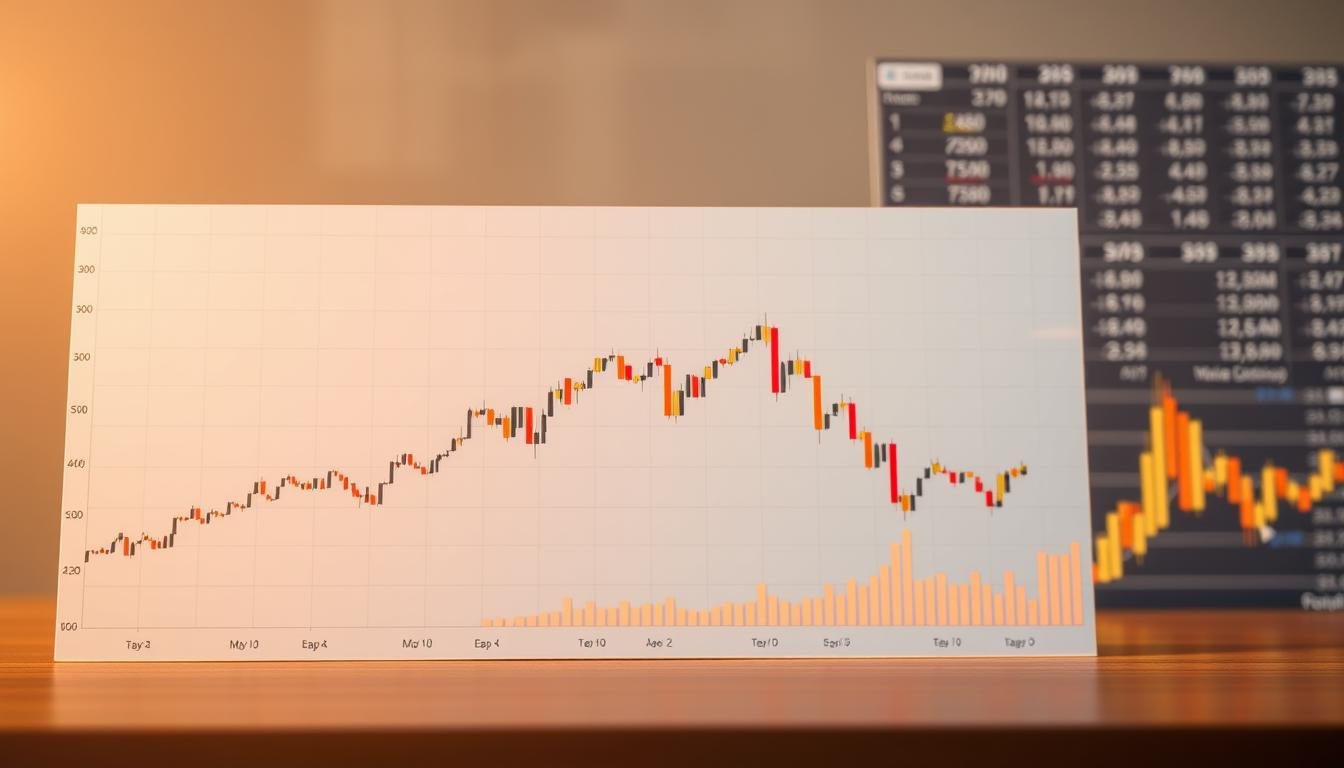
Understanding price charts is key for smart investment choices. Did you know many successful investors owe their success to knowing how to read chart basics well?
Starting out in investing can feel overwhelming. But learning to analyze price charts is a great first step. By learning the basics of chart education, you can better understand market trends. This helps you make choices that fit your financial goals.
It’s not just about numbers when you analyze price charts. It’s about understanding market behavior. With the right knowledge, you can use data to make smart moves. This sets you on the path to financial confidence.
Key Takeaways
- Understanding price charts is essential for informed investment decisions.
- Chart basics can significantly impact your investment success.
- Chart education empowers you to navigate market trends effectively.
- Analyzing price charts helps in making data-driven investment decisions.
- Gaining insights from price charts can lead to financial confidence.
The Fundamentals of Gold Market Behavior
The gold market is shaped by many factors. To trade well, you need to know how these factors work together. This knowledge helps you make smart choices about gold prices.
What Drives Gold Prices
Gold prices are influenced by several things. These include:
- Inflation rates and expectations
- Interest rates and monetary policy
- Geopolitical tensions and conflicts
- Central bank reserve management
- Investor demand for safe-haven assets
These elements can greatly change gold prices. It’s crucial to keep up with world economic news and events.
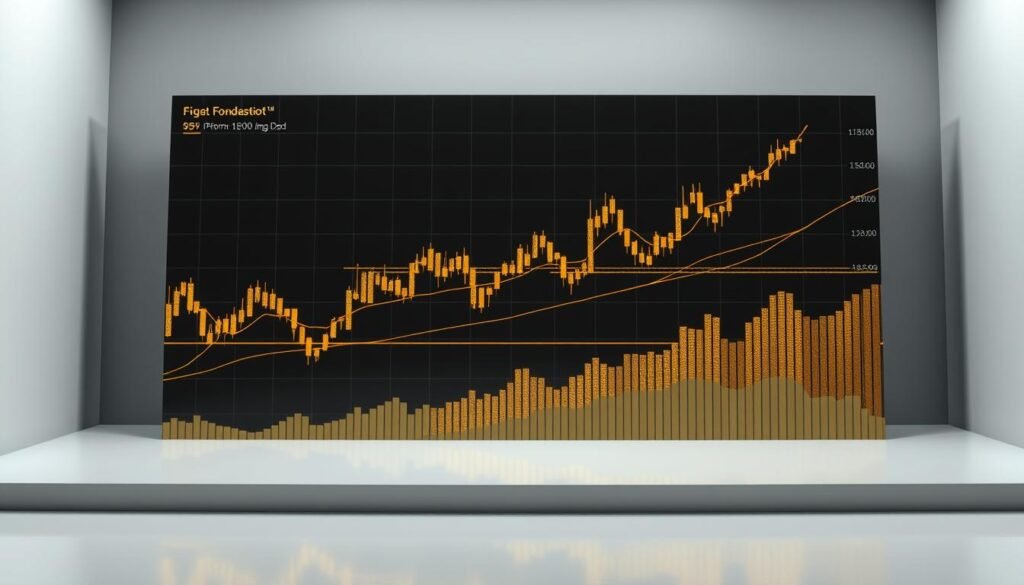
The Unique Properties of Gold as a Trading Asset
Gold is special for traders. It’s a safe-haven asset when the economy is shaky. Its value often goes up when the US dollar goes down. Gold is also a liquid market, making it easy to buy and sell.
Knowing what affects gold prices and its unique traits helps you trade better. This knowledge lets you confidently move through the gold market.
Essential Tools for Analyzing Gold Charts
Understanding the tools for gold chart analysis is key. As a gold trader, the right tools are vital for smart decisions.
Recommended Charting Platforms for Gold Traders
Many charting platforms are out there for gold traders. Each has its own features and benefits. Here are some popular ones:
- TradingView: It’s known for its easy-to-use interface and lots of technical indicators.
- MetaTrader: This platform offers advanced charting and automated trading.
- Thinkorswim: It has strong charting tools and lots of technical analysis features.
“The right charting platform can really improve your trading,” says a seasoned trader. “It’s important to try out different ones to find the best fit for you.”
Setting Up Your First Gold Price Chart
Choosing a charting platform is the first step. Then, setting up your first gold price chart is easy. Pick the gold instrument you want, like XAU/USD. Next, choose your chart type, like a candlestick chart. Adjust the timeframe to fit your analysis needs.
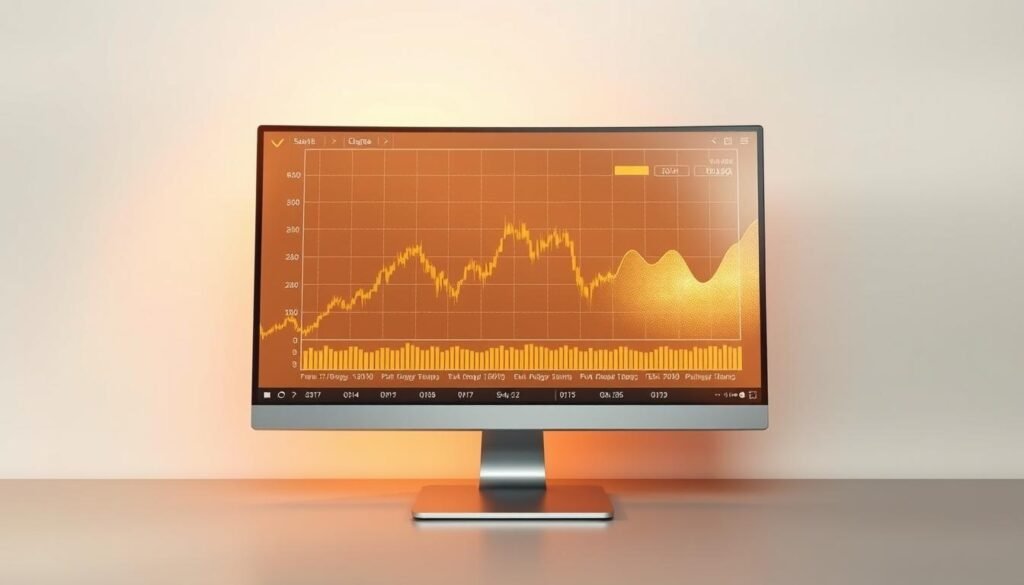
Must-Have Features in Your Charting Software
When picking charting software, look for these key features:
- Customizable indicators: The ability to add and adjust technical indicators to fit your analysis.
- Drawing tools: Tools for drawing trend lines, shapes, and other graphical elements.
- Multiple timeframes: The ability to view charts across different timeframes.
- Real-time data: Access to real-time price data for accurate analysis.
With the right tools and knowledge, you’ll be ready to analyze gold charts well. This will help you make smart trading decisions.
Different Types of Gold Price Charts Explained
Gold price charts come in various forms, each offering unique insights into market trends. Knowing these different types is key for effective price analysis and technical study. As you explore gold trading, you’ll find three main chart types: line charts, bar charts, and candlestick charts.
Line Charts: The Simplest Approach
Line charts are the simplest. They show a line connecting gold’s closing prices over time. This chart is great for a quick look at gold’s price trend.
Bar Charts: Adding More Price Information
Bar charts offer more detail than line charts. Each bar shows the opening, closing, high, and low prices for a time period. This helps traders see price swings better.
Candlestick Charts: The Gold Standard for Technical Analysis
Candlestick charts are the favorite among traders. They show a lot of information in a neat way. Each candlestick has the open, close, high, and low prices, with color showing if the price went up or down.
| Chart Type | Key Features | Usefulness for Traders |
|---|---|---|
| Line Chart | Simple line connecting closing prices | Overview of price movement |
| Bar Chart | Open, close, high, low prices for each period | Understanding price volatility |
| Candlestick Chart | Visual representation of open, close, high, low prices | Detailed analysis of price action and trends |
By learning and using these chart types, you can improve your chart understanding. This helps you make better choices in the gold market.
Selecting the Right Timeframes for Gold Analysis
Choosing the right timeframe is key when analyzing gold prices. The timeframe you pick can greatly affect your understanding of price movements. It also impacts how well your trading strategy works.
Short-term vs. Long-term Gold Price Analysis
Gold analysis can be done short-term or long-term. Short-term analysis looks at quick chart signals. It’s great for traders who want to make money fast.
Long-term analysis, on the other hand, gives a wider view of market trends. It helps investors make smart decisions about their gold investments.
Matching Timeframes to Your Investment Goals
Your investment goals should guide your choice of timeframe. Day traders often use 15-minute or hourly charts to catch fast price movements.
Long-term investors, though, might prefer daily, weekly, or monthly charts. These charts show long-term trends more clearly.
Multiple Timeframe Analysis Techniques
Using multiple timeframes can give you a deeper understanding of gold markets. This method involves looking at technical indicators across different timeframes. It helps confirm trends and spot trading chances.
By combining insights from various timeframes, you can craft a stronger trading plan. This plan considers both short-term changes and long-term trends.
Identifying Support and Resistance in Gold Markets
Understanding support and resistance levels is key to navigating the gold market. As you learn about chart learning, you’ll see these levels are vital for analyzing price trends and making smart trading choices.
Support and resistance levels are price points where the price often reverses or consolidates. Knowing these levels helps you grasp the market’s sentiment and chart fundamentals that shape gold prices.
How to Spot Key Price Levels in Gold Charts
To spot key price levels, look at historical price data on your gold chart. Find areas where the price has bounced back several times; these are support levels. On the other hand, where the price has struggled to rise are resistance levels. Recognizing these levels helps you understand price trends and predict future price movements.
Historical Support and Resistance Zones
Historical support and resistance zones are areas on your chart where big price movements have happened before. These zones are key to understanding how the market might react to current prices. By studying these zones, you can learn about the chart fundamentals that affect gold price movements.
Using These Levels for Entry and Exit Points
After finding support and resistance levels, you can use them to guide your trading. For example, you might buy gold near a support level or sell near a resistance level. This strategic trading, based on chart learning and price trends analysis, can lead to better trading outcomes.
By mastering support and resistance levels, you’ll be more skilled at navigating the gold market. This will improve your overall trading strategy.
Understanding Gold Price Trends and Momentum
When you start trading gold, knowing about price trends and momentum is key. These concepts are the foundation of a good trading plan. They help you spot chances and dangers in the gold market.
Identifying Uptrends, Downtrends, and Sideways Markets
To grasp gold price trends, you must know the three main types: uptrends, downtrends, and sideways markets. An uptrend shows a series of higher highs and lows, meaning gold is in demand. On the other hand, a downtrend has lower highs and lows, showing gold’s value is falling. A sideways market means prices stay in a tight range, showing a balance between buyers and sellers.
Drawing Effective Trend Lines on Gold Charts
Trend lines are essential in technical analysis. They help you see the direction and strength of gold prices. To draw a good trend line, find two key price points (highs or lows) and connect them. The more times a trend line is tested, the more solid it becomes. Trend lines can also show when a breakout or reversal might happen, helping you make better trading choices.
Recognizing Early Signs of Trend Reversals
Spotting early signs of trend reversals is crucial for adjusting your trading plan. Look for changes in momentum, like a slowdown in price movement or a shift in trading volume. Also, watch for chart patterns like head and shoulders or double tops, which can signal a change. By being alert and adjusting to these signs, you can safeguard your investments and find new opportunities.
Essential Chart Patterns for Gold Trading
To trade gold well, you must know key chart patterns. These patterns offer insights into price movements. They help you make smart choices. In gold trading, knowing these patterns can mean the difference between profit and loss.
Reversal Patterns in Gold Markets
Reversal patterns show a trend change. Spotting these patterns helps you prepare for market shifts.
Head and Shoulders Formations
The Head and Shoulders pattern is a top reversal sign. It has a peak (the head) and two smaller peaks (the shoulders). This pattern hints at a trend change.
Double Tops and Bottoms
Double Tops and Bottoms are reversal signs too. A Double Top happens when the price hits a high twice without breaking through. It signals a possible downtrend. On the other hand, a Double Bottom hints at an uptrend.
Continuation Patterns
Continuation patterns show the trend will keep going. These patterns are key for traders who want to follow the trend.
Flags and Pennants in Gold Charts
Flags and Pennants are short-term patterns. They appear after a big price move, showing a brief pause before the trend goes on.
Triangle Patterns and Their Significance
Triangle patterns are made by trend lines coming together. They can be symmetrical, ascending, or descending. Triangles show energy building up before a big move. They help traders guess the next big change.
| Pattern Type | Description | Indication |
|---|---|---|
| Head and Shoulders | Peak flanked by two smaller peaks | Reversal |
| Double Tops/Bottoms | Two consecutive highs/lows | Reversal |
| Flags and Pennants | Brief pause in trend | Continuation |
| Triangles | Converging trend lines | Breakout |
By knowing and spotting these chart patterns, you can improve your gold trading strategy. This makes your decisions based on technical analysis more informed.
Technical Indicators That Work Best for Gold Analysis
To trade gold well, knowing the best technical indicators is key. These tools help spot trends and find good times to buy or sell. Here, we’ll look at top indicators for gold analysis.
Moving Averages and Golden Crosses
Moving averages smooth out price data to show trends. The Simple Moving Average (SMA) and Exponential Moving Average (EMA) are favorites. A “Golden Cross” happens when a short-term MA goes above a long-term MA, hinting at a rise in gold prices.
Oscillators: RSI, Stochastic, and MACD
Oscillators spot when prices are too high or too low. The Relative Strength Index (RSI) looks at recent price changes. The Stochastic Oscillator compares closing prices to their range. The Moving Average Convergence Divergence (MACD) shows when trends might change or keep going.
Bollinger Bands for Volatility Assessment
Bollinger Bands show how volatile gold prices are. They include a moving average and two standard deviations above and below it. In gold trading, they help spot when prices might jump a lot.
Indicator Combinations Specific to Gold
Using one indicator alone is not enough. Mixing indicators gives a clearer view of the market. For gold, mixing moving averages with RSI or MACD improves trend spotting and accuracy. As one expert says,
“The key to successful trading is not to rely on a single indicator, but to combine multiple indicators to form a robust trading strategy.”
Learning and using these technical indicators can boost your gold trading. It helps make better choices.
Volume Analysis in Gold Trading
To trade gold wisely, you need to know about volume analysis. It shows the strength and lasting power of gold price changes. By looking at trading volume, you can see how much interest gold has at different prices. This helps you make better trading choices.
What Trading Volume Reveals About Gold Price Movements
Trading volume shows the market’s mood and the strength of gold price moves. High volume when prices go up means lots of buying. High volume when prices drop means lots of selling. Low volume during price changes might mean traders are unsure, which could lead to a change in trend.
For example, if gold prices go up with high volume, it’s a good sign. It means the trend is likely to keep going. But if prices go up with low volume, it might be a sign of a weakening trend.
Volume Indicators and Their Interpretation
There are several volume indicators to help you understand gold trading volume better. Some key ones are:
- On-Balance Volume (OBV): It compares the volume on up days to down days to show buying and selling pressure.
- Volume-Weighted Average Price (VWAP): It calculates the average gold price based on price and volume, giving a clearer market view.
- Chaikin Money Flow (CMF): It looks at price and volume to see if money is flowing into or out of gold.
| Indicator | Description | Interpretation |
|---|---|---|
| On-Balance Volume (OBV) | Compares volume on up and down days | Rising OBV indicates buying pressure |
| Volume-Weighted Average Price (VWAP) | Calculates average price based on price and volume | VWAP above current price indicates potential support |
| Chaikin Money Flow (CMF) | Assesses money flow into or out of gold | Positive CMF indicates accumulation |
Identifying Volume Divergences
Volume divergences happen when price and volume indicators don’t match. For example, if gold prices hit new highs but the OBV doesn’t, it might signal a change. Spotting these divergences helps you predict trend shifts and adjust your strategy.
As John Murphy, a technical analysis expert, said, “Volume is the steam that makes the locomotive of price movement go.” This shows how vital volume is in your analysis.
“Volume is the steam that makes the locomotive of price movement go.” – John Murphy
By using volume analysis in your gold trading strategy, you can better understand market dynamics. This helps you make more informed trading decisions.
Applying Fibonacci Retracement to Gold Charts
To improve your gold trading strategy, think about using Fibonacci retracement levels. These levels show important support and resistance areas. Fibonacci retracement is a common tool in technical analysis. It predicts price movements by finding levels in the Fibonacci sequence.
Understanding Fibonacci Levels in Gold Markets
Fibonacci levels come from the Fibonacci sequence, a series of numbers. Each number is the sum of the two before it, starting with 0 and 1. In gold markets, these levels mark potential reversal points. The key levels are 23.6%, 38.2%, 50%, 61.8%, and 76.4%.
These levels are where the price might change direction or pause.
Drawing and Using Fibonacci Retracements
To use Fibonacci retracement on gold charts, find a big high and low in a trend. Most platforms let you draw these levels automatically between these points. For example, in an uptrend, draw from the low to the high.
Combining Fibonacci with Other Technical Tools
Fibonacci retracement is strong on its own but even better with other tools. You can use moving averages to see the trend’s direction. Or, use oscillators like the RSI to spot overbought or oversold conditions at Fibonacci levels.
By mixing Fibonacci with other tools, you get a stronger trading strategy. This strategy gives clearer signals and better timing for your trades.
Understanding and using Fibonacci retracement levels can help you see potential price changes. This knowledge helps you make smarter trading choices.
Creating Your First Gold Trading Strategy Using Charts
Creating your first gold trading strategy means learning about chart basics. You’ll need a clear plan with rules for when to buy or sell. This plan should also include profit goals and how to manage risks.
Developing Entry and Exit Rules
Your entry rules decide when to buy or sell gold. For example, you might buy when the price goes above a certain level. Exit rules tell you when to close a trade, to make a profit or avoid a loss. Technical indicators like moving averages or RSI can help make these rules better.
Setting Realistic Profit Targets and Stop Losses
Setting profit targets means knowing gold’s price history. Use past data to guess price swings and set targets. Stop losses protect your money from big losses. A good stop loss can save you from big losses.
Backtesting Your Gold Chart Strategy
Backtesting is key before trading live. It means testing your strategy on past data. Backtesting lets you improve your strategy, find mistakes, and feel more confident in your trades. By looking at the results, you can tweak your strategy to make it better.
By following these steps and keeping your strategy sharp, you’re on the path to a successful gold trading strategy.
Common Mistakes Beginners Make When Reading Gold Charts
Starting your journey in gold chart analysis? It’s key to know the common pitfalls. Beginners often find it hard to analyze gold charts because they don’t understand key concepts. Knowing these mistakes can help you avoid them and get better at trading.
Overcomplicating Your Analysis
One big mistake is using too many indicators or complex strategies. This can confuse you and lead to bad trading choices. Keep your analysis simple and clear to avoid this.
Ignoring Risk Management Principles
Another mistake is not using risk management, like setting stop-loss orders. These are crucial for protecting your money and reducing losses. By using risk management, you can trade with more confidence.
Emotional Decision Making in Gold Trading
Emotional decisions are a big problem for many traders. They make choices based on fear or greed, not facts. Having a trading plan and sticking to it can help you avoid emotional decisions and stay focused on your goals.
Failing to Adapt to Changing Market Conditions
Lastly, not adapting to market changes can lead to missed chances or big losses. Keeping up with market news and adjusting your strategy as needed is important. This helps you navigate the changing gold market.
By knowing these common mistakes and avoiding them, you can get better at chart analysis. Remember, successful gold trading takes patience, discipline, and continuous learning.
Conclusion: Mastering Gold Chart Analysis Takes Practice
You now have a solid foundation in analyzing gold price charts. This skill is key for making smart investment choices. By learning about gold market behavior, using important tools, and applying different chart analysis techniques, you’re getting better at gold trading.
Keep practicing and improving your skills. Chart analysis isn’t the same for everyone. You’ll need to change your strategies as the market changes. Keeping up with new information will help you stay on top in gold trading.
To get even better, try using more advanced techniques. This could mean combining different indicators or adding external market data to your analysis. With regular practice and a desire to learn, you’ll grow more confident in your ability to read price charts and make smart trading choices.