Diversifying your investment portfolio is key for long-term financial health. One smart way to do this is by using precious metals for international diversification. With economic uncertainty on the rise, investors are looking at metals like silver, platinum, and palladium. These metals help protect against inflation and market ups and downs.
Investing in precious metals is a great way to diversify globally. It lets you access the stability of certain assets. This can potentially lead to long-term value gains.
Key Takeaways
- Diversifying your portfolio internationally can help mitigate financial risks.
- Precious metals like silver, platinum, and palladium offer a hedge against inflation.
- Global diversification can provide access to stable assets and long-term value.
- Investing in precious metals can be a strategic move for long-term financial stability.
- You can achieve a more balanced portfolio by incorporating international diversification.
The Global Economic Landscape and Portfolio Protection
Understanding the global economy is key to protecting your investments. The world’s economies are linked, making them prone to risks. This is why it’s important to know how to protect your portfolio.
Current Market Volatility and Systemic Risks
Market ups and downs are a big worry. Things like political tensions, trade issues, and policy changes add to the uncertainty. It’s vital to know these risks to keep your investments safe.
The market today faces:
- Fluctuations in global currency markets
- Shifts in commodity prices
- Changes in global trade policies
The Need for Alternative Asset Classes
Precious metals diversification is a smart move in uncertain times. Adding gold, silver, and platinum to your portfolio can help shield you from market swings.
These metals act as a safety net against big risks and downturns. They’re a must-have for a well-rounded global diversification plan.
Understanding Precious Metals as an Asset Class
Wondering how precious metals can boost your global investment strategy? Let’s explore. Gold, silver, platinum, and palladium have been key in investment portfolios for ages. They offer both stability and growth potential.
Historical Performance During Economic Crises
Precious metals shine during economic downturns, serving as a safe haven. For example, gold prices soared in 2008 as investors fled shaky stock markets. This shows why adding precious metals to your portfolio can help manage risk.
Correlation with Traditional Financial Assets
Investing in precious metals is great because they don’t closely follow stocks and bonds. Their value often changes on its own, helping protect against market ups and downs.
Precious Metals vs. Stocks and Bonds
Unlike stocks and bonds, precious metals keep their value better over time. This makes them a solid choice for diversifying your portfolio and lowering risk.
Performance During Inflation and Deflation
Precious metals do well when prices rise, as their value goes up too. But during deflation, they still hold their value, even if not as strongly.
Understanding precious metals’ role in your portfolio helps you make better investment choices. It allows you to use their unique benefits to improve your returns and reduce risk.
Why Gold Remains the Premier Precious Metal for International Diversification
Gold is a key part of international diversification, known for its value and stability. It’s important to understand gold’s role in global investing.
Gold’s Unique Properties as a Global Store of Value
Gold is unmatched as a global store of value. It’s universally accepted and keeps its value over time. Unlike currencies, gold isn’t affected by inflation or government changes, making it safe during economic ups and downs.
“Gold is the perfect substitute for cash when the market is in chaos,” notes a leading financial expert. Many investors choose gold during market volatility.
Central Bank Gold Reserves and International Demand
Central banks worldwide hold large gold reserves, showing gold’s key role in finance. These reserves are a strategic asset for settling international deals and providing liquidity when needed.
Strategic National Holdings
Countries like the United States, Germany, and Italy hold significant gold reserves. These reserves are crucial for national financial planning. They act as a safe haven and help diversify national wealth.
Cross-Border Gold Flows
The global gold market is connected, with gold moving across borders to meet demand. This ensures investors can easily buy or sell gold on international markets.
Gold is essential for international diversification. Its unique qualities and role in central bank reserves make it vital for investors in global markets.
Silver, Platinum, and Palladium: Complementary Precious Metals for Global Allocation
When you spread your investments around the world, think about more than just gold. Silver, platinum, and palladium bring their own special benefits. They can add value to your collection of precious metals.
Industrial Applications and Investment Potential
Silver is great for electronics and solar panels because it conducts electricity well. It’s also used in medicine. This makes it a solid choice for investors. You can buy silver in many ways, like bullion, ETFs, or stocks in mining companies.
Platinum and palladium are key in car exhaust systems. Their prices change with car sales and rules on pollution. This makes them interesting for investors who watch the car market.
International Price Drivers and Market Dynamics
The prices of silver, platinum, and palladium are shaped by many things. Investment interest, industrial use, and world events all play a part. For example, silver’s price can go up when people want a safe investment, like gold.
Platinum and palladium prices are more tied to car sales and pollution rules. Knowing these factors helps you make smart choices. Adding these metals to your portfolio can help you earn more and take on less risk.
It’s important to think about where these metals are used around the world. Their prices can be affected by things like currency changes, trade rules, and local demand.
Geographic Diversification in Precious Metals Markets
Exploring international diversification in precious metals markets can be beneficial. Investing in precious metals from various countries helps reduce exposure to regional economic ups and downs. It also allows you to take advantage of different market trends.
Major Gold-Producing Countries and Their Economic Profiles
Major gold-producing countries are key players in the global market. Countries like Australia, South Africa, and Russia lead in gold production. Each has its own economic profile that affects their production costs and capacities.
- Australia: Known for its significant gold reserves and advanced mining technology.
- South Africa: Historically a major gold producer, with deep-level mining operations.
- Russia: Increasing its gold production with a focus on Eastern Siberian deposits.
Knowing these countries’ economic profiles helps you make better choices for your global metals investments.
Regional Price Variations and International Arbitrage Opportunities
Regional price variations in precious metals offer chances for international arbitrage. These differences come from supply and demand, local economic conditions, and transaction costs. They lead to price gaps across regions.
“The price of gold can vary significantly between regions due to factors like local demand, supply chain logistics, and currency fluctuations.”
By spreading your international portfolio across different regions, you can benefit from these price differences. This can improve your investment returns.
Investment Vehicles for International Precious Metals Exposure
To diversify your portfolio with international precious metals, you’ll need to choose the right investment vehicle. The options available allow you to tailor your investment strategy to your specific needs and risk tolerance.
Physical Ownership vs. Paper Assets Across Borders
When considering international precious metals, you can choose between physical ownership and paper assets. Physical ownership involves buying and storing actual precious metals, which can provide a sense of security and tangibility. But, it also comes with challenges such as storage costs and security concerns. On the other hand, paper assets, including exchange-traded funds (ETFs) and mining stocks, offer convenience and liquidity but may be subject to market volatility and counterparty risks.
You should weigh the pros and cons of each approach based on your investment goals and circumstances. For instance, physical gold can be a hedge against inflation and currency fluctuations, while ETFs tracking precious metals can offer diversified exposure without the need for physical storage.
Global ETFs, Mining Stocks, and Futures Contracts
Global ETFs, mining stocks, and futures contracts are popular paper assets for gaining exposure to international precious metals. ETFs allow you to invest in a diversified basket of precious metals or track the price of a specific metal. Mining stocks provide exposure to the operational performance of mining companies, which can be influenced by factors such as production costs and geopolitical risks. Futures contracts enable you to speculate on the future price of precious metals or hedge against potential price movements.
Jurisdiction Considerations for ETFs
When investing in global ETFs, it’s crucial to consider the jurisdiction in which the ETF is domiciled. Different jurisdictions have varying regulatory frameworks and tax implications that can affect the ETF’s performance and your returns. For example, some ETFs may be more tax-efficient than others due to their domicile.
International Mining Company Evaluation
Evaluating international mining companies requires a thorough analysis of their operational efficiency, financial health, and geopolitical exposure. You should consider factors such as the company’s track record, management team, and the political stability of the countries in which they operate. Professional services can provide valuable insights and expertise in this complex area.
“The future of gold is bright, and it’s not just because of its shine. It’s because gold has historically performed well during times of economic uncertainty.”
Here’s a comparison of different investment vehicles:
| Investment Vehicle | Advantages | Disadvantages |
|---|---|---|
| Physical Ownership | Tangible asset, hedge against inflation | Storage costs, security concerns |
| Global ETFs | Diversified exposure, liquidity | Market volatility, management fees |
| Mining Stocks | Potential for high returns, operational leverage | Operational risks, geopolitical exposure |
Tax Implications of International Precious Metals Investing
Investing in global precious metals can diversify your portfolio. But, it’s important to think about the taxes involved to get the most out of your investment. Knowing the tax rules for international precious metals is key.
U.S. Tax Considerations for Global Precious Metals Portfolios
U.S. investors in global precious metals face specific tax rules. The IRS treats precious metals as collectibles, which have their own tax rates. For example, selling gold or other metals after a year can lead to a 28% tax.
| Investment Type | Tax Rate (Long-term) | Holding Period |
|---|---|---|
| Precious Metals | Up to 28% | More than 1 year |
| Other Investments | 0%, 15%, or 20% | More than 1 year |
International Tax Treaties and Offshore Considerations
Understanding tax treaties between the U.S. and other countries is important. These treaties can prevent you from being taxed twice on your investments. For instance, investing in a Swiss gold ETF might benefit from the U.S.-Switzerland tax treaty.
Also, think about the tax effects of holding metals in foreign countries. Always talk to a tax expert to make sure you follow all tax laws.
Currency Effects on Global Precious Metals Investments
Currency effects are key in global precious metals investing. They shape your returns. Knowing how currency changes affect your investments is vital.
Dollar Strength and International Gold Prices
The US dollar’s strength greatly affects international gold prices. A strong dollar makes gold more expensive for investors with other currencies. On the other hand, a weak dollar makes gold cheaper for international buyers.
It’s important to consider these factors when investing.
- A strong dollar can reduce the appeal of gold for international investors.
- A weak dollar can increase demand for gold, driving up prices.
- Monitoring dollar strength is essential for timing your gold investments.
Hedging Currency Risk with International Precious Metals Strategy
Hedging currency risk is crucial in a solid international precious metals strategy. You can lessen losses from currency changes by spreading out your currency exposure. For example, investing in metals priced in various currencies can balance your portfolio.
Key strategies for hedging currency risk include:
- Diversifying your investments across different currencies.
- Using financial instruments like futures and options to hedge against currency risk.
- Investing in precious metals that have a low correlation with your domestic currency.
Understanding and managing currency effects can make your global precious metals investments more resilient.
Creating a Balanced International Precious Metals Portfolio
Investing in precious metals can be complex. It’s key to spread your investments across different metals and places. This approach helps reduce risks and can lead to better returns.
Global Allocation Strategies Across Metals and Geographies
To have a balanced portfolio, think about the metals and places you invest in. You should split your money among gold, silver, platinum, and palladium. Each has its own market trends.
- Gold is seen as a safe asset, great during economic worries.
- Silver is valuable but also used in industry, affecting its price differently than gold.
- Platinum and palladium are key for cars, with prices tied to car demand.
Investing in metals from various countries is also smart. This global allocation spreads risk and might boost your earnings.
International Rebalancing Techniques and Timing Considerations
International rebalancing keeps your investment mix right. Markets change, affecting your metal and country investments. This can shift your original mix.
Seasonal Factors in Different Markets
Markets for precious metals can change with the seasons. Demand for some metals goes up at certain times. Knowing these trends helps you decide when to buy or sell.
Economic Cycle Positioning
Investing based on the economic cycle is smart. In downturns, gold often does well. In growth times, silver might see more demand.
Using these strategies can help you manage international precious metals investing. A balanced and diversified portfolio can help you reach your financial goals.
Risk Management in International Precious Metals Investing
When you add international precious metals to your portfolio, knowing the risks is key. Investing in metals worldwide can be smart, but you need a solid risk plan. This helps you handle the global market’s challenges.
Political and Regulatory Risks in Global Markets
Political and regulatory risks are big when investing in metals globally. Changes in laws or taxes can change your investment’s value. For example, some places might make it harder to export metals, affecting prices.
To lessen these risks, spread your investments across different places. This way, you can balance losses in one area with gains in another. Keeping up with market news helps you make better choices.
International Storage, Insurance, and Security Considerations
Keeping your metals safe is crucial when investing internationally. You’ll need to think about the cost and how to store them securely. Look at the storage provider’s reputation, security, and insurance options.
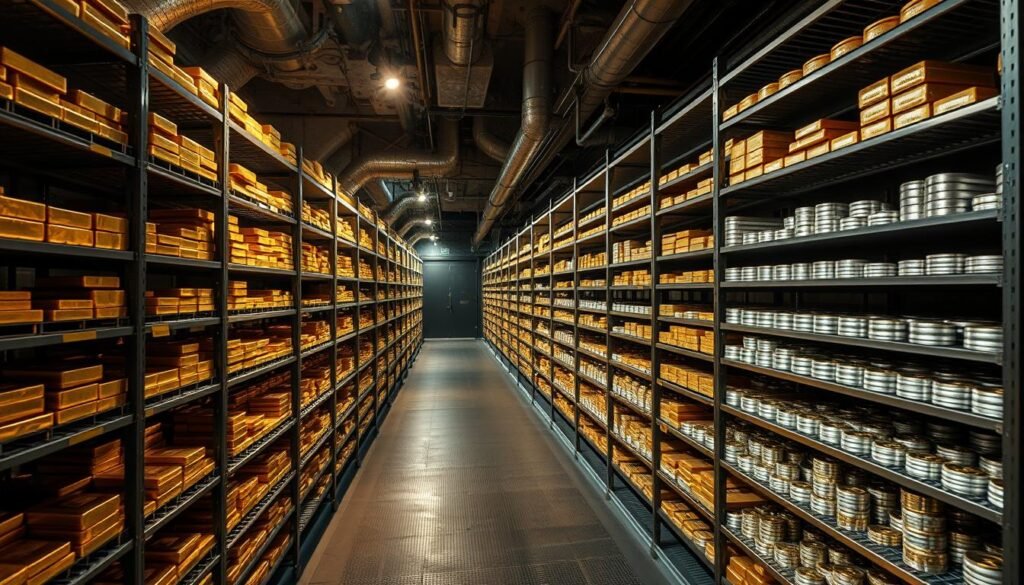
Insurance is vital for protecting your metals. Make sure your storage has good insurance that covers many risks. Know what the policy includes and any exceptions.
Case Studies: Successful International Precious Metals Diversification
Real-world case studies show the benefits of adding international precious metals to a portfolio. They highlight the potential for big returns and the risk management benefits. This is true for both institutional investors and individual investors.
Institutional Investor Global Approaches
Institutional investors lead in using international precious metals in their portfolios. For example, some pension funds invest in gold and other precious metals. This helps protect against inflation and market ups and downs.
The Yale University Endowment is a great example. It has diversified by investing in international precious metals mining companies and gold ETFs. This approach helps balance risk and potential returns, making their portfolios stronger.
Individual Investor International Success Stories
Individual investors have also seen big benefits from adding international precious metals. Some have invested in silver ETFs or mining stocks. Others prefer owning physical gold and silver, often in stable places.
One investor, expecting market swings, put a big part of their portfolio into gold, silver, and platinum. This move not only kept their wealth safe but also made money when metal prices went up during tough times.
Future Trends in Global Precious Metals Markets
The future of global precious metals markets is changing fast. This is due to new market demands and tech advancements. Knowing these trends is key for smart investment choices.
Emerging Market Demand and International Central Bank Policies
Emerging markets like China and India are big players in precious metals. They use these metals for both investment and industry. This growing need will shape global prices and market trends.
Central banks also play a big role. They buy gold to diversify their reserves. This trend supports gold and other precious metals’ prices.
| Country | Gold Reserve (tonnes) | Change from Previous Year |
|---|---|---|
| United States | 8,133.5 | +0.5% |
| Germany | 3,363.4 | +2.1% |
| Italy | 2,451.8 | -1.3% |
Technology and Sustainability Impacts on Global Precious Metals
Technology and sustainability are changing the precious metals market. Precious metals are used more in green tech like electric cars and solar panels. Also, mining is becoming more eco-friendly.
As tech improves, we’ll see new uses for precious metals. This could change their prices. Sustainability is also important, with investors looking for companies that care about the environment.
Key Trends to Watch:
- Increasing demand from emerging markets
- Continued central bank buying
- Growing use in green technologies
- Advancements in sustainable mining practices
Conclusion: Building Resilience Through International Precious Metals Diversification
You’ve learned about using precious metals to diversify your investments. This includes understanding their role and how to balance your portfolio. Adding global precious metals to your strategy can help you face market ups and downs.
Using metals like gold, silver, platinum, and palladium can spread out your risk. This helps shield your investments from local economic troubles and currency changes. It’s a step towards keeping your finances stable over time.
When thinking about your investments, remember the importance of a diverse portfolio. Mixing different metals and investment types can make a strong plan. It fits your financial goals and how much risk you’re willing to take.