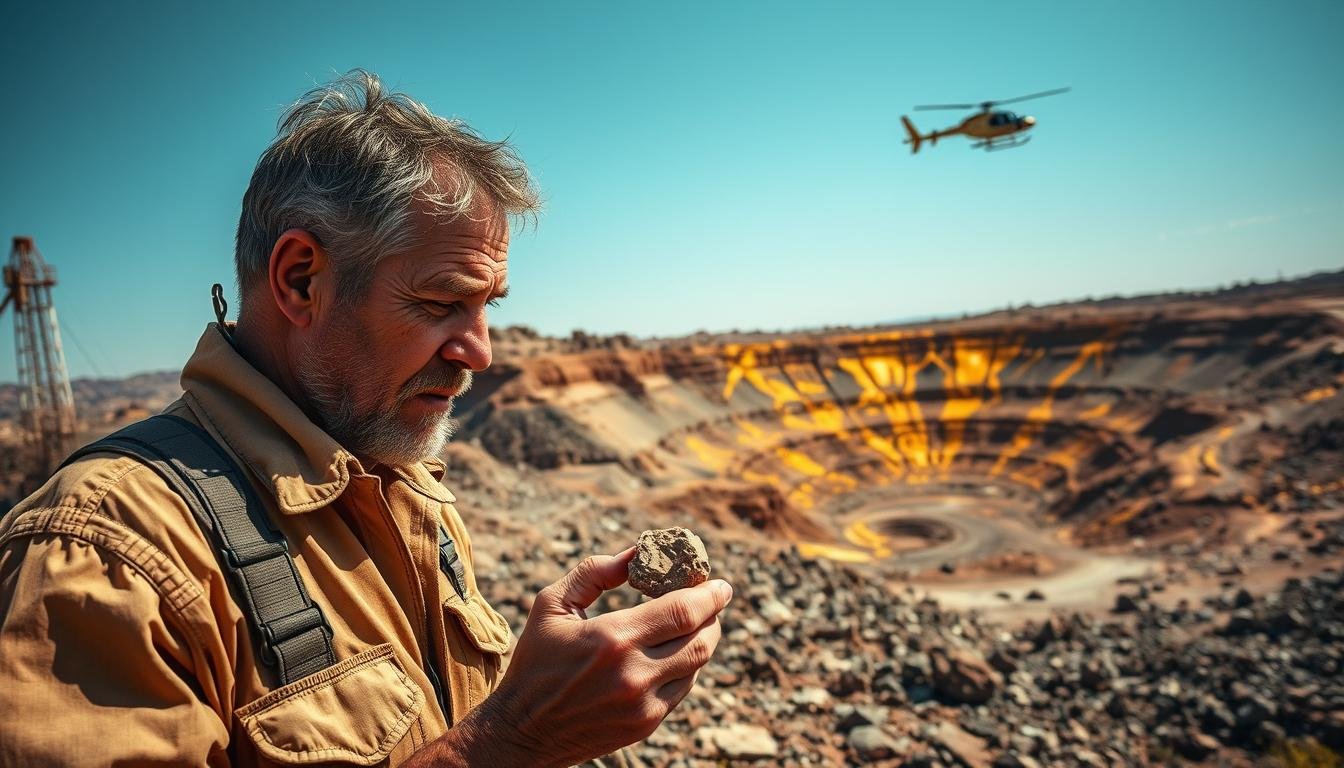
Thinking about adding some variety to your investment mix? Investing in gold exploration companies might just be the smart move you’re looking for. These firms are all about finding and growing mineral deposits. This could mean big profits for you.
The mining world is a big deal globally. By putting money into these companies, you help find new minerals. This can spark new mining projects and create jobs.
Looking for ways to boost your wealth? Exploration investing is a popular choice. It offers the chance for big gains and adds variety to your investment portfolio.
Key Takeaways
- Investing in gold exploration companies can diversify your portfolio.
- Exploration companies are involved in discovering and developing mineral deposits.
- This type of investment can potentially lead to significant returns.
- You’re supporting the discovery of new mineral resources.
- Exploration investing can be a lucrative opportunity for growth.
Understanding the Gold Exploration Sector
Exploring gold investing means knowing the gold exploration sector well. This sector is key in the mining world. It finds new gold deposits that turn into mines.
What Are Gold Exploration Companies?
Gold exploration companies look for gold deposits. They vary from small explorers to big mining firms.
Definition and Business Model
These companies use methods like geological surveys and drilling to find gold. They aim to find gold that’s worth mining. They raise money to fund their search.
Differences from Production Companies
Exploration companies focus on finding gold, not mining it. They start the mining process, taking big risks but aiming for big rewards.
The Role of Exploration in the Mining Value Chain
Exploration is the first step in mining. It finds and checks if mineral deposits are worth mining.
Current State of the Gold Exploration Industry
The gold exploration industry is buzzing with activity. This is thanks to higher gold prices and better exploration tools.
| Exploration Stage | Description | Typical Activities |
|---|---|---|
| Regional Exploration | Identifying potential areas for mineralization | Geological mapping, geochemical sampling |
| Prospecting | Evaluating specific targets within identified areas | Drilling, trenching, sampling |
| Resource Definition | Delineating the extent and quality of a discovered deposit | Infill drilling, resource estimation |
Why Invest in Gold Exploration Companies
Gold exploration companies are appealing because they can offer big returns and diversify your portfolio. They are a good choice for investors looking to make the most of the gold market.
Potential for Exponential Returns
These companies have the chance for exponential returns if they find big gold deposits. This is a big reason why investors are drawn to them for high-growth opportunities.
Portfolio Diversification Benefits
Investing in gold exploration companies can also diversify your portfolio. Gold usually moves in the opposite direction of other assets. This can help reduce risk and make your portfolio stronger.
Hedge Against Economic Uncertainty
Gold is seen as a safe-haven asset. So, investing in gold exploration companies can be a smart move against economic uncertainty. It can protect against inflation and currency value drops.
Inflation Protection
Gold does well when prices rise, as its value often goes up. Investing in gold exploration companies can help you profit from this trend.
Currency Devaluation Hedge
When currencies lose value, gold exploration companies can gain. This makes them a good choice for protecting against currency changes.
Types of Gold Exploration Companies
The gold exploration world includes various types of companies. These range from small junior explorers to large major mining companies. Knowing these categories helps investors make better choices in the gold exploration sector.
Junior Explorers vs. Major Mining Companies
Gold exploration companies fall into two main groups: junior explorers and major mining companies. Junior explorers are smaller companies that focus on early exploration. They have less money but can grow a lot. In contrast, major mining companies are bigger and have more money. They also have a wider range of projects.
Pure Exploration vs. Development Companies
Gold exploration companies can also be divided by their development stage. Pure exploration companies mainly look for new gold deposits. Development companies, on the other hand, are closer to starting production.
Geographic Specialization
Some companies specialize in certain areas, becoming experts in those regions. This focus can help them find better places to explore.
Regional Exploration Experts
Companies that focus on specific areas, like the Canadian Shield or West Africa, know the local geology well. This knowledge increases their chances of finding important discoveries.
Global Exploration Portfolios
Other companies explore globally, with projects in many countries. This approach helps spread out risks and can lead to more discoveries.
The Gold Exploration Process
Gold exploration is a complex process that turns early geological surveys into mining sites. For investors, knowing this process is key to judging gold exploration companies.
Stages of Mineral Exploration
The mineral exploration process has several stages. Each stage has its own goals and results.
Early-Stage Exploration
Early-stage exploration starts with surveys and sampling. It aims to find areas with mineral potential. This stage is vital to decide if a project is worth more study.
Advanced Exploration
Advanced exploration uses drilling and trenching to understand mineral deposits better. It gives the data needed for project decisions.
Exploration Technologies and Methods
Gold exploration uses many technologies and methods, including:
- Geophysical surveys to find underground structures
- Geochemical sampling to spot mineral signs
- Drilling for core samples
These tools help find and study gold deposits.
From Discovery to Production Timeline
The time from discovery to production varies a lot. It can take years or decades. Factors like deposit complexity, approvals, and funding affect this timeline.
Knowing the gold exploration process helps investors make smart choices. By understanding the stages and technologies, you can assess the risks and benefits of investing in gold exploration.
Key Metrics for Evaluating Gold Exploration Stocks
To make smart choices about gold exploration stocks, investors need to look at key metrics. These metrics show a company’s chances of success and help investors understand the risks.
Resource Estimates and Classifications
Resource estimates are a key metric for gold exploration stocks. They show how much gold a company thinks it can get from its properties.
Inferred vs. Indicated vs. Measured Resources
Resource estimates are divided into inferred, indicated, and measured resources. Measured resources are the most reliable, based on detailed exploration. Indicated resources are less sure, and inferred resources are the least reliable, often from limited data.
Grade and Tonnage Significance
The grade and tonnage of a deposit are very important. A higher grade means more gold per ton of ore. Tonnage shows the total ore available. Together, they help investors see the deposit’s value.
Management Team Experience
The experience and success of a company’s management team is crucial. A team with a good track record can greatly improve a company’s chances.
Cash Position and Burn Rate
A company’s cash and burn rate are also key. The cash position shows how much money a company has. The burn rate shows how fast it’s spending that money. A company with a lot of cash and a slow burn rate is more likely to survive financially.
As Max Lowenstein, a well-known mining analyst, once said,
“The key to successful gold exploration investing lies in understanding the nuances of resource estimation and the financial health of the companies you’re investing in.”
By looking at these key metrics, investors can make better choices about gold exploration stocks. This can help them get better returns on their investments.
Due Diligence for Gold Exploration Investments
To succeed in gold exploration investments, mastering due diligence is key. This means carefully checking many factors that could affect your investment’s success. By doing your research, you can make better choices and avoid big mistakes.
Analyzing Technical Reports
Technical reports are vital when looking at gold exploration companies. They offer deep insights into the company’s projects. This includes geological data, exploration results, and resource estimates.
NI 43-101 and JORC Code Reports
When you look at technical reports, make sure they follow standards like NI 43-101 or the JORC Code. These reports are made by experts. They give a full view of the project’s technical side.
Key Elements to Focus On
Here are important things to look at in technical reports:
- Geological setting and mineralization
- Exploration history and results
- Resource estimates and classifications
- Proposed future exploration plans

Assessing Property Portfolio Quality
The quality of a gold exploration company’s properties is very important. Check the location, geology, and infrastructure of the properties.
Evaluating Past Exploration Results
Looking at past exploration results can give you useful information. Look for signs of big mineral finds, the success of past exploration, and how the company handled challenges.
By doing deep due diligence, you can understand a gold exploration company’s potential better. This helps you make smarter investment choices.
Risk Factors in Gold Exploration Investing
Investing in gold exploration comes with many risks. It can be very rewarding, but knowing the dangers is key. These risks can affect your investment.
Geological and Technical Risks
Gold exploration is full of geological risks. The success of a project depends on accurate surveys and gold deposits. Technical risks come from extracting gold from hard-to-reach places.
Key geological risks include:
- Incorrect estimates of gold reserves
- Complex geological formations that are difficult to mine
- Unexpected geological structures that can halt production
Financial and Funding Risks
Financial risks are big in gold exploration. Companies need a lot of money to explore and develop gold deposits.
Dilution Concerns
Dilution is a financial risk. It happens when new shares are issued, making existing shares less valuable. This often occurs when companies need money fast.
Financing Cycles
Gold exploration companies face financing cycles. The money available can change with market conditions and investor mood.
| Risk Factor | Description | Impact on Investment |
|---|---|---|
| Geological Risks | Inaccurate reserve estimates, complex formations | Potential for significant losses if reserves are overestimated |
| Financial Risks | Dilution, financing cycles | Reduction in share value, difficulty in raising capital |
| Political Risks | Regulatory changes, political instability | Project delays or cancellations, increased operational costs |
Political and Regulatory Risks
Political and regulatory risks can also affect gold exploration investments. Changes in policies or instability in countries where companies operate can harm projects.
Knowing these risks is vital for smart investment decisions in gold exploration. By understanding the challenges, you can better handle the complexities of investing in gold exploration.
Gold as an Investment Asset
Gold is a top pick for investors looking to protect against economic ups and downs. Knowing about gold’s role in investments is key.
Historical Performance of Gold
Gold’s past performance is a big reason why investors like it. For centuries, gold has kept its value, making it a solid wealth storage. When the economy is shaky, gold prices often go up, helping investors stay safe.
For example, during the 2008 financial crisis, gold prices soared. This was because investors were looking for safe places to put their money.
Gold also shines when it comes to fighting inflation and currency value drops. As inflation goes up, the value of regular money can fall. But gold usually goes up, helping keep your buying power strong.
Gold vs. Gold Exploration Stocks
Investing in gold can be done in a few ways: buying physical gold, investing in gold ETFs, or in gold exploration stocks. Gold exploration stocks can offer big gains if a major discovery is made.
But, investing in these stocks is riskier than buying gold itself. Stock values can swing wildly, based on many things like the company’s success and market trends. You must think about these risks and the chance for bigger rewards.
Gold in a Diversified Portfolio
Adding gold to a diversified portfolio can lower risk. Gold doesn’t move in the same way as stocks or bonds, making it a great addition. It can help smooth out your portfolio’s ups and downs.
It’s common to put a small part of your portfolio into gold. This can act as a safety net during market downturns. Still, you can keep exploring other investment chances. Your financial goals and how much risk you’re willing to take should guide how much gold you invest in.
Investment Strategies for Gold Exploration Stocks
To get the most out of gold exploration stocks, you need a smart investment plan. Knowing the different ways to invest in gold exploration can help you succeed.
Long-term vs. Short-term Approaches
Investing in gold exploration stocks can be done in two ways: long-term or short-term. Long-term investing means keeping your money in for a long time. This way, you can handle market ups and downs and might see big gains from new discoveries.
Short-term investing, on the other hand, aims to make quick profits from current trends and news.
Long-term investing in gold exploration can be very rewarding. It lets you enjoy the growth of companies that find and develop gold deposits over time.
Building a Diversified Exploration Portfolio
Having a diverse portfolio is key when investing in gold exploration stocks. This means spreading your money across different companies, places, and stages of exploration. This helps reduce risk.
Risk Distribution Techniques
- Invest in a mix of junior and senior exploration companies.
- Diversify geographically across different gold-rich regions.
- Consider companies at various stages of exploration and development.
Balancing Early and Advanced Stage Companies
Mixing early-stage and advanced-stage exploration companies in your portfolio is a smart move. Early-stage companies are riskier but could offer big rewards. Advanced-stage companies are more stable but might not grow as much.
| Company Stage | Risk Level | Potential Return |
|---|---|---|
| Early Stage | High | High |
| Advanced Stage | Moderate | Moderate to High |
Timing Entry and Exit Points
When to buy and sell gold exploration stocks is very important. Knowing the right times can greatly affect your profits.
“The key to successful investing is not about timing the market perfectly but making informed decisions based on thorough research and analysis.”
With a solid investment strategy, you can confidently invest in the gold exploration market.
The Impact of Gold Prices on Exploration Companies
The price of gold greatly affects gold exploration companies, mainly junior explorers. Knowing this is key for smart investing in the gold sector.
Price Sensitivity of Junior Explorers
Junior explorers feel gold price changes a lot. Their funding often depends on gold prices. High prices help them get funding, but low prices make it hard.
Key factors influencing price sensitivity include:
- Cash reserves and burn rate
- Exploration project pipeline
- Ability to adapt to changing market conditions
How Gold Price Trends Affect Exploration Funding
Gold price trends directly affect funding for exploration. Bull markets bring more funding as investors look for high returns. Bear markets reduce funding as investors get cautious.
“The gold price is a critical factor in determining the viability of gold exploration projects. High gold prices can make previously uneconomic deposits viable, while low prices can halt projects.”
Leveraging Gold Price Movements
Investors can use gold price trends to their advantage. By watching trends and adjusting strategies, they can make good investments. For example, investing in junior explorers at the start of a bull market can be very profitable.
Understanding gold prices’ effect on exploration companies helps you make better investment choices. This way, you can take advantage of opportunities in the gold exploration sector.
Financing Methods in Gold Exploration
Financing is key for gold exploration companies to move forward. It’s important to know the different ways they get money to invest wisely.
Equity Financings and Dilution
One way companies get money is through equity financing. They issue new shares to raise capital. This can lead to dilution for current shareholders, as there are more shares.
For example, if a company you invested in issues more shares, your share of the company might go down. It’s crucial to think about dilution when investing in gold exploration.
Strategic Partnerships and Joint Ventures
Gold exploration companies also use partnerships and joint ventures for funding. These partnerships share costs and risks. They bring in expertise and resources.
A great example is when junior explorers team up with big mining companies. These partnerships can give the needed money and know-how to move projects forward.
Royalty and Streaming Deals
Royalty and streaming deals are also used. Investors give upfront money for a share of future production or revenue. These deals can give investors a steady income.
For instance, a streaming company might fund a gold project in exchange for a share of the gold. This helps the project get funded and gives investors a chance to see gold production.
| Financing Method | Description | Benefits |
|---|---|---|
| Equity Financings | Raising capital through issuing new shares | Provides necessary funds for project advancement |
| Strategic Partnerships | Collaborations to share costs and risks | Brings in expertise and resources |
| Royalty and Streaming Deals | Investors provide capital for future production | Offers steady income stream |
Knowing about these financing methods is key for investors. It helps you understand how gold exploration companies fund their projects. This knowledge can guide your investment choices.
Top Gold Exploration Regions Worldwide
Gold exploration is happening all over the world. Many places are known for their gold potential. If you’re looking to invest, knowing where to look is key.
North American Gold Exploration Hotspots
North America is a top spot for gold. Its history has led to many gold deposits. This makes it a great place for searching.
Nevada and Western United States
Nevada is famous for its gold. The Carlin Trend is a major gold area. Alaska and Colorado also have lots of gold to find.
Canadian Gold Belts
Canada is also big in gold. Places like Ontario and Quebec have mines and projects. The Abitibi Greenstone Belt is known for its gold.
Emerging Exploration Territories in Africa
Africa is full of gold, with many countries exploring. West Africa is getting a lot of attention. Its geology is good for finding gold.
Ghana, Mali, and Burkina Faso are drawing big mining companies. The Birimian greenstone belts are rich in gold.
Australian and Asia-Pacific Opportunities
Australia is a big gold producer, with lots in Western Australia. The Asia-Pacific area also has gold mines. Places like Papua New Guinea and Indonesia are worth looking at.
The area’s varied geology means there are many types of gold deposits to find.

Knowing about these places can help you choose where to invest in gold. Each area has its own geology and potential for finding gold.
Analyzing Junior Mining Exploration Opportunities
Investing in junior mining exploration needs careful thought. You must understand the risks and benefits. Knowing about junior mining companies and their place in gold exploration is key.
Identifying Promising Junior Explorers
To find good junior explorers, look for certain signs. Technical indicators include the project’s quality and the area’s geological potential. Also, check the results of early drilling.
Technical Indicators of Potential
- Proximity to existing mines or known mineral deposits
- Presence of favorable geological structures
- Results from initial drilling programs
Corporate Development Signals
Corporate signals are also crucial. Look at the management team’s experience and the company’s finances. Also, check for strategic partnerships or joint ventures.
Red Flags in Junior Mining Companies
Watch out for red flags in junior mining companies. These include unclear reporting, management’s big claims, and poor financial handling.
Valuation Methods for Junior Explorers
Valuing junior explorers is tough due to risks and uncertainties. Common methods include comparing the company’s value to its resources. Also, look at the chance for future dilution.
| Valuation Method | Description | Key Considerations |
|---|---|---|
| Enterprise Value/Resource Estimate | Compares the company’s value to its estimated resources | Resource estimate quality, commodity prices |
| Potential for Future Dilution | Assesses the likelihood of future share issuances | Financial health, funding plans |
By analyzing these factors, you can make better investment choices in junior mining.
Interpreting Gold Exploration News and Results
As an investor, understanding gold exploration results is key to potential returns. You must grasp the technical side of gold exploration news to make smart choices.
Understanding Drill Results
Drill results show a gold project’s potential. You should look at assay interpretation and the importance of intercept lengths and grades.
Assay Interpretation
Assay results tell us how much gold is in a sample. Knowing how to read these results is important. You need to understand the units used and the assay method’s limits.
Significance of Intercept Lengths and Grades
Intercept lengths and grades tell us if a gold deposit is worth mining. Longer intercepts with higher grades usually mean a bigger resource.
Resource Updates and Their Implications
Resource updates give new estimates of gold reserves. These updates can change a project’s value. It’s key for investors to know the project’s potential.
| Resource Category | Description | Impact on Project Valuation |
|---|---|---|
| Inferred Resources | Estimated based on geological evidence | Potential for significant increase with further exploration |
| Indicated Resources | Estimated with a higher degree of confidence | More reliable estimate, can positively impact valuation |
| Measured Resources | Well-defined and confirmed | High confidence, can significantly boost valuation |
Recognizing Significant Corporate Developments
Corporate events like mergers or management changes can affect a gold company’s path. Keeping up with these events is vital for investors.
By grasping drill results, resource updates, and corporate news, you can better invest in gold exploration.
Current Market Outlook for Gold Exploration
To understand the gold exploration market, we must look at economic indicators. It’s key to see how the economy affects gold exploration.
Macroeconomic Factors Affecting Gold Exploration
The gold exploration sector is influenced by many economic factors. Inflation, in particular, tends to boost gold prices, making exploration more attractive. Also, watch for currency changes and global tensions, as they can push investors towards gold.
Funding Environment for Junior Explorers
Junior explorers often struggle to get funding. The funding scene is shaped by investor mood, gold prices, and mining sector health. Strategic partnerships and alternative funding sources are vital for junior explorers to move their projects forward.
Trends in Mergers and Acquisitions
| Trend | Description | Impact |
|---|---|---|
| Consolidation | Major companies acquiring junior explorers | Increased efficiency and resource consolidation |
| Strategic Partnerships | Collaborations between companies to share risk and expertise | Enhanced project viability and reduced costs |
| Divestiture | Companies selling off non-core assets | Focus on core projects and improved financial health |
Common Mistakes When Investing in Gold Exploration
Gold exploration is exciting, but it comes with risks. Investors need to watch out for common mistakes. Knowing these can help you make better financial choices.
Chasing Hype and Promotions
Many investors fall for the hype around gold companies. Promotions can hide the real value of an investment. It’s key to see through the marketing and find real opportunities.
Ignoring Dilution and Share Structure
Ignoring dilution is a big mistake. Dilution happens when new shares are issued, which can lower the value of existing ones. Knowing about share structures and dilution is crucial for smart investing.
Failing to Understand Technical Aspects
Many investors don’t value technical knowledge enough. This includes understanding geological data and economic studies.
Geological Misinterpretations
Wrongly understanding geological data can lead to bad choices. It’s important to know the geology or get advice from experts.
Economic Feasibility Misconceptions
Not understanding a project’s economic viability can be costly. Investors should look closely at costs and potential earnings.
Knowing these common mistakes can help you invest wisely in gold exploration. It’s about weighing the potential gains against the risks and challenges.
Conclusion: Building Your Gold Exploration Investment Strategy
Creating a winning gold exploration investment strategy needs deep knowledge and careful planning. Investing in gold exploration can be very profitable, but it requires hard work and a solid plan.
To craft your strategy, first think about your financial goals and how much risk you can take. Spread your investments across junior explorers and established companies. Keep up with market trends and be ready to change your strategy as the gold market changes.
Your strategy should always be updated with new knowledge and careful research. Keep learning about the industry and evaluate companies thoroughly before investing. This way, you’ll make smart choices and handle the challenges of gold exploration investing.
Remember, a good investment strategy grows with your goals and the market. Stay true to your plan, and you’ll be ready to seize the chances in the gold exploration market.