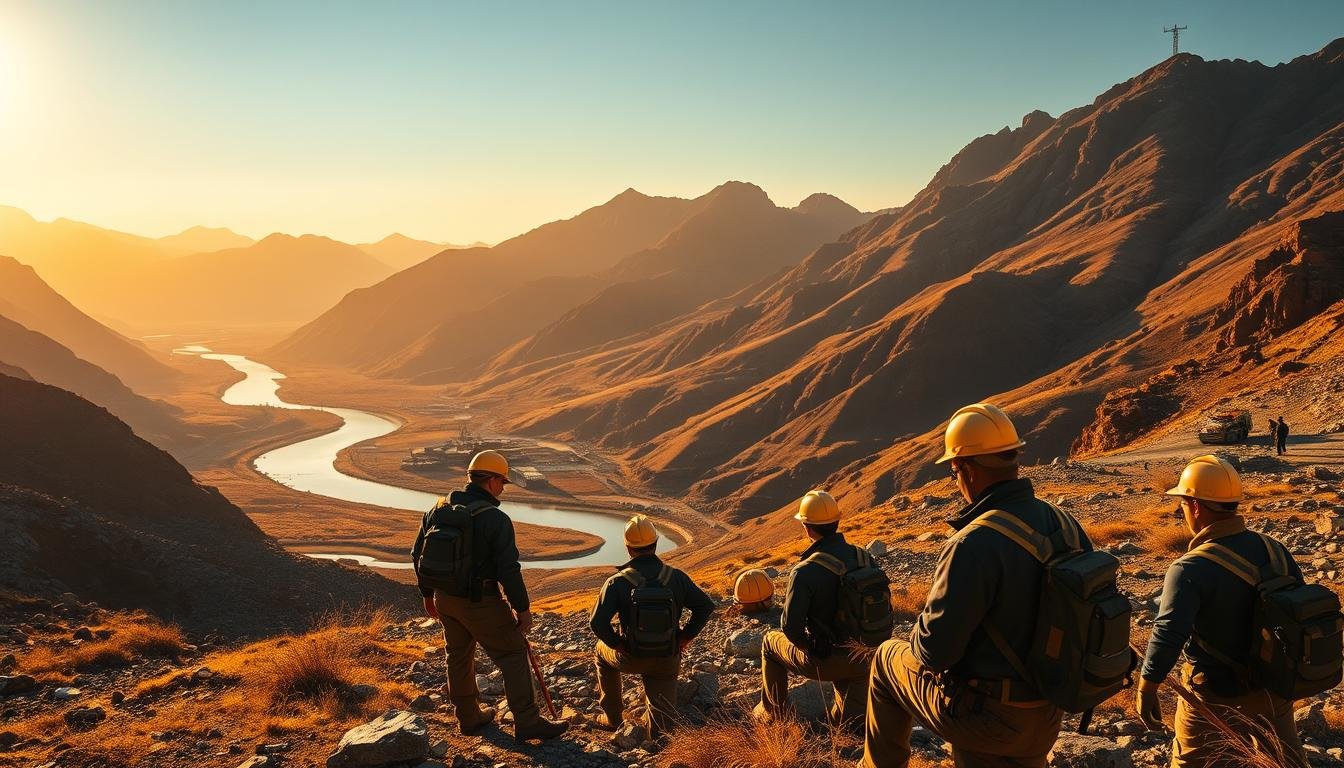
Have you thought about investing in gold? There’s a special group called gold exploration companies that could be a smart choice. They find new gold deposits, which can make your investment pay off big time.
Gold’s demand keeps rising, making these companies even more important. By investing in them, you help find new gold mines. This can be a great way to add variety to your investment portfolio.
Key Takeaways
- Investing in gold exploration companies can provide a unique opportunity for portfolio diversification.
- These companies are crucial in the discovery of new gold deposits, potentially leading to significant returns.
- Understanding the risks and benefits is key to making informed investment decisions.
- Exploration investing is a vital part of the mining industry, driving growth and innovation.
- Careful consideration of market trends is essential for successful investing in this sector.
The Gold Exploration Sector: An Overview
Investors need to understand the gold exploration sector to make smart choices. This sector is key in the mining world. It’s all about finding new gold deposits.

What Are Gold Exploration Companies?
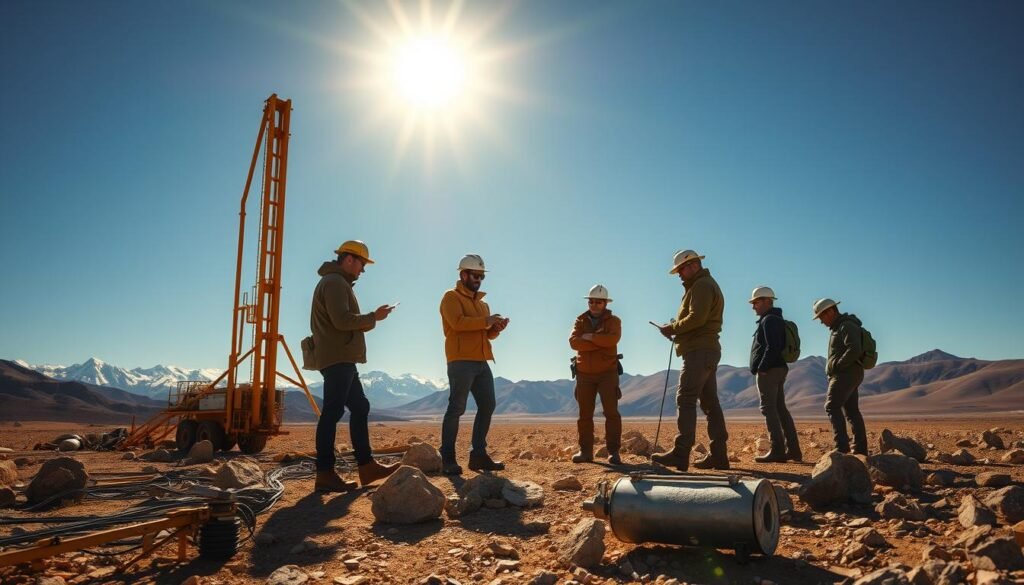
Gold exploration companies are firms that look for new gold deposits. They are essential in the mining world. They find gold deposits that can become mines. These companies use methods like geological surveys and drilling to find gold.
The Role of Exploration in the Mining Value Chain
Exploration is the first step in the mining process. It finds and checks if mineral deposits are worth mining. This stage is crucial. It leads to new mines. A good exploration project can find a big gold deposit, turning it into a mine.
- Identifying potential gold deposits
- Conducting geological surveys and drilling
- Determining the economic viability of deposits
Current Market Landscape
The gold exploration market is shaped by many things. These include global gold demand, prices, and rules. The sector is always changing, with companies adjusting to new situations.
- Global demand for gold
- Commodity prices
- Regulatory environments
Why Invest in Gold Exploration Companies?
Gold exploration companies offer a mix of growth and risk that can attract investors. It’s key to know the benefits they can add to your portfolio.
Growth Potential vs. Established Miners
Junior gold explorers have a high growth potential compared to established miners. They come with higher risks but offer big rewards. These companies are in the early stages of gold discovery and development.
Portfolio Diversification Benefits
Investing in gold exploration companies can diversify your portfolio. Their performance isn’t tied to traditional assets like stocks and bonds. This can lower your overall risk.
Hedge Against Economic Uncertainty
Gold is seen as a safe asset during economic uncertainty. Investing in gold exploration companies can protect against inflation and currency loss.
Inflation Protection
The value of gold goes up during inflation. This makes gold exploration companies a good hedge against rising prices. As currency value drops, gold’s value often increases.
Currency Devaluation Safeguard
In times of currency loss, gold exploration companies gain from gold’s increased value. They’re a solid choice for investors wanting to protect their wealth.
| Investment Benefits | Description |
|---|---|
| Growth Potential | High potential for growth, with a focus on junior explorers |
| Portfolio Diversification | Reduces overall portfolio risk due to low correlation with traditional assets |
| Hedge Against Uncertainty | Provides a safeguard against economic uncertainty, inflation, and currency devaluation |
Understanding the Gold Mining Industry
To make smart investment choices in gold exploration companies, knowing the gold mining industry is key. This industry has many stages, from finding gold to producing it. Each stage is important for the whole process.
From Exploration to Production
Finding gold and then getting it out is a tough journey. Exploration starts with searching for gold deposits. Companies use different methods for this.
After finding a deposit, the development phase begins. This involves detailed planning and getting ready for mining. Then, production starts, where gold is mined and processed.
Current State of the Global Gold Market
The global gold market is shaped by many things. These include the economy, world events, and how investors feel. Right now, gold demand is strong. This is because investors want safe assets and central banks are adding gold to their reserves.
Supply and Demand Dynamics
It’s important to understand gold supply and demand. The supply side includes new mines, recycling, and sales by central banks. Demand comes from jewelry, tech, and investment.
Changes in supply and demand can really affect gold prices. This can change how profitable mining companies are.
Knowing these parts of the gold mining industry helps you make better choices when investing in gold exploration companies. This way, you can make more informed decisions.
Types of Gold Exploration Companies
Gold exploration companies vary in their characteristics and investment potential. It’s important for investors to understand these differences. This knowledge helps them navigate the gold exploration market.
Junior Explorers
Junior explorers are small companies in the early stages of exploration. They are known for their high-risk, high-reward nature. These companies often struggle financially and need to raise capital to continue their work.
Mid-Tier Exploration Companies
Mid-tier companies have moved past the early exploration stages. They have more financial stability and aim to define resources or start production. Their projects are more advanced than those of junior explorers.
Major Mining Companies with Exploration Divisions
Major mining companies have exploration divisions to find new resources. These divisions handle both early and advanced projects. Their goal is to keep production going for the long term.
Strategic Partnerships and Joint Ventures
Many gold exploration companies form partnerships or joint ventures. This helps share the costs and risks of exploration. For junior explorers, these partnerships are key to advancing their projects.
Investors should think carefully about the type of gold exploration company they want to invest in. They should consider the company’s development stage, financial health, and exploration potential.
Investing in exploration companies can be a smart move to diversify your portfolio. These firms lead the way in finding new mining sites. This can mean big profits for investors.
When thinking about exploration investing, it’s important to know what these companies do. They search for gold deposits that could start new mines.
Key Takeaways
- Investing in exploration companies can diversify your portfolio.
- These companies are crucial for discovering new mining prospects.
- Understanding the exploration process is key to making informed investment decisions.
- Exploration investing comes with potential risks and rewards.
- Researching exploration companies is essential before investing.
The Gold Exploration Sector: An Overview
Gold exploration companies are key in the mining world. They find new gold deposits. This is crucial for the gold mining industry’s growth and survival.
The Role of Exploration Companies
Exploration companies start by finding gold deposits. They use methods like geological surveys and drilling. This helps figure out if a deposit is worth mining.
Key Activities of Exploration Companies:
- Conducting geological surveys to identify potential gold deposits
- Drilling to gather samples and assess the quality of the deposit
- Evaluating the economic viability of the discovered deposits
Importance in the Mining Value Chain
The mining value chain has many stages, from finding to producing gold. Exploration companies lead by finding new deposits. Without them, there would be no new mines.
Current Market Landscape
The gold exploration market is shaped by several factors. These include gold prices, laws, and new technologies. Knowing these factors is important for investors and companies.
| Factor | Impact on Gold Exploration |
|---|---|
| Gold Prices | Higher gold prices encourage more exploration activity |
| Regulatory Environment | Favorable regulations can boost exploration, while stringent regulations may deter it |
| Technological Advancements | New technologies can improve the efficiency and effectiveness of exploration |
Why Invest in Gold Exploration Companies?
Investing in gold exploration companies has its ups and downs. They offer growth chances but also face unique hurdles.
Growth Potential vs. Established Miners
Junior explorers have a big growth edge over established miners. They start early in exploration, which can lead to big finds and profits. For example, some junior explorers have found major discoveries that boosted their stock prices.
Key statistics for junior explorers vs. established miners:
| Category | Junior Explorers | Established Miners |
|---|---|---|
| Growth Potential | High | Moderate |
| Risk Level | High | Lower |
| Exploration Stage | Early-stage | Production-stage |
Portfolio Diversification Benefits
Adding gold exploration stocks to your portfolio can diversify it. This can lower your risk by not relying on one asset. Exploration investing is appealing when the economy is uncertain.
Hedge Against Economic Uncertainty
Gold exploration investments can protect against economic uncertainty. Gold is often seen as a safe asset. Investing in junior mining companies taps into this market.
Inflation Protection
Gold exploration investments also protect against inflation. As inflation goes up, gold’s value often increases. This makes gold exploration stocks a good investment.
Currency Devaluation Safeguard
Gold exploration investments also safeguard against currency devaluation. When currencies fall, gold tends to rise. This adds a protective layer to your portfolio.
Understanding the growth, diversification, and hedging benefits of gold exploration investments helps you make better choices for your portfolio.
Understanding the Gold Mining Industry
Gold mining is more than just digging for gold. It’s a complex process that includes many steps, from finding gold to producing it. Knowing these steps can help investors make better choices.
From Exploration to Production
The gold mining journey starts with exploration. Companies look for gold deposits in this stage. They use geological surveys, sampling, and drilling to find gold.
After finding a good deposit, the next step is resource development. This is when they figure out how big the deposit is and how easy it is to get the gold out. Then, mining begins, and gold ore is dug up from the earth.
The ore is then processed to separate the gold from other minerals. Lastly, the gold is refined into bullion. This bullion can be sold worldwide.
Current State of the Global Gold Market
The global gold market is shaped by many things. These include the economy, world events, and how investors feel. Gold is seen as a safe-haven asset during uncertain times, drawing in investors.
| Year | Global Gold Production (Tonnes) | Average Gold Price (USD/Oz) |
|---|---|---|
| 2020 | 3,300 | 1,770 |
| 2021 | 3,400 | 1,800 |
| 2022 | 3,500 | 1,850 |
Supply and Demand Dynamics
The gold market’s supply and demand are key to its prices. Supply comes from mines, recycling, and central banks. Demand comes from jewelry, investments, and industrial needs.
Knowing these factors helps investors predict market trends. It guides them in finding exploration opportunities in gold mining.
Types of Gold Exploration Companies
The gold exploration sector is full of different companies, each with its own traits and investment appeal. Knowing the various types of gold exploration companies is key to making smart choices.
Junior Explorers
Junior explorers are small firms that search for new gold deposits. They are considered high-risk, high-reward investments. With less money, they start early in exploration. But, they could grow a lot if they find big gold deposits.
Mid-Tier Exploration Companies
Mid-tier companies have moved past the early exploration stages and are getting ready to produce gold. They have more money than juniors and have found big gold resources. They offer a mix of growth and stability, appealing to investors who want a moderate risk.
Major Mining Companies with Exploration Divisions
Big mining companies have special teams for finding new gold deposits. They have lots of money and know-how for big projects. Investing in them can be stable, as they have many projects and are already producing.
Strategic Partnerships and Joint Ventures
Many gold exploration firms team up through strategic partnerships or joint ventures. This way, they share costs and risks. It can lead to better exploration. Knowing about these partnerships can help investors see a company’s potential.
When looking at gold exploration companies, think about their money, management, and plans. Understanding the different types helps you make choices that fit your risk level and goals.
The Gold Exploration Process
As an investor, knowing the gold exploration process is key. It includes exploration, resource definition, and feasibility studies. These stages help us see if a gold exploration company is worth investing in.
Early-Stage Exploration Techniques
Early exploration finds where gold might be by mapping, sampling, and surveys. These steps help narrow down where to look for gold.
- Geological mapping: Creating detailed maps of the geological features of an area.
- Geochemical sampling: Collecting and analyzing samples to determine the presence of gold and other minerals.
- Geophysical surveys: Using techniques such as magnetic and electrical surveys to identify subsurface features.
Advanced Exploration and Resource Definition
After finding a promising area, companies use more detailed methods. Drilling and trenching help figure out how big the gold deposit is.
Drilling is key here. It gives important data on the deposit’s size and quality.
| Exploration Stage | Techniques Used | Objective |
|---|---|---|
| Early-Stage | Geological mapping, geochemical sampling, geophysical surveys | Identify potential gold-bearing areas |
| Advanced Exploration | Drilling, trenching | Define the extent of the gold deposit |
| Feasibility Studies | Economic and technical analysis | Determine the viability of the project |
Feasibility Studies and Development Decision
Feasibility studies look at if the project makes economic sense. This is a big step in deciding if to go ahead with the gold project.
Knowing the gold exploration process helps you make better investment choices. It lets you see if a gold exploration company is a good bet.
Key Factors That Drive Exploration Success
The success of gold exploration companies depends on several key elements. When looking at gold exploration investments, it’s important to understand these factors.
Geological Potential
The geological potential of a gold exploration project is crucial. It’s about finding gold deposits based on geological surveys and data. Projects in known gold districts or with good geological features have a better chance of success.
Key indicators of geological potential include:
- Presence of gold anomalies in soil or rock samples
- Favorable geological structures such as faults or shear zones
- Historical mining activity or known gold deposits in the area
Management Team Experience
The experience of the management team is vital. A team with a history of successful projects can greatly improve a company’s chances.
“A good management team can make all the difference in the success of a gold exploration project. Their ability to navigate geological, financial, and operational challenges is paramount.”
Capital Structure and Financing
Gold exploration companies need enough money to fund their projects. The company’s capital structure, including debt and equity, affects its ability to explore.
| Financing Option | Advantages | Disadvantages |
|---|---|---|
| Equity Financing | No debt obligation, potential for high returns | Dilution of ownership, potential for stock price volatility |
| Debt Financing | No dilution of ownership, tax-deductible interest | Debt repayment obligation, potential for higher financial risk |
Technical Capabilities
The technical skills of a gold exploration company are essential. They need to be good at geological surveys, drilling, and resource estimation. Companies with strong technical skills can better find and define gold deposits.
Technical capabilities include:
- Geological modeling and resource estimation
- Drilling and sampling techniques
- Geophysical survey capabilities
By focusing on these key factors, you can better evaluate the potential success of gold exploration companies. This helps make more informed investment decisions.
Evaluating Gold Exploration Investments
When you look at gold exploration investments, it’s important to do your homework. You need to know what makes a company successful in this field. This knowledge helps you make smart choices.
Resource Estimates and NI 43-101 Reports
Resource estimates are key when checking out gold exploration investments. These estimates come from NI 43-101 reports. These reports follow a set standard for reporting on mineral resources and reserves.
Key aspects to consider in NI 43-101 reports include:
- The competency and independence of the qualified person preparing the report
- The methodology used for resource estimation
- The assumptions made regarding cut-off grades and metallurgical recoveries
Drilling Results Analysis
Drilling results tell a lot about a project’s potential. Look at the grade and thickness of mineralized intercepts. Also, consider the depth and location of the drill holes. The drilling method and any data biases are also important.
Some key metrics to focus on when evaluating drilling results include:
- Gold grade and thickness of intersections
- Consistency of mineralization across multiple drill holes
- Presence of any significant intervals of low-grade or waste material
Property Portfolio Assessment
Looking at a company’s property portfolio is crucial. Think about the location, size, and geology of the properties. Also, consider any existing infrastructure or nearby mining operations.
Location and Jurisdiction
The location and jurisdiction of a project matter a lot. Look for projects in areas with a gold mining history. These areas should have favorable geology and good regulations.
Infrastructure Access
Having good infrastructure access is important. This includes roads, power, and water. Projects near existing infrastructure are often easier and cheaper to develop.
By carefully looking at these factors, you can make better investment choices in gold exploration. Always check different sources and talk to experts. This way, you’ll understand the investment opportunities fully.
Financial Analysis of Junior Gold Explorers
Looking into the financial health of junior gold explorers is key for investors. These companies often have little money, so it’s vital to check their balance sheets and cash levels.
Balance Sheet Considerations
A junior explorer’s balance sheet shows their financial health. You should look at:
- Cash and cash equivalents: A good cash level means they can fund their work.
- Current assets and liabilities: Knowing their short-term money matters is important.
- Long-term debt: Too much debt is a warning sign of financial trouble.
Burn Rate and Cash Position
The burn rate shows how fast a junior explorer uses their cash. A high burn rate can be risky if not managed well.
Key considerations include:
- Monthly cash burn: Knowing how much cash is used each month.
- Cash runway: How long they can run before needing more money.
Financing Options and Dilution Risk
Junior explorers often need more money to keep going. This can mean their shares might become less valuable.
“The ability to secure financing is crucial for junior explorers, but it can come at the cost of equity dilution.”
You should look at:
- Financing history: Past funding shows if they can get more money.
- Dilution risk: The chance that current shares will lose value with new shares.
Valuation Metrics for Exploration Companies
Valuing junior gold explorers is hard because of the risks in finding new resources. Yet, some metrics can help.
Common valuation metrics include:
| Metric | Description |
|---|---|
| Price-to-NAV ratio | Compares the company’s market value to its net asset value. |
| Enterprise Value-to-Resource ratio | Looks at the company’s value compared to its resources. |
Risk Factors in Gold Exploration Investments
Investing in gold exploration comes with many risks. These risks include geological, technical, operational, and regulatory challenges. Knowing these risks helps you make better investment choices.
Geological and Technical Risks
Gold exploration is risky because you don’t know if gold is there until you start drilling. The technical challenge of getting gold out of hard rock formations can also affect costs and feasibility.
Operational Challenges
Managing exploration logistics, keeping everyone safe, and fixing equipment are big tasks. If not done right, these tasks can cause delays and cost more money.
Market and Commodity Price Volatility
The gold market’s price can change a lot. This is because of world economic changes, currency shifts, and what investors think. These changes can make or break the profit of gold exploration projects.
Political and Regulatory Risks
Political and regulatory risks are wide-ranging. They include changes in mining laws, taxes, and environmental rules. These can make or break a gold exploration project.
Environmental Permitting Hurdles
Getting environmental permits is a big challenge. It takes time and can face public scrutiny, which can slow down projects. Following environmental rules is key to success in gold exploration.
| Risk Category | Description | Impact on Investment |
|---|---|---|
| Geological and Technical Risks | Uncertainty about gold presence and extraction challenges | Project feasibility and cost |
| Operational Challenges | Logistical, safety, and equipment management issues | Project delays and increased costs |
| Market and Commodity Price Volatility | Fluctuations in gold prices due to global economic conditions | Project profitability |
| Political and Regulatory Risks | Changes in laws, taxation, and environmental regulations | Project viability and compliance costs |
U.S. Gold Exploration Opportunities
The United States is rich in gold exploration opportunities. Its diverse landscape makes it a key place for gold mining. Many projects are underway across different states.
Major Gold Districts in the United States
The U.S. has several major gold districts. Each has its own unique features and potential for exploration. Some notable districts include:
- The Carlin Trend in Nevada, known for its significant gold deposits and ongoing exploration activities.
- The Battle Mountain District, also in Nevada, which has been a major source of gold production.
- The Black Hills of South Dakota, a historic gold mining region with continued exploration efforts.
These districts offer a range of exploration opportunities, from early-stage projects to advanced mines.
Regulatory Environment for U.S. Mining
The mining regulations in the U.S. are complex. They involve federal, state, and local laws. Key factors include:
| Regulatory Level | Key Regulations | Impact on Exploration |
|---|---|---|
| Federal | National Environmental Policy Act (NEPA), Mining Law of 1872 | Sets national standards for environmental impact assessments and mining claims. |
| State | Varies by state; includes reclamation laws and permitting requirements | Influences the cost and feasibility of exploration projects. |
| Local | Zoning laws, community regulations | Affects project approvals and community relations. |
Notable American Junior Exploration Companies
Several junior exploration companies are actively engaged in gold exploration in the U.S. Some notable examples include:
- Barrick Gold Corporation, involved in various exploration projects across the U.S.
- Newmont Corporation, a major gold producer with significant exploration activities.
- Alamos Gold, a junior explorer with projects in the U.S. and Canada.
Investment Vehicles for U.S. Investors
U.S. investors have several options for investing in gold exploration companies, including:
- Direct stock purchases of junior exploration companies.
- Exchange-Traded Funds (ETFs) focused on gold mining and exploration.
- Mutual funds that include gold exploration companies in their portfolios.
Each investment vehicle has its advantages and risks. Investors should carefully evaluate their options.
Investment Strategies for Exploration Stocks
Investing in exploration stocks needs a smart plan to get the best results. Knowing the right strategies is key to improving your portfolio’s performance. This is crucial in the complex world of gold exploration investments.
Portfolio Allocation Recommendations
Diversification is essential when investing in exploration stocks. You should put a part of your portfolio in junior explorers for their high growth potential. Also, invest in established companies to balance out the risk. A good mix could include junior explorers, mid-tier companies, and major mining firms with exploration divisions.
Consider the following allocation strategy:
- Allocate 20-30% of your mining investment portfolio to junior explorers.
- Invest 40-50% in mid-tier exploration companies or established miners with significant exploration potential.
- Place 30-40% in major mining companies with strong exploration divisions.
Timing Market Entry and Exit
Timing is everything when investing in exploration stocks. You must know when to enter and exit the market to maximize gains. Watch market trends, exploration results, and economic indicators that affect gold prices.
Market entry strategies might include:
- Investing during market downturns when stock prices are low.
- Entering the market after positive exploration results or significant discoveries.
Balancing Risk with Established Gold Producers
While junior explorers offer great growth potential, they also come with higher risks. Investing in established gold producers can help balance these risks. These producers usually offer stability and dividends, which can reduce the volatility of junior explorers.
Creating a Tiered Approach to Mining Investments
A tiered investment approach means spreading your investments across different mining companies. This is based on their development stage and risk level. It helps manage risk while still benefiting from exploration stocks’ growth potential.
By adopting a tiered approach, you can:
- Invest in high-risk, high-reward junior explorers.
- Include mid-tier companies that offer a balance between risk and potential return.
- Anchor your portfolio with established producers that provide stability.
Due Diligence Process for Junior Companies
When looking at junior gold exploration companies, doing thorough due diligence is key. This means checking the company’s potential, risks, and if it’s a good investment.
Research Methodology
Good due diligence starts with solid research. First, look at the company’s public info like financial reports and press releases. It’s important to understand their exploration projects, the geology, methods used, and results.
Also, check the company’s management and technical teams. Look at their experience and success in gold exploration. You can find this info on their website, in interviews, or at industry events.
Red Flags to Watch For
Keep an eye out for certain red flags during your research. These include:
- Inconsistent or unexplained changes in financial reports
- Lack of transparency about exploration results or project details
- Poor corporate governance or management structure
- Unrealistic expectations or projections
- Regulatory issues or non-compliance with industry standards
Finding these red flags early can help avoid bad investments.
Information Sources for Investors
To do good research, you need reliable sources. Some important ones are:
| Source | Description |
|---|---|
| Company Website | Financial reports, press releases, project updates |
| SEDAR (System for Electronic Document Analysis and Retrieval) | Technical reports, NI 43-101 reports, other regulatory filings |
| Industry Conferences | Presentations, interviews with management and technical teams |
| Independent Research Reports | Analyst reports, industry research studies |
As
“The key to successful investing is to identify companies with strong management, robust projects, and a clear path to production.”
This quote shows why thorough research is crucial for finding good investments.
Evaluating Management and Technical Teams
The management and technical teams are crucial for junior exploration companies. You should look at their experience, skills, and past success. A team with a proven track record can greatly improve the company’s chances.
Find out about the company’s key people, their roles, and experience. Also, check their work on other projects and their reputation in the field.
By following a detailed due diligence process, you can make better investment choices in junior gold exploration companies.
Case Studies: Successful Exploration Ventures
The world of gold exploration is full of stories of junior companies making it big. These junior exploration companies have turned into major players. They show the great potential of gold exploration.
Junior Explorer to Major Producer Transformations
Seeing a junior explorer grow into a major producer is truly inspiring. This change comes from good geological potential, smart management, and the right funding.
- Identifying promising exploration targets
- Executing successful drilling programs
- Progressing through feasibility studies
- Navigating regulatory approvals
Companies like Barrick Gold and Newmont Corporation started as junior explorers. They show how much growth is possible and the key role of exploration success.
Acquisition Success Stories
Acquisitions are another way for gold exploration to succeed. Big mining companies buy junior explorers with great assets. This gives investors a good exit.
- Junior explorers find big mineral deposits
- Larger companies notice and start talks
- These talks lead to a sale, often at a high price
This shows the exploration potential of junior companies. It creates value for their shareholders.
Lessons from Failed Ventures
Not every exploration venture works out, and there’s a lot to learn from failures. Knowing the risks can help investors make smarter choices.
- Not enough money can stop a project too soon
- Bad management choices can harm a project
- Regulatory issues that are too hard to solve
By looking at these examples, investors can understand the risks and rewards of junior exploration better.
The Future of Mining Exploration
The mining exploration future is changing with new tech, hotspots, and a focus on the environment and society. If you’re thinking about investing in mining, knowing these trends is key.
Technological Innovations in Exploration
New tech is changing mining exploration. Remote sensing, geophysical surveys, and drone technology make it more efficient and accurate. For example, drones with hyperspectral imaging can quickly scan big areas and find mineral deposits.
Artificial intelligence (AI) and machine learning (ML) are also big in exploration. They help companies analyze lots of data, predict where minerals might be, and plan drilling better. A mining expert says, “AI in exploration is not just a trend; it’s essential for staying ahead.”
Emerging Exploration Hotspots
New places are becoming popular for mining exploration. This is because of their geological potential and better rules. Sub-Saharan Africa and Latin America are getting more attention because of their potential and better mining laws.
- Sub-Saharan Africa: Countries like Ghana and Tanzania are seeing more mining because of their gold and better rules.
- Latin America: Peru and Chile are still top for mining exploration. They have lots of copper and gold.
Environmental and Social Governance Factors
Environmental and Social Governance (ESG) matters a lot in mining now. People want mining companies to be open about their impact on the environment and society.
“The mining industry is under increasing pressure to show it cares about the planet and people. Companies that don’t adapt will fall behind.”
To meet these demands, mining companies are using sustainable mining practices. They work with local communities and report on their ESG efforts. Balancing profits with caring for the planet and people is crucial for success in the future.
Conclusion
You’ve learned about the gold exploration sector, its ups and downs. Investing in gold exploration companies can be rewarding. But, it comes with challenges. To do well, you must carefully choose and invest in these companies.
When looking at exploration investing, check the geological potential and the team’s experience. Also, look at the project’s capital structure. This helps you understand the gold exploration market better and make smart choices.
Remember, a balanced approach is essential. Spread out your investments, keep up with market trends, and be ready to adjust. With the right plan, investing in gold exploration companies can add value to your portfolio.