You’ve probably heard that gold is a trusted form of currency. For traders, its value makes it a popular choice. The global gold market is growing, making it a great asset for diversifying your portfolio.
As a trader, making informed decisions is key. This is where technical indicators play a big role. They help you understand market trends and patterns. This knowledge is vital for both new and experienced traders in gold trading.
Key Takeaways
- Technical indicators are essential tools for traders.
- They help analyze market trends and patterns.
- Informed decisions can be made using these indicators.
- Understanding technical indicators is crucial for trading success.
- They support diversification of investment portfolios.
Understanding the Gold Market Dynamics
It’s key to know how the gold market works to trade well. You must understand gold’s special traits and what affects its price.
Unique Characteristics of Gold as a Trading Asset
Gold is a liquid trading tool. This means it has low spreads and big trades don’t move the market much. This makes gold appealing to traders.
Factors Influencing Gold Price Movements
Many things affect gold’s price. These include economic indicators and geopolitical events.
Economic Indicators
Things like inflation, interest rates, and GDP growth impact gold prices. For example, when inflation is high, gold’s price goes up because it’s seen as safe.
Geopolitical Events
Events like political instability and conflicts also raise gold prices. Investors look for safe assets like gold during these times. Knowing this helps in using technical analysis better.
| Factor | Impact on Gold Price |
|---|---|
| Economic Instability | Increases |
| Geopolitical Tensions | Increases |
| Strong Economic Growth | Decreases |
By understanding these dynamics and using chart indicators in your technical analysis, you can make better trading choices with gold.

The Role of Technical Analysis in Gold Trading
Technical analysis is key in gold trading. It looks at past market data like price and volume to guess future trends. This helps traders make smart choices.
Fundamentals vs. Technical Analysis
Fundamental analysis looks at gold’s price drivers like supply and demand. It also considers economic and geopolitical factors. On the other hand, technical analysis uses charts and indicators to predict prices.
Why Technical Indicators Matter for Gold Traders
Technical indicators are vital for gold traders. They give trading signals for spotting good trades. These tools help analyze trends, predict prices, and set safety levels.
| Indicator Type | Description | Use in Gold Trading |
|---|---|---|
| Trend Following | Indicators that follow the direction of the market trend. | Identify the direction and strength of the trend in gold prices. |
| Momentum Indicators | Indicators that measure the speed of price changes. | Help traders identify overbought or oversold conditions in the gold market. |
Understanding technical analysis, including indicator analysis, boosts gold traders’ strategies. It leads to better trading decisions.
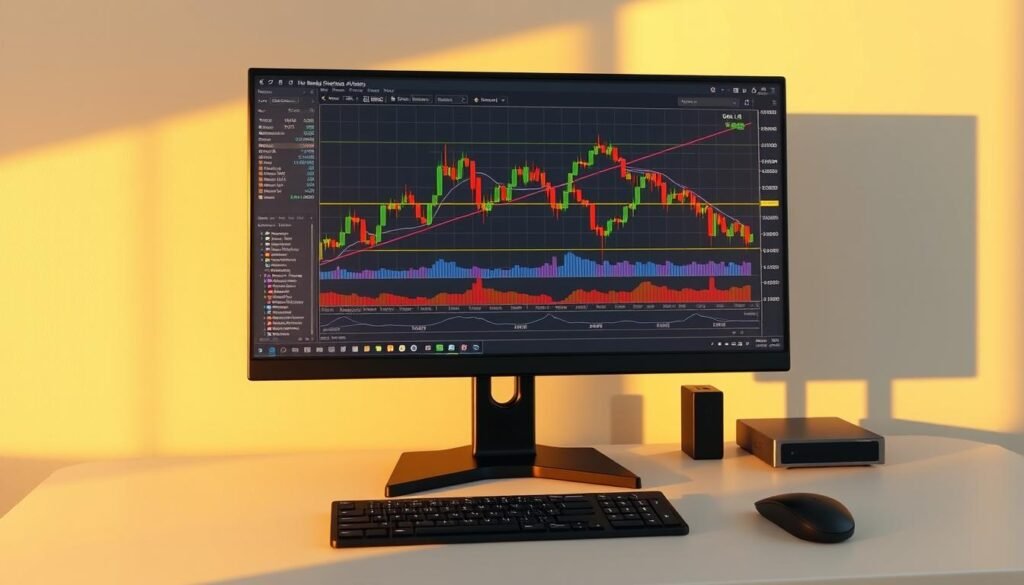
Essential Gold Technical Analysis Principles
To navigate the gold market well, you must understand key technical analysis principles. This method predicts future prices based on past data. It’s vital for making smart trading choices.
Price Action Basics
Price action trading focuses on gold price movements, not technical indicators. By knowing how prices move, you spot trends and patterns. This skill requires a deep grasp of market dynamics and chart reading.
Chart Types for Gold Analysis
Various charts offer unique insights into gold prices. Knowing these can improve your trading strategy.
Candlestick Charts
Candlestick charts are favored for their detailed price info. They show market sentiment, helping spot reversals and continuations.
Line and Bar Charts
Line charts simplify price trends, while bar charts show detailed price data. Both are key technical tools for gold trend analysis.
| Chart Type | Description | Usefulness for Gold Trading |
|---|---|---|
| Candlestick | Detailed visual representation of price action | High |
| Line | Simplified view of price trends | Medium |
| Bar | Detailed price information (open, close, high, low) | High |
Trend-Following Indicators for Gold
In gold trading, trend-following indicators are key. They help spot market trends and their strength. This makes trading decisions easier.
Moving Averages (Simple and Exponential)
Moving averages are simple yet powerful tools for gold traders. A simple moving average averages gold prices over time. An exponential moving average weighs recent prices more, reacting faster to market changes.
These averages help find trends and when they might change. For example, when the short-term average goes above the long-term one, it’s a good sign.
MACD (Moving Average Convergence Divergence)
The MACD is a strong indicator that shows how two moving averages of gold prices relate. It helps spot trends, momentum, and buy/sell signals. A MACD line crossing above the signal line means it’s time to buy.
Parabolic SAR
The Parabolic SAR is another helpful indicator for finding entry and exit points. It shows as dots on the chart, above or below the price. Dots below the price mean the trend is up; above, it’s down.
Using these indicators together can build a strong trading plan. It helps you confidently move through the gold market.
Momentum Indicators for Gold Trading
Understanding momentum is crucial for tracking gold prices. Several indicators help you do this effectively. These tools measure price changes’ speed and strength, aiding in better trading decisions.
Relative Strength Index (RSI)
The Relative Strength Index (RSI) is a key tool for traders. It shows when a market is overbought or oversold. An RSI below 30 means it’s oversold, and above 70 means it’s overbought.
Using RSI in Gold Trading: The RSI can spot gold price reversals. If it drops below 30, buying gold might be wise. If it goes above 70, selling could be a good move.
Stochastic Oscillator
The Stochastic Oscillator compares gold’s closing price to its price range. It helps find overbought and oversold spots, and trend reversals.
Interpreting the Stochastic Oscillator: Above 80, gold is overbought. Below 20, it’s oversold. These levels help predict price shifts.
Williams %R
Williams %R looks at the close relative to the high-low range over 14 days. It spots overbought and oversold, and trend reversals.
Applying Williams %R: Below -80 is oversold, above -20 is overbought. Use it with other indicators for stronger signals.
| Indicator | Description | Overbought/Oversold Levels |
|---|---|---|
| RSI | Measures magnitude of recent price changes | 70 (overbought), 30 (oversold) |
| Stochastic Oscillator | Compares closing price to price range | 80 (overbought), 20 (oversold) |
| Williams %R | Measures close relative to high-low range | -20 (overbought), -80 (oversold) |
Knowing and using these indicators can improve your gold trading. They help in making better trading choices.
Volume-Based Indicators for Gold Markets
Volume-based indicators offer valuable insights for gold traders. They help you make better decisions.
These indicators are key to understanding price movements in the gold market. By looking at volume, you can tell if a trend will keep going or change.
On-Balance Volume (OBV)
The On-Balance Volume (OBV) shows buying and selling pressure. It compares trading volume on up days to down days. This indicator helps spot strong or weak trends.
Key points about OBV:
- OBV rising with price means a strong uptrend.
- OBV falling with price means a strong downtrend.
- Divergence between OBV and price can signal a reversal.
Volume Rate of Change
The Volume Rate of Change indicator shows volume changes over time. It highlights shifts in market sentiment by showing volume changes.
Using Volume Rate of Change effectively:
- Look for divergences between volume rate of change and price movements.
- Use it to confirm trend strength or potential breakouts.
Accumulation/Distribution Line
The Accumulation/Distribution Line checks if a security is being bought or sold. It looks at price action and volume to see money flow.
Interpreting the Accumulation/Distribution Line:
- A rising Accumulation/Distribution Line means buying pressure.
- A falling Accumulation/Distribution Line suggests selling pressure.
Using these volume-based indicators in your analysis can improve your trading strategies. You’ll understand technical signals in the gold market better.
Volatility Indicators for Gold Price Analysis
Understanding volatility is key for successful gold trading. There are several important indicators to help you navigate the markets. These indicators give insights into gold price changes. They help you understand market trends and make better trading choices.
Bollinger Bands
Bollinger Bands are a well-known indicator. They include a moving average and two standard deviations plotted above and below it. These bands show when prices are moving a lot or a little.
When the bands are close, prices are stable. But when they spread out, prices are changing a lot. You can use Bollinger Bands to find good times to buy or sell gold.
Average True Range (ATR)
The Average True Range (ATR) shows the average price movement over time. It’s great for seeing how volatile gold prices are. A high ATR means prices are changing a lot, while a low ATR means they’re stable.
You can adjust your trading plan based on the ATR. This helps you stay on track with the market.
Keltner Channels
Keltner Channels are another useful indicator. They have a moving average and two bands based on the ATR. These channels help spot trends and potential breakouts.
When the price goes outside the channels, it might signal a big change. Using Keltner Channels with other indicators can make your trading strategy stronger.
Adding these indicators to your trading plan can help you understand gold markets better. It can also improve your ability to predict price changes. Whether you’re experienced or new, using these indicators can boost your trading success.
Support and Resistance Indicators for Gold
Support and resistance indicators are key for gold traders. They help spot important market levels. This makes planning trades easier. We’ll look at three main indicators used in gold trading.
Fibonacci Retracement
Fibonacci retracement levels show where the gold price might bounce back or pause. By using Fibonacci lines on a chart, traders can predict these points.
Pivot Points
Pivot points are useful for finding support and resistance. They’re based on the previous day’s high, low, and close prices. This gives traders key levels to watch.
Ichimoku Cloud
The Ichimoku Cloud is a detailed indicator. It shows support, resistance, and trend direction. It has multiple lines that help traders understand market momentum.
| Indicator | Primary Use | Key Benefit |
|---|---|---|
| Fibonacci Retracement | Identifying support and resistance levels | Helps predict price reversals |
| Pivot Points | Determining intraday support and resistance | Provides clear levels for trading decisions |
| Ichimoku Cloud | Gauging trend direction and support/resistance | Offers a comprehensive view of market momentum |
Using these indicators, gold traders can improve their analysis. This leads to better trading decisions.
Specialized Oscillators for Gold Analysis
To improve your gold trading strategy, add specialized oscillators to your toolkit. These tools help you grasp gold price movements and spot trading chances.
Commodity Channel Index (CCI)
The Commodity Channel Index (CCI) is great for spotting overbought and oversold gold prices. It shows the price difference from its average over time. Key benefits of using CCI include:
- Identifying overbought conditions when CCI rises above +100
- Spotting oversold conditions when CCI falls below -100
- Recognizing divergence between CCI and price movements
Detrended Price Oscillator
The Detrended Price Oscillator strips away trends to highlight cycles and oscillations. It’s perfect for volatile gold markets, showing short-term changes. Adjust its settings to fit your trading time frame.
Ultimate Oscillator
The Ultimate Oscillator blends three timeframes for a full view of gold’s momentum. It uses short, medium, and long-term data for a balanced view. It’s great for backing up trading signals from other indicators.
Using these specialized oscillators in your analysis can deepen your gold market understanding. This leads to better trading choices.
Pattern Recognition in Gold Charts
Recognizing patterns in gold charts is key for traders. It helps them make smart decisions. You must know how to spot and understand different patterns to lead in the market.
Candlestick Patterns Specific to Gold
Candlestick patterns offer deep insights into market mood. They help spot trading chances. Two important patterns to watch are:
Doji Formations
A Doji formation shows when opening and closing prices are almost the same. It means the market is unsure. This pattern might signal a trend change or its continuation.
Engulfing Patterns
An Engulfing pattern is when a big candlestick covers the whole of the last one. It shows a big shift in market mood. This could mean a trend change.
Chart Patterns for Gold Trading
Chart patterns are also vital in gold trading. Knowing them helps in making better trading choices.
Head and Shoulders
The Head and Shoulders pattern is a sign of trend change. It has a high peak (the head) and two lower peaks (the shoulders).
Double Tops and Bottoms
Double Tops and Bottoms happen when price hits a level twice before turning. They hint at trading chances.
Learning these chart indicators and trading indicators boosts your gold trading strategy. It leads to better decisions.
To use pattern recognition well in gold trading, mix these methods with other trading indicators. Also, keep up with market trends.
Combining Multiple Indicators for Gold Trading
To boost your gold trading, it’s key to know how to mix different technical indicators. This way, you can build a strong trading plan. It helps you understand the gold market better.
Creating a Balanced Indicator Strategy
A good strategy mixes various indicators. You might use trend-following tools like Moving Averages and momentum tools like the Relative Strength Index (RSI). This mix gives you a full view of the market.
Avoiding Indicator Redundancy
It’s important not to repeat indicators. Using the same info from different indicators can lead to biased decisions. Instead, pick indicators that show different things. For example, combining a trend indicator with a Bollinger Bands for volatility gives a deeper market insight.
Confirmation Techniques
Confirmation techniques are key to trust your trading signals. Using several indicators to back up a signal is a smart move. For example, if the MACD and Stochastic Oscillator both say it’s time to buy, you can trust your decision more. This method lowers the chance of wrong signals and makes your strategy better.
By mixing indicators and using confirmation methods, you can craft a detailed trading plan. This plan will help you make smarter choices in the gold market.
Timeframe Considerations for Gold Technical Analysis
To make your gold trading strategy better, knowing how timeframes affect analysis is key. The right timeframe choice depends on your trading goals and strategy.
Short-term vs. Long-term Indicators
Traders must pick between short-term and long-term indicators for gold analysis. Short-term indicators are great for quick market gains. Long-term indicators spot bigger trends.
Multi-timeframe Analysis
Multi-timeframe analysis gives a full view of the gold market. It lets you check trends across different periods, guiding better trading choices.
Indicator Settings for Different Timeframes
Changing indicator settings for each timeframe is vital. Short timeframes need more sensitive settings. Longer ones do better with less sensitivity.
| Timeframe | Indicator Type | Setting Adjustment |
|---|---|---|
| Short-term | Momentum Indicators | Increase sensitivity |
| Long-term | Trend-following Indicators | Decrease sensitivity |
| Multi-timeframe | Combination of Indicators | Adjust based on primary timeframe |
Understanding and using these timeframe tips can boost your gold trading. It helps in making more precise predictions with technical analysis.
Common Mistakes When Using Technical Indicators for Gold
Technical indicators are familiar to many traders. Yet, they often make mistakes when using them for gold trading. It’s crucial to know these pitfalls to improve your indicator interpretation and trading results.
Over-reliance on Single Indicators
Dependence on a single indicator narrows your market view. It’s like navigating with only one sense. Using different trading tools gives a fuller picture of the gold market.
Ignoring Market Context
Technical indicators are not isolated; they’re shaped by the market’s broader context. Overlooking economic news, geopolitical events, or market mood can mislead you. Always look at the bigger picture when reading indicator signals.
Improper Indicator Settings
Default indicator settings might not fit the current market. Adjusting them to match your strategy and the gold market’s specifics is essential. This ensures accurate signals.
Knowing these common errors helps you use technical indicators better. It leads to better gold trading results. Effective indicator interpretation is vital for smart trading choices.
“The key to successful trading is not about being right all the time, but about minimizing losses when you’re wrong.” – Unknown
Advanced Gold Trading Strategies Using Technical Indicators
As you get better at trading gold, it’s key to learn advanced strategies. These use technical indicators to improve your trading analysis. This way, you can make smarter choices in the gold market.
Trend Reversal Strategies
Trend reversal strategies help spot changes in the gold market. Use the Relative Strength Index (RSI) and Moving Average Convergence Divergence (MACD) together. Look for reversals when the RSI shows overbought or oversold, and the MACD shows a divergence.
- Watch RSI for extreme values
- Use MACD to check divergences
- Combine with other indicators for better results
Breakout Trading Techniques
Breakout trading is about spotting key support or resistance levels. Then, trade when these levels are broken. Use Bollinger Bands and Average True Range (ATR) to see volatility and predict breakouts. A strong breakout with high volume is a big sign for traders.
“The key to successful breakout trading is patience and the ability to wait for confirmation.” –
Swing Trading Approaches
Swing trading is holding positions for a bit longer than day trading but shorter than investing. Use Stochastic Oscillator and Ichimoku Cloud to find the best times to enter and exit. Analyzing these indicators helps refine your swing trading plan.
Adding these advanced strategies to your trading can boost your trading analysis and results. Success comes from using these strategies with good risk management.
Conclusion
You now know a lot about the technical indicators used in gold trading. These tools help you make better decisions and improve your trading plan. Trend-following and momentum indicators give you different views of the market.
Keep learning and using these tools as a gold trader. Mixing different indicators and timeframes helps you understand the market better. This can make your trading more successful.
Start practicing with different indicators and strategies. This will show you what works best for you. With hard work and dedication, you can reach your financial goals in gold trading.