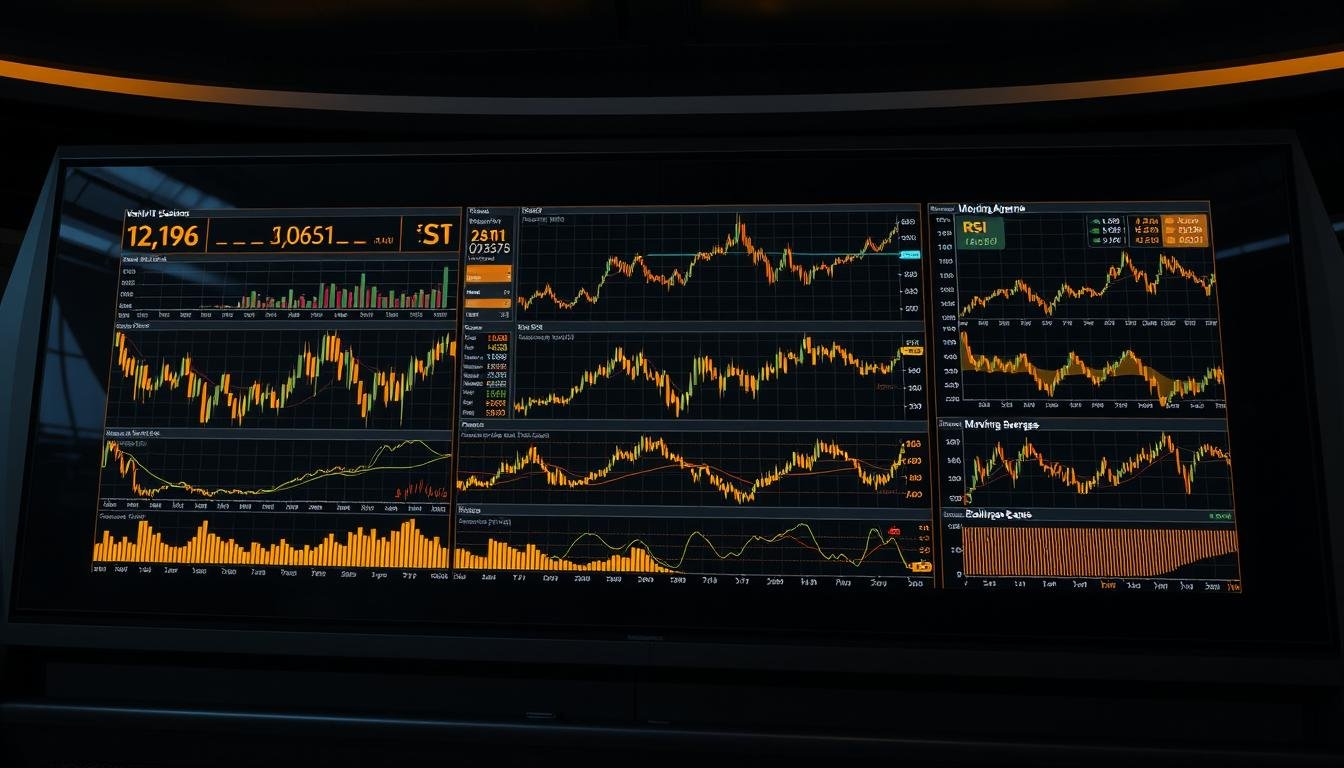
The gold trading world is huge and always moving, with $130 billion traded every day. This shows how popular it is with traders and investors.
When you trade gold, knowing technical indicators is key. They let you see market trends, guess price changes, and make smart choices. Using technical indicators in your strategy can help you grab more market chances.
With the right tools, your trading can get better and maybe even more profitable.
Key Takeaways
- Gold trading is highly liquid with a $130 billion daily volume.
- Technical indicators are crucial for analyzing market trends.
- These indicators help predict price movements and inform trading decisions.
- Incorporating technical indicators can enhance your trading strategy.
- Effective use of technical indicators can lead to more profitable trading.
Understanding the Gold Market Dynamics
To navigate the gold market, you need to grasp its dynamics. Gold is a unique trading asset. It’s influenced by many factors that can greatly affect its price.
Unique Characteristics of Gold as a Trading Asset
Gold is seen as a safe-haven asset. People seek it during economic uncertainty or geopolitical tensions. Its value isn’t tied to any country’s economy, making it a global commodity. Gold’s price can be influenced by its role as both a commodity and a currency.
Factors Influencing Gold Price Movements
Several key factors affect gold price movements. These include geopolitical developments, inflation fears, monetary policy decisions, and physical supply and demand. Knowing these factors is key to using technical indicators well in gold trading.

| Factor | Impact on Gold Price | Example |
|---|---|---|
| Geopolitical Tensions | Increased demand for safe-haven assets | Conflict in major gold-producing countries |
| Inflation Fears | Higher demand for gold as a hedge | Rising inflation rates in major economies |
| Monetary Policy | Interest rate changes affecting gold’s attractiveness | Federal Reserve interest rate decisions |
| Supply and Demand | Physical demand and supply impacting price | Changes in jewelry demand or mining production |
Understanding these dynamics helps you analyze the gold market better. This way, you can make more informed trading decisions.
The Role of Technical Analysis in Gold Trading
Trading gold well means knowing about technical analysis. It’s a way to look at market data to make smart choices. As a gold trader, using technical analysis can really help your strategy.

Fundamental vs. Technical Analysis for Gold
There are two main ways to analyze gold: fundamental and technical. Fundamental analysis looks at gold’s real value based on economic factors. Technical analysis, on the other hand, studies past market data to guess future prices. Technical analysis is great for spotting trends in gold prices.
“The price of gold is determined by the forces of supply and demand, and technical analysis helps traders understand these dynamics.”
Why Technical Indicators Matter for Gold Traders
Technical indicators are key for gold traders. They show market trends, when to buy or sell, and more. Using these indicators can lead to better trading decisions. They offer clear data, spot trends, and warn of market changes.
| Technical Indicator | Function | Benefit for Gold Traders |
|---|---|---|
| Moving Averages | Identify trends | Helps in understanding the direction and strength of the trend |
| Relative Strength Index (RSI) | Measure market momentum | Aids in identifying overbought or oversold conditions |
| Bollinger Bands | Assess volatility | Assists in recognizing potential breakouts or trend reversals |
Using technical analysis and indicators can give you an edge in gold trading. It’s useful for both new and experienced traders. Knowing and using technical analysis can greatly improve your trading results.
Essential Moving Average Indicators for Gold
Moving average indicators are key for traders in the gold market. They help understand market direction and when to buy or sell. You’ll learn about various moving averages and their use in gold trading.
Simple Moving Average (SMA) Applications
The Simple Moving Average (SMA) calculates gold’s average price over time. It’s great for spotting trends and finding support or resistance levels.
Optimal SMA Periods for Gold Markets
Choosing the right SMA period is key. Common periods are 50, 100, and 200 days. Shorter periods react quickly to price changes, while longer periods show the bigger picture.
SMA Crossover Strategies
SMA crossover strategies use two SMAs with different periods. A buy signal happens when a shorter SMA goes above a longer one. A sell signal occurs when the shorter SMA goes below the longer one.
Exponential Moving Average (EMA) Strategies
The Exponential Moving Average (EMA) weighs recent prices more. This makes it quicker to react to new data. EMA is great for catching trends early.
- EMA shows the trend’s strength.
- It’s perfect for short-term trading because it reacts fast to price changes.
Moving Average Convergence Divergence (MACD) for Gold
The MACD is a momentum indicator. It compares two moving averages (usually 12-period and 26-period EMAs). It helps spot buy and sell signals and trend strength.
MACD signals happen when the MACD line crosses the signal line. A bullish crossover is when MACD goes above the signal line. A bearish crossover is when it goes below.
Momentum Indicators for Gold Trading
In the fast-paced world of gold trading, momentum indicators are key. They show the strength and speed of price changes. This helps traders make better choices.
These indicators are also important for spotting when trends might change or keep going in the gold market.
Relative Strength Index (RSI) Analysis
The Relative Strength Index (RSI) is a well-known tool for gold trading. It shows when prices might be too high or too low. RSI values range from 0 to 100.
Levels above 70 usually mean prices are too high, and levels below 30 mean they’re too low.
RSI Divergence in Gold Markets
RSI divergence happens when gold prices and RSI go in opposite directions. This can signal a big change in the trend. For example, if gold prices hit new highs but the RSI doesn’t, it might mean a bearish trend.
RSI Overbought and Oversold Levels for Gold
Traders use RSI levels to find good times to buy or sell. When the RSI drops below 30, it might be a good time to buy. An RSI above 70 could mean it’s time to sell.
Stochastic Oscillator Applications
The Stochastic Oscillator is another important tool for gold traders. It compares gold’s closing price to its price range over time. This helps traders spot trend reversals and confirm trends.
Rate of Change (ROC) Indicator Usage
The Rate of Change (ROC) indicator shows how fast gold prices are changing. It measures the percentage change over a set period. A rising ROC means prices are going up fast, while a falling ROC means they’re going down.
Volume-Based Indicators for Gold Markets
Trading gold? Knowing about volume-based indicators is key. They show the power of price changes by looking at trade volume. This helps you see market mood and predict better.
On-Balance Volume (OBV) Interpretation
On-Balance Volume (OBV) links volume to price changes. It shows buying and selling power, spotting strong or weak trends. A rising OBV with price means a strong uptrend. Falling OBV with price shows a strong downtrend.
Volume Price Trend (VPT) Analysis
The Volume Price Trend (VPT) is like OBV but focuses on price percentage changes. This makes VPT more alert to price shifts. VPT spots volume and price divergences, hinting at reversals.
Using OBV and VPT in your analysis gives a deeper look into gold market trends. Remember, “Volume is the lifeblood of the markets, and ignoring it can lead to poor trading decisions.”
Gold Trend Identification Indicators
To succeed in gold trading, you must learn about trend identification indicators. These tools help you see where gold prices are going. They guide you in making smart trading choices.
Average Directional Index (ADX)
The Average Directional Index (ADX) is key for spotting strong gold price trends. It shows how strong a trend is. If ADX is over 25, the trend is strong. Below 20, it’s weak or gone.
ADX helps you skip trading when prices don’t move much. Instead, you focus on trends with clear directions.
Parabolic SAR Implementation
Parabolic SAR (Stop and Reverse) is great for finding gold trends. It shows dots above or below the price, pointing to when trends might change. Dots below mean the price is going up; dots above mean it’s going down.
You can use Parabolic SAR to set stops and keep profits as trends grow. It’s good for catching most of a trend and cutting losses.
Ichimoku Cloud Analysis for Gold Trends
The Ichimoku Cloud is a detailed tool for spotting trends. It has parts like the Kumo (cloud), showing support and resistance. If the price is above the cloud, it’s going up; below, it’s going down.
The cloud’s thickness shows how strong these levels are. By looking at the Ichimoku Cloud, you can understand trend directions and possible changes in gold.
| Indicator | Purpose | Key Signal |
|---|---|---|
| ADX | Measures trend strength | Above 25: strong trend |
| Parabolic SAR | Identifies trend direction and reversal | Dots below price: uptrend |
| Ichimoku Cloud | Provides comprehensive trend analysis | Price above cloud: uptrend |
Volatility Indicators for Gold Trading
Understanding and using volatility indicators can really help your gold trading. They show you how the market feels and help you make smart choices.
Bollinger Bands Applications
Bollinger Bands are great for gold traders. They show how volatile the market is and where prices might go. They’re made of a moving average and two standard deviations above and below it.
Bollinger Band Squeezes in Gold Markets
A Bollinger Band squeeze happens when the bands get closer together. This means volatility is low, and a big price move might be coming.
Using Bollinger Bands for Gold Price Targets
Traders look at Bollinger Bands to see when prices are too high or too low. If the price hits the upper band, it might be too high. If it hits the lower band, it might be too low.
Average True Range (ATR) Strategies
The Average True Range (ATR) shows market volatility by looking at price movements. It helps set stop-loss levels and understand the market.
| Indicator | Purpose | Application in Gold Trading |
|---|---|---|
| Bollinger Bands | Volatility Measurement | Identifying potential breakouts and overbought/oversold conditions |
| ATR | Volatility Measurement | Setting stop-loss levels and assessing market volatility |
Using these indicators in your trading plan can help you deal with the gold market’s challenges. It makes your trading decisions smarter.
Support and Resistance Indicators for Gold
Understanding support and resistance indicators is key to a good gold trading strategy. These tools help spot levels where gold prices might change direction or stabilize. This knowledge lets you make better trading choices.
Fibonacci Retracement Levels
Fibonacci retracement levels are a favorite among gold traders. They use Fibonacci lines on charts to find support and resistance areas. The levels are 23.6%, 38.2%, 50%, 61.8%, and 78.6%. These numbers come from the Fibonacci sequence and help predict gold price movements.
Pivot Points for Gold Trading
Pivot points are also crucial for gold traders. They’re calculated from the day before’s high, low, and close prices. This gives a base for the day’s trading. Pivot points help find the best times to enter or exit trades, boosting your success.
Oscillator Indicators for Gold Market Analysis
Oscillator indicators are key in gold market analysis. They help spot trading chances by showing market momentum and mood. This makes trading decisions smarter.
Commodity Channel Index (CCI)
The Commodity Channel Index (CCI) tracks price changes against average changes over time. It spots when gold prices are too high or too low. Readings above +100 mean gold is overbought, and below -100, it’s oversold. This info is vital for timing trades.
Williams %R Indicator Applications
The Williams %R indicator looks at the close price against the high-low range. It finds potential reversal points in gold. Below -80 means gold is oversold, a buy signal. Above -20 means it’s overbought, a sell signal.
Using these indicators in your gold trading strategy boosts your market analysis. It leads to better trading decisions.
Combining Multiple Technical Indicators for Gold Trading
To make more money in gold trading, it’s key to know how to mix different technical indicators. This way, you can build a strong trading system. It helps you make better choices.
When you mix indicators, you use their best points and avoid their weak spots. For example, a moving average can show the trend. At the same time, a momentum indicator like the RSI can tell you how strong that trend is.
Creating a Comprehensive Gold Trading System
To build a solid gold trading system, pick indicators that work well together. Here’s how to do it:
- Choose a main trend indicator, like a moving average or the Ichimoku Cloud.
- Add a momentum indicator, such as the RSI or Stochastic Oscillator, to check the trend’s strength.
- Include a volatility indicator, like Bollinger Bands, to see how the market is doing.
By stacking these indicators, you get a deeper view of the gold market. This helps you predict more accurately.
Avoiding Indicator Redundancy
It’s also vital to not repeat yourself with indicators. Too many similar indicators can confuse you. To avoid this:
- Pick indicators that do different things, like spotting trends, measuring momentum, and checking volatility.
- Check your indicators often to make sure they still fit your trading plan.
- Don’t overdo it by using too many indicators at once.
By carefully mixing technical indicators and avoiding too much repetition, you can build a strong gold trading system. This system will improve your trading results.
Chart Patterns in Gold Technical Analysis
Understanding chart patterns can greatly improve your gold trading strategy. These patterns show price movements on a chart. They help spot when trends might change or keep going.
By recognizing these patterns, you can make better trading choices in the gold market.
Reversal Patterns for Gold
Reversal patterns signal when the market trend might change. Knowing these patterns helps you know when to buy or sell.
Head and Shoulders Patterns in Gold Charts
The Head and Shoulders pattern is a key reversal sign. It has a peak (the head) and two smaller peaks (the shoulders). This pattern shows a possible shift from an upward to a downward trend.
Double Tops and Bottoms are also reversal signs. A Double Top means the price hits a high twice before falling, showing a bearish reversal. On the other hand, a Double Bottom hints at a bullish reversal.
Continuation Patterns in Gold Markets
Continuation patterns suggest the trend will likely keep going. They help you stay in winning trades longer.
Patterns like triangles, wedges, and flags are common. For example, a Bullish Flag pattern means a short pause in an uptrend before it goes up again.
Timeframe Considerations for Gold Technical Indicators
Choosing the right timeframe for gold technical indicators is crucial. These tools work differently for short-term moves versus long-term trends. Your choice can greatly affect your trading decisions.
Short-term vs. Long-term Indicator Settings
Settings for technical indicators should match your trading goals. Short-term traders need indicators with short timeframes to catch fast price changes. Long-term investors prefer longer timeframes to see the big picture and smooth out volatility.
For example, day traders might use a 15-minute chart with a short-term moving average. Long-term investors might choose a daily or weekly chart with a longer-term moving average.
Multi-timeframe Analysis Techniques
Using multiple timeframes can strengthen your trading signals. It gives a broader view of the market. Trends seen on short-term charts might be part of a larger trend on longer-term charts.
| Timeframe | Indicator Setting | Trading Use |
|---|---|---|
| Short-term (15-minute) | Short-term MA (e.g., 50-period) | Day trading, capturing quick movements |
| Medium-term (Daily) | Medium-term MA (e.g., 100-period) | Swing trading, identifying intermediate trends |
| Long-term (Weekly) | Long-term MA (e.g., 200-period) | Long-term investing, focusing on major trends |
Common Mistakes When Using Technical Indicators for Gold
When trading gold, knowing common mistakes is key. Technical indicators are great tools, but they need to be used carefully. This helps you make more money in your trades.
Overreliance on Single Indicators
Putting all your faith in one indicator can lead to bad choices. For example, just using the Relative Strength Index (RSI) without checking other signs can cause wrong buy or sell signals. Diversifying your indicators gives a clearer view of the market. Mix trend indicators like Moving Averages with momentum ones like the Stochastic Oscillator.
Ignoring Market Context and Fundamentals
Not looking at the big picture and ignoring fundamentals can mess up your trades. Use technical indicators with an eye on market basics, like economic news and global events. A technical signal might not be right if fundamentals show a downturn. Always consider the bigger picture to make sure your trades are sound.
Advanced Gold Trading Strategies Using Technical Indicators
Exploring gold trading, you’ll find advanced technical indicators boost your strategies. It’s key to know and use these tools well to increase your earnings.
Divergence Trading Techniques
Divergence trading spots when price and indicator signals don’t match. For example, if gold’s price hits new highs but the Relative Strength Index (RSI) doesn’t, it might signal a change. This helps you make smarter trading choices.
Breakout Trading Strategies
Breakout trading looks for key support and resistance levels. When gold price crosses these levels, it shows a big trend change. Tools like Bollinger Bands and Average True Range (ATR) help measure these breakouts, guiding your trades.
Trend-Following Methods for Gold
Trend-following uses indicators to track market trends. Tools like the Moving Average Convergence Divergence (MACD) and Ichimoku Cloud keep you in sync with the market. This way, you can gain more while taking less risk.
Adding these advanced strategies to your gold trading arsenal prepares you for the market’s challenges. It helps you make better investment choices.
Conclusion: Mastering Technical Indicators for Gold Trading Success
You’ve learned about the technical indicators that can boost your gold trading strategy. Mastering these tools is key to success in gold trading. By knowing and using indicators like moving averages and momentum, you can make better trading choices.
Remember, no single indicator is perfect. The best strategy is to use several indicators together. This way, you can spot trends, predict changes, and manage risks better.
Keep working on your trading skills. Learning about technical indicators is a continuous journey. Stay updated on market news and adjust your strategy when needed. With time and effort, you can get better at trading and reach your financial goals.
Using these techniques will help you understand the gold market better. Your path to success in gold trading begins with knowing technical indicators well. Keep learning and growing in your trading journey.