You’ve probably seen that gold prices have been going up. It’s not just a random trend. Global tensions are making prices climb, turning gold into a key asset when things are uncertain.
Governments worldwide are buying up gold for their strategic reserves. They see gold as a safe place to put their money when the world is in chaos. As tensions rise, gold’s value goes up, making it a smart choice for investors.
Key Takeaways
- Geopolitical events significantly impact gold prices.
- Rising global tensions lead to increased demand for gold.
- Governments stockpile gold as a strategic reserve during uncertain times.
- Gold is considered a safe-haven asset during geopolitical turmoil.
- Investors should consider gold as a crucial asset in their portfolios.
The Fundamental Relationship Between Global Politics and Precious Metals
Gold’s value has always been linked to global politics. It acts as a safe haven when political situations are uncertain or unstable. This connection helps investors understand the complex global markets better.
The Historical Safe Haven Status of Gold
Gold has been a reliable value store during global crises. Its performance during major conflicts shows its stability.
Gold’s Performance During Major 20th Century Conflicts
In the 20th century, gold proved its worth as a safe haven. For example, during World War II, gold prices stayed steady despite economic chaos.
- World War I: Gold prices rose as investors sought safe havens.
- World War II: Gold remained a stable store of value.
- Cold War: Periodic tensions led to increased gold demand.
Currency Collapse Scenarios and Gold Stability
When currencies fail, gold keeps its value. This pattern is seen in many economic crises.
| Event | Gold Price Before | Gold Price After | Change |
|---|---|---|---|
| 1971 Nixon Shock | $35/oz | $38/oz | +8.6% |
| 2008 Financial Crisis | $800/oz | $900/oz | +12.5% |
| 2020 COVID-19 | $1,500/oz | $2,000/oz | +33.3% |
The table shows gold’s value has stayed strong or grown during big events. This makes it a solid choice in uncertain times.

Market Mechanics: How Geopolitical Events Trigger Gold Price Movements
Geopolitical events can cause big changes in gold prices. Tensions can shake global markets, changing how investors act and affecting gold’s value. It’s key for investors to grasp these shifts in the gold market.
Supply Chain Disruptions and Mining Impacts
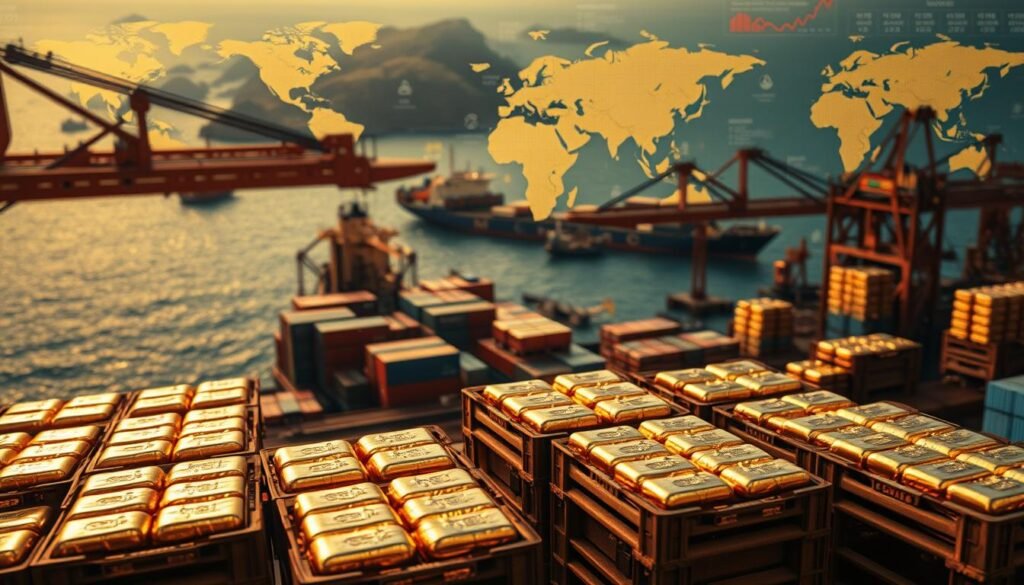
Geopolitical events can mess up gold supply chains. This can close mines or make mining hard, cutting gold supply and raising prices.
Investor Psychology During Global Crises
When global crises hit, investors look for safe places like gold. This demand can push gold prices up. The fear and uncertainty of crises greatly influence investor choices.
Currency Devaluation Effects on Gold Valuation
Currency devaluation, caused by global tensions, makes gold more appealing. When currencies lose value, gold becomes a better choice against inflation and currency loss.
Dollar Strength Correlation
The US dollar’s value has a big impact on gold prices. When the dollar gets stronger, gold costs more for foreign buyers. This can lower demand and prices.
Emerging Market Currency Collapse Scenarios
When emerging market currencies fail, gold becomes even more attractive. Investors moving away from devalued currencies often buy gold, increasing its price.
| Geopolitical Event | Impact on Gold Supply | Effect on Gold Price |
|---|---|---|
| Political instability in gold-producing countries | Reduced gold supply due to mine closures | Increase in gold price |
| Currency devaluation | No direct impact | Increase in gold price as investors seek safe-haven |
| Dollar strength | No direct impact | Decrease in gold price due to reduced demand |
Gold as the Ultimate Geopolitical Barometer
Gold has always been seen as a sign of global tensions. Its value changes with world conflicts. It’s a safe place for investors when things get uncertain, showing how stable the market is.
Key Metrics for Tracking Gold Performance During Crises
To track gold’s performance in crises, look at these key metrics:
- Price Volatility: This shows how much gold prices swing, revealing market mood.
- Trading Volume: Looking at how much gold is traded gives clues on investor actions in tough times.
- Correlation with Other Assets: Seeing how gold relates to other safe assets helps spread out risk.
Comparing Gold to Other Safe Haven Assets
Gold’s value compared to other safe assets like bonds, Swiss Franc, and Japanese Yen is key. In times of global tension, these assets often move together. But, their performance can change based on the crisis type.
Treasury Bonds vs. Gold During Conflicts
Treasury bonds are safe, but gold beats them in some conflicts. Gold’s real value and history make it stand out.
Swiss Franc and Japanese Yen Comparisons
The Swiss Franc and Japanese Yen are also safe choices. Yet, their crisis performance can differ from gold. This is due to central bank actions and currency shifts.
Knowing these differences helps investors make better choices in uncertain times.
Historical Analysis: Major Geopolitical Flashpoints and Their Gold Price Impact
To understand how geopolitical events affect gold prices, we must look at past flashpoints. These events have greatly influenced the market. By studying them, we can predict how gold prices might react to future tensions.
The 1970s Oil Crisis and Gold Standard Abandonment
The 1970s oil crisis caused a big jump in gold prices. This was partly because the gold standard was abandoned. As the U.S. dollar’s value dropped, investors turned to gold. This made gold prices go up.
Gulf War Price Movements
During the Gulf War, gold prices soared. This was because of the uncertainty in the global oil market. It showed gold’s role as a safe-haven asset.
9/11 and Its Aftermath
The 9/11 attacks made gold prices jump. Investors sought safe assets as global uncertainty grew.
2008 Financial Crisis Gold Surge
In 2008, gold prices surged during the financial crisis. Investors lost faith in financial markets. They turned to gold as a safe-haven.
Brexit Referendum Aftermath
The 2016 Brexit referendum caused a short-term gold price rise. Investors were uncertain about the UK’s EU exit.
Looking at these events, we see a pattern. During geopolitical tensions, gold prices tend to rise. Investors seek safe assets. The table below shows how these events affected gold prices:
| Event | Gold Price Before | Gold Price After | % Change |
|---|---|---|---|
| 1970s Oil Crisis | $35/oz | $180/oz | +414% |
| Gulf War | $350/oz | $390/oz | +11% |
| 9/11 | $270/oz | $320/oz | +19% |
| 2008 Financial Crisis | $800/oz | $1,900/oz | +138% |
| Brexit Referendum | $1,060/oz | $1,360/oz | +28% |
By understanding gold’s past reactions to geopolitical events, we can better prepare for future market changes.
Middle East Conflicts: A Persistent Driver of Gold Market Volatility
The Middle East is a key area for geopolitical tensions. These tensions greatly affect the gold market. The region’s ongoing conflicts and political instability impact global financial markets, making gold a safe choice.
Arab Spring Economic Consequences
The Arab Spring protests in 2010 had big economic effects. They affected not just the countries involved but the whole world. As political instability grew, investors turned to gold, pushing its price up.
“The turmoil in the Middle East and North Africa during the Arab Spring led to a significant increase in gold prices as investors looked for safe havens,” notes a financial analyst.
Iran Nuclear Deal Negotiations and Price Fluctuations
Debates over Iran’s nuclear deal have greatly influenced gold prices. Tensions with Iran and other countries raise geopolitical risks. This makes investors buy more gold.
Recent Israel-Palestine Tensions
Recent tensions in Israel-Palestine have also made gold prices more volatile. The risks from these conflicts push investors towards gold.
Supply Route Disruptions
Conflicts in the Middle East often disrupt supply routes. This affects the global economy. Such instability can make gold prices go up as investors worry about economic downturns.
Regional Investment Patterns
The Middle East conflicts also shape how investors act in the region. When tensions are high, investors there often choose gold. This choice drives gold prices up.
Key Takeaway: The Middle East’s ongoing conflicts are a big reason for gold market volatility. Knowing how these conflicts affect the market can help investors make better choices.
Russia-Ukraine War: A Case Study in Modern Conflict’s Impact on Gold
The Russia-Ukraine conflict is a major geopolitical flashpoint affecting gold prices globally. As tensions rise, investors flock to gold, boosting demand and prices.
Initial Market Reaction to the Invasion
When Russia invaded Ukraine, gold prices jumped sharply. Investors turned to gold for safety, fearing broader conflict. This surge in demand pushed prices up, showing the market’s fear.
“The invasion led to a immediate flight to safety, with gold prices rising as investors sought to hedge against the geopolitical uncertainty,” notes a market analyst.
Long-term Price Trend Analysis
Looking at long-term trends, gold’s appeal remains strong. The ongoing conflict and sanctions on Russia kept investors cautious, supporting gold prices.
This trend highlights gold’s role as a reliable store of value during tense times.
Sanctions Impact on Global Gold Trading
The sanctions on Russia affected global gold trading in several ways:
- Russian Gold Export Restrictions
- Alternative Payment Systems Development
Russian Gold Export Restrictions
Restrictions on Russian gold exports cut global gold supply, possibly raising prices. This was part of economic sanctions to limit Russia’s war funding.
Alternative Payment Systems Development
Russia started working on new payment systems to get around SWIFT sanctions. This could change the gold market, making it less dependent on traditional currencies.
“The development of alternative payment systems could lead to a more de-dollarized gold market, with significant implications for global trade and finance,” according to a financial expert.
As the conflict goes on, watching its effect on gold prices is key for investors. The Russia-Ukraine war is a key example of how conflicts shape the gold market.
US-China Relations: Trade Tensions and Their Gold Market Consequences
The complex dynamics of US-China relations have far-reaching consequences for gold investors worldwide. As trade tensions between these two global powers escalate, the gold market reacts with significant price movements.
Tariff Wars and Resulting Price Movements
The imposition of tariffs by both countries has led to increased uncertainty in global markets. This uncertainty prompts investors to seek safe-haven assets like gold. This flight to safety has driven gold prices higher, as investors look to hedge against potential losses stemming from the trade war.
Technology Restrictions and Economic Uncertainty
Restrictions on technology transfers and the ongoing competition in tech innovation have added another layer of complexity to US-China relations. This has created economic uncertainty, causing investors to flock to gold as a reliable store of value.
Taiwan Situation as a Potential Flashpoint
The Taiwan situation remains a potential flashpoint in US-China relations. Any escalation in tensions could lead to significant market volatility. Gold is likely to benefit as a safe-haven asset.
Military Posturing Effects on Investor Sentiment
Military posturing in the region can heighten investor anxiety. This leads to increased demand for gold.
Regional Gold Buying Patterns
Regional gold buying patterns may also shift in response to escalating tensions. Investors in the Asia-Pacific region may drive demand.
Understanding these dynamics is crucial for gold investors. They need to navigate the complex landscape of geopolitical tensions and their impact on the gold market.
Central Bank Gold Reserves: Strategic Responses to Geopolitical Instability
Central banks around the world are adding to their gold reserves. This is a smart move to spread out their investments and protect against risks. These risks come from unstable global politics.
National Reserve Building Trends
Gold accumulation by central banks is on the rise. They want to lessen their reliance on the US dollar. This is clear in the growing gold reserves of banks globally.
| Country | Gold Reserves (Tonnes) | Change |
|---|---|---|
| United States | 8,133.5 | +0.5% |
| Germany | 3,363.4 | +1.2% |
| Italy | 2,451.8 | +0.8% |
De-dollarization Movements
Geopolitical tensions are pushing central banks to reduce their dollar holdings. They are buying more gold. This helps them avoid the risks of dollar value drops or sanctions.
“The role of gold in central banks’ reserves is becoming increasingly important as a hedge against geopolitical risks and currency devaluation.”
BRICS Nations’ Gold Acquisition Strategies
BRICS countries are boosting their gold reserves. This is part of their plan to lessen their dollar dependence and improve financial stability.
Russian Central Bank Accumulation
The Russian Central Bank is leading in gold accumulation. Over the last decade, it has significantly increased its gold reserves. This move helps Russia diversify its assets and avoid economic sanctions.
Chinese Reserve Diversification
China is also buying gold, but at a slower pace. The People’s Bank of China is growing its gold reserves. This supports China’s efforts to diversify its vast foreign exchange reserves.
As global politics remains unstable, central banks’ gold reserve strategies are key. They help manage risks and ensure financial stability.
Investment Vehicles: How Gold ETFs and Futures React to Global Flashpoints
Gold ETFs and futures show us how investors act when global tensions rise. These tools help investors protect their money when things get uncertain.
Trading Volume Analysis During Crisis Periods
When global crises hit, gold ETFs and futures see a lot of trading. This means more money moving around, but it can also make prices swing wildly.
Price Premium Patterns and Arbitrage Opportunities
Geopolitical events can make gold ETFs and futures prices go up. This creates chances for smart investors to make money by finding the right trades.
Institutional vs. Retail Investor Behavior
Institutional investors and retail investors react differently to global events. Knowing these differences helps us understand the market better.
Flight to Quality Phenomena
When global stress increases, investors look for safe places to put their money. Gold is often the go-to, causing big price swings in gold ETFs and futures.
Liquidity Considerations During Market Stress
Liquidity is key when markets are stressed. Gold ETFs and futures usually have a lot of liquidity. But, extreme events can make it hard to trade without affecting prices.
Understanding how gold ETFs and futures react to global crises helps investors. It lets them make smarter choices in these complex markets.
Predictive Frameworks: Anticipating Gold Price Movements During Political Unrest
The link between global tensions and gold prices is intricate. It needs advanced predictive tools. Investors need reliable methods to forecast gold price movements and make smart choices.
Leading Economic Indicators for Gold Investors
Leading economic indicators are key for predicting gold prices. They include inflation rates, GDP growth, and unemployment rates. By studying these, investors can understand the economy’s health and how it might affect gold prices.
Geopolitical Risk Indices and Their Reliability
Geopolitical risk indices measure global tensions and their market impact. They combine factors like conflict risks, terrorism, and political instability. Investors use these to assess geopolitical risk and adjust their strategies.
Social Media Sentiment Analysis as an Emerging Tool
Social media sentiment analysis is growing in importance. It helps investors understand market mood and predict price shifts by analyzing social media and news.
Real-time Data Sources
Real-time data is vital for sentiment analysis. It includes social media, news, and financial databases. Real-time data helps investors quickly react to trends and political unrest.
Algorithmic Trading Responses
Algorithmic trading systems quickly respond to market changes and geopolitical events. They use advanced algorithms to analyze data and make fast trades. This allows investors to profit from gold price movements.
| Indicator | Description | Impact on Gold Prices |
|---|---|---|
| Inflation Rate | Measures the rate of inflation in the economy | High inflation typically increases gold prices |
| Geopolitical Risk Index | Quantifies geopolitical tensions and risks | Increased geopolitical risk often boosts gold prices |
| Social Media Sentiment | Analyzes market sentiment through social media | Positive sentiment can drive prices up, negative sentiment can drive prices down |
Using these predictive tools, investors can better predict gold price movements during political unrest and geopolitical risk. This helps them make informed decisions and handle complex markets.
Current Global Flashpoints on the Gold Investor’s Radar
Geopolitical instability can really sway gold prices. Let’s look at the current hotspots. For gold investors, knowing about global tensions is key to smart decisions.
Indo-Pacific Military Tensions
The Indo-Pacific is a big worry spot due to rising military tensions. Conflicts here could mess up global trade and gold supply chains. Escalating tensions between major powers in this area are really something to watch.
North Korean Nuclear Ambitions
North Korea’s nuclear plans are a big worry for global markets. The chance of conflict in Korea is a big worry for gold investors. It could make people want safe assets more.
European Energy Security Vulnerabilities
Europe’s energy security is a big concern, thanks to the Ukraine conflict. Energy supply disruptions can hurt the economy and gold prices. Energy security is key to global economic stability.
African Political Instability and Resource Nationalism
Africa is full of gold, but political instability is a risk. Resource nationalism is growing, which could change mining rules and affect gold production.
Mining Operation Disruptions
Political instability can mess up mining, affecting gold supply. Countries with lots of gold mining are most at risk.
Supply Chain Vulnerabilities
Gold supply chains are complex and can be disrupted by political instability and logistics issues. Knowing these risks is important for predicting gold price changes.
As a gold investor, knowing about these global flashpoints helps you make better choices. By keeping up with geopolitical news, you can guess how gold prices might change. This lets you adjust your investment plans.
Protective Strategies: Safeguarding Your Gold Investments During Global Crises
Global uncertainties are changing the economy. Protecting your gold investments is more important than ever. You must act now to keep your assets safe during hard times.
Portfolio Diversification Techniques
Diversifying your portfolio is key to managing risk. For gold investments, think about how much of your portfolio should go to gold and other precious metals.
Optimal Allocation Percentages
Finding the right amount of gold in your portfolio depends on your financial goals and how much risk you can take. A good starting point is to put 5% to 15% of your portfolio in gold. This balance helps you enjoy gold’s benefits without risking too much.
Correlation Analysis with Other Assets
It’s important to know how gold relates to other assets in your portfolio. Gold often goes up when stocks and other risky assets go down. Checking this regularly helps keep your portfolio balanced.
Hedging Strategies Using Options and Futures
Hedging is a strategy to protect your investments. It uses options and futures to reduce potential losses. By using these tools, you can protect your gold investments.
Physical vs. Paper Gold Considerations
When investing in gold, you must choose between physical gold and paper gold (like ETFs and futures). Each option has its own pros and cons.
Storage and Security Solutions
If you pick physical gold, you need to think about where to store it. Safe deposit boxes at banks and vaulting services are common choices. Make sure your storage is insured and secure.
Liquidity Trade-offs
Paper gold is more liquid but might have higher fees and risks. It’s important to understand these differences to make the best choice for you.
Using these strategies can help protect your gold investments. This way, you can face global crises with more confidence.
The Evolution of Gold’s Role in a Changing Geopolitical Landscape
Gold’s role in the global economy is changing due to new trends and shifts in politics. Understanding what affects gold’s value is key to smart investing.
Digital Gold and Cryptocurrency Competition
Digital assets, like cryptocurrencies, are challenging gold’s status as a safe investment. You might wonder how these new assets compare to gold. Gold’s long history and real value still attract many investors, despite the rise of digital assets.
When looking at digital gold and cryptocurrencies, consider their regulation, volatility, and adoption. These factors are crucial when choosing where to invest.
Climate Change as an Emerging Geopolitical Factor
Climate change is now a big player in global politics, affecting economic stability and gold prices. Climate events can disrupt gold mining, which might change gold’s value.
As climate concerns grow, investing in green gold mining could become more appealing. This could shape gold’s future demand and its place in your portfolio.
Changing Central Bank Policies and Reserve Diversification
Central banks are changing how they diversify their reserves, which affects gold demand. Some banks are adding gold to their reserves as part of a move away from the US dollar.
Basel III Implications
Basel III rules have made it harder for banks to hold gold, which could change market liquidity. Knowing about these rules helps predict future market trends.
Central Bank Digital Currencies Impact
Central Bank Digital Currencies (CBDCs) could change global finance, possibly altering gold’s role. Thinking about how CBDCs might affect gold is important.
By keeping up with these changes, you can make better choices for your gold investments.
Conclusion
Geopolitical flashpoints greatly affect gold prices. It’s key to understand these impacts when planning your investments. Keeping up with global events and using protective strategies helps you make better choices for your gold investments.
Historical events, like conflicts in the Middle East and trade tensions, have shaped gold prices. Knowing this helps you predict market changes and adjust your investments.
To protect your investments, diversify your portfolio and use hedging strategies. Staying informed about geopolitical news lets you quickly respond to changes in the gold market.