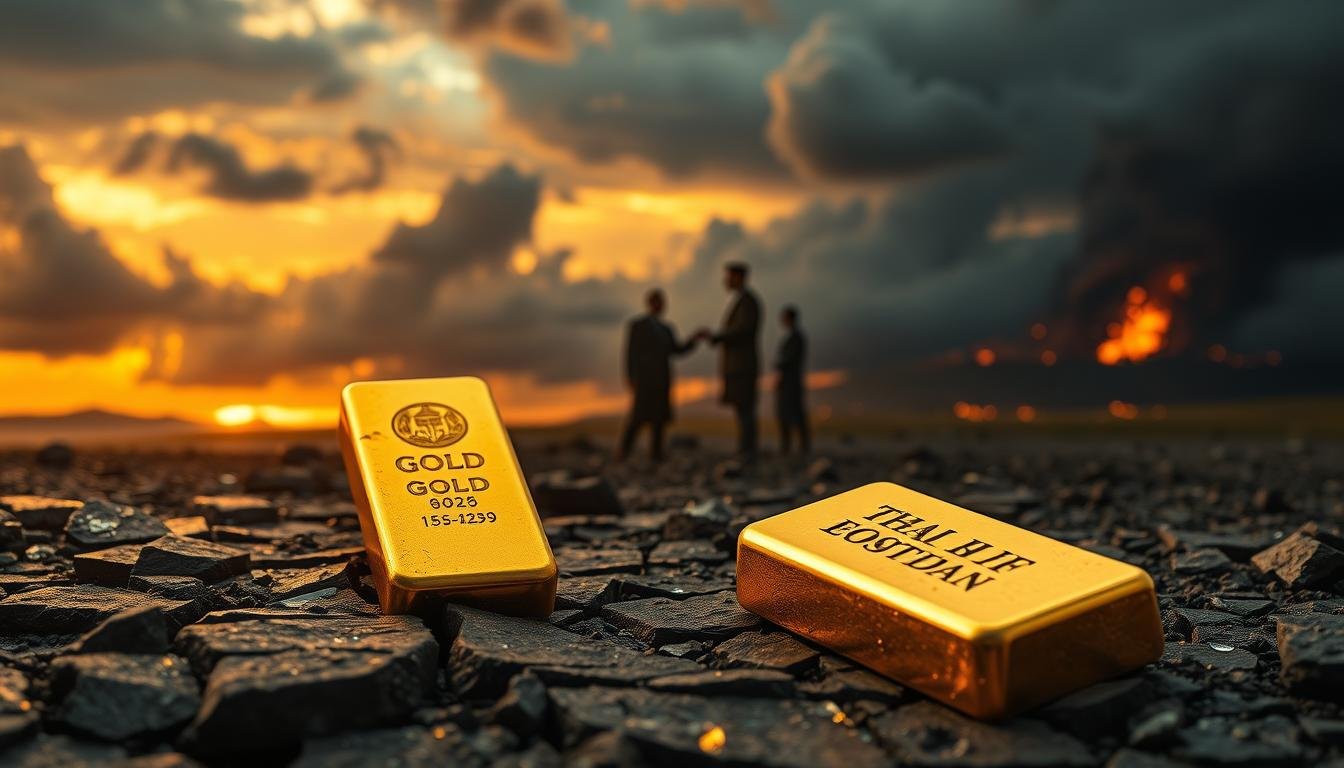
Have you noticed global tensions rising? It’s not just news headlines; it’s real and affecting financial markets. One big impact is on gold prices. Governments are buying more strategic reserves because of these tensions, making gold prices go up.
“The trend is your friend,” and it’s true for gold. As tensions worldwide grow, gold prices climb. You might ask why gold reacts so much to global issues. It’s because gold has always been a safe place to put money, even in times of war. Knowing this can help you understand the financial world better.
Key Takeaways
- Geopolitical tensions are driving gold prices higher.
- Governments are stockpiling gold as strategic reserves.
- Gold is considered a safe-haven asset during geopolitical uncertainty.
- The trend for gold has been upward due to global tensions.
- Understanding gold’s role can help in navigating financial markets.
Gold as a Safe-Haven Asset in Times of Crisis
Gold’s appeal as a safe-haven asset comes from its past performance in tough times. You might ask why gold is so attractive when things are uncertain. The reason is its ability to keep its value when others don’t.

The Historical Role of Gold in Economic Uncertainty
Gold has always been a shield against bad economic times and inflation. When the economy is down, people turn to gold because it usually keeps its worth. For example, in the 1970s, gold prices went up when inflation and economic troubles were high. This history shows gold’s role as a trusted safe-haven.
Why Investors Turn to Gold During Geopolitical Tensions
When global tensions increase, investors look for safe places to keep their money. Gold is often their first choice because it’s seen as a stable value. The comfort of owning gold in uncertain times is big. Investors think gold will do well even when other investments suffer from global issues.
In short, gold’s past success and its seen stability make it a good choice in times of global tensions and economic uncertainty. Knowing this can help you make better investment choices.
Understanding the Gold-Geopolitics Connection
It’s key for investors to know how geopolitics affects gold prices. This knowledge helps in making smart choices in uncertain markets. The shift from a single world leader to a multipolar world has made gold and other precious metals more valuable as safe havens.

The Psychological Factors Driving Gold Investment
Gold investment is driven by psychological factors, mainly during uncertain times. When global tensions rise, investors turn to gold as a safe choice. This is because of risk aversion, as they aim to safeguard their wealth.
- Fear of loss
- Uncertainty about the future
- Desire for stability
These factors boost gold demand, pushing its price up. Knowing these psychological drivers can help you make better gold investment choices.
Risk Aversion and Precious Metals Markets
Risk aversion is crucial in precious metals markets, more so during global tensions. As tensions grow, investors become more cautious, leading to more gold investment. This move is not just about avoiding risk but also about spreading investments to include assets that do well in crises.
Key aspects of risk aversion include:
- Increased demand for safe-haven assets
- Reduced investment in riskier assets
- Portfolio diversification
Understanding risk aversion’s impact on precious metals markets helps you navigate gold investment better during global uncertainties.
How Geopolitical Events Trigger Market Volatility
Geopolitical instability can send shockwaves through financial markets, leading to increased volatility. You need to understand this dynamic to navigate the complex world of global investments.
The Ripple Effect of Political Instability on Financial Markets
Political instability can have a ripple effect on financial markets. It influences investor sentiment and asset prices. When tensions rise, investors often seek safe-haven assets, such as gold, driving up their prices.
This reaction is not limited to the immediate region of conflict. It can have far-reaching implications across global markets.
The key factors driving this ripple effect include:
- Escalation of conflicts or tensions
- Uncertainty surrounding political outcomes
- Potential disruptions to global supply chains
Measuring Market Sentiment During Global Crises
Measuring market sentiment during global crises is crucial for investors. Market sentiment can be gauged through various indicators. The VIX index measures volatility, and gold prices often rise during uncertainty.
As noted by a financial expert,
“In times of geopolitical stress, gold repricing occurs, forming new equilibrium levels on the charts.”
This observation highlights the importance of monitoring gold prices. They act as a barometer of market sentiment during geopolitical flashpoints.
Types of Geopolitical Flashpoints That Impact Gold
It’s important to know how different global events affect gold prices. Events like military conflicts, trade wars, political changes, and terrorism play big roles. These happenings make markets uncertain, leading investors to gold as a safe choice.
Military Conflicts and Gold Price Movements
Military conflicts can push gold prices up. When countries or regions are at odds, investors get cautious. They look for safe places to put their money, like gold. For example, the Ukraine-Russia conflict has raised geopolitical uncertainty, making gold more valuable.
Keep an eye on these conflicts. They can greatly affect gold markets.
Trade Wars and Economic Sanctions
Trade wars and sanctions also impact gold prices. When countries trade blows, it creates economic doubt. This can shake markets. The U.S.-China trade tensions, for instance, have made gold more appealing as a safe asset.
Stay updated on these issues. They help shape your investment plans.
Political Regime Changes and Elections
Political shifts and elections can sway gold prices too. Uncertainty around elections or regime changes can cause market jitters. For example, big elections or political shake-ups in key places can push investors towards gold.
Watch global politics closely. They can sway gold prices.
Terrorism and Regional Instability
Terrorism and regional instability also affect gold prices. Terrorism or growing unrest, like in the Middle East, can make markets uncertain. This uncertainty drives investors to gold.
Be aware of these risks. They can impact your gold investments.
Understanding these geopolitical flashpoints helps you navigate gold price changes. This knowledge aids in making better investment choices.
The Mechanics of Gold Price Fluctuations During Crises
The link between global conflicts and gold price changes is complex. It involves many factors. Knowing these can help you understand the gold market better.
Supply and Demand Dynamics in Uncertain Times
Geopolitical crises change how gold supply and demand work. Investors often look for safe assets like gold. This increased demand can push prices up.
On the other side, tensions can stop gold mining. This can limit supply and affect prices.
Gold recycling and central bank actions also play a part. In uncertain times, some sell gold, while others buy. This changes demand.
Central Bank Responses to Geopolitical Tensions
Central banks are key in handling global tensions. Their moves can greatly influence gold prices. They have been buying gold to diversify their reserves.
This buying is often to lessen reliance on the US dollar. As tensions grow, central banks might buy more gold. This increases demand and prices. Keep an eye on what central banks do and say.
Historical Analysis: Major Geopolitical Events and Gold Performance
Gold has always been key during big world crises. Looking at how gold acted in major events can teach us a lot.
The 1970s Oil Crisis and Gold Surge
In the 1970s, the oil crisis made gold prices soar. As oil prices went up, so did inflation and doubts about the US dollar. This made investors flock to gold. Gold’s price jumped from $35 an ounce in 1970 to $850 by 1980. It showed gold’s value as a safe place during tough times.
Post-9/11 Market Reactions
After 9/11, gold prices quickly rose. People wanted safe investments, and gold was it. Gold went from $271 an ounce in 2001 to $417 by 2003. This showed gold’s role in times of fear and uncertainty.
The 2008 Financial Crisis as a Geopolitical Event
In 2008, gold did well, going from $800 an ounce to $1,900 by 2011. The financial crisis made many investors choose gold. It proved gold’s worth during global economic troubles.
The Russia-Ukraine Conflict and Gold Markets
The 2022 Russia-Ukraine conflict made gold prices jump. Gold hit $2,070 an ounce in March 2022. This showed gold’s importance as a safe investment during global tensions.
| Event | Gold Price Before | Gold Price After | Percentage Change |
|---|---|---|---|
| 1970s Oil Crisis | $35 (1970) | $850 (1980) | +2,329% |
| Post-9/11 | $271 (2001) | $417 (2003) | +54% |
| 2008 Financial Crisis | $800 (2008) | $1,900 (2011) | +138% |
| Russia-Ukraine Conflict | $1,800 (2021) | $2,070 (2022) | +15% |
Gold has always done well in big world events. Knowing this can help you make better investment choices.
Regional Conflicts and Their Varying Impact on Gold Prices
The link between regional conflicts and gold prices is intricate. Various elements play a role in gold’s price changes during crises. Different regions affect gold prices differently, based on their geopolitical and economic roles.
Regional conflicts can push gold prices up because gold is seen as a safe haven. But, how much this happens depends on the region and the conflict’s nature.
Middle East Tensions and Oil-Gold Correlations
Tensions in the Middle East, where major oil producers are involved, can greatly affect gold prices. This is because oil and gold prices often move together when there’s geopolitical uncertainty. Both are considered safe assets.
- The Iran nuclear deal tensions have historically driven gold prices up.
- Conflicts in the region can disrupt oil supplies, further influencing gold prices.
- The interplay between oil and gold is complex, with both commodities often moving in tandem during crises.
Asian Geopolitical Disputes and Market Reactions
Asian geopolitical disputes, like tensions between major powers or conflicts in key areas, can also affect gold prices. Market reactions to these disputes are often based on risk perceptions and the potential for economic impact.
- The South China Sea disputes have the potential to escalate tensions and affect gold prices.
- North Korea-related tensions have historically led to safe-haven buying, including gold.
- The economic interdependence of Asian nations means that regional conflicts can have far-reaching effects on global markets, including gold.
Understanding these dynamics is key for investors trying to grasp the complex relationship between regional conflicts and gold prices.
The Relationship Between Gold and Other Safe-Haven Assets
Gold is often seen as a safe-haven asset. But how does it compare to other safe-havens like U.S. Treasury Bonds and cryptocurrencies? This is important during times of geopolitical uncertainty.
Gold’s value isn’t tied to any country’s promises. This makes it attractive for investors looking to diversify their portfolios during tough times.
Gold vs. U.S. Treasury Bonds During Political Crises
When tensions rise, both gold and U.S. Treasury Bonds attract investors seeking safety. But they react differently to political crises. U.S. Treasury Bonds are seen as more liquid and less volatile than gold. Yet, gold’s value isn’t tied to any government’s creditworthiness, making it unique.
| Characteristics | Gold | U.S. Treasury Bonds |
|---|---|---|
| Liquidity | High, but can be affected by market conditions | Very High |
| Volatility | Can be volatile during crises | Generally less volatile |
| Dependency on Government Creditworthiness | No | Yes |
Gold and U.S. Treasury Bonds have their pros and cons. Your choice depends on your investment goals and risk tolerance.
Cryptocurrencies as Alternative Safe Havens
Cryptocurrencies, like Bitcoin, have become potential safe-havens. But their volatility and new status in finance make them more speculative than gold.
“Bitcoin is not a safe-haven asset in the traditional sense, but it can be seen as a digital store of value that operates independently of traditional financial systems.”
Cryptocurrencies offer a decentralized option to traditional safe-havens. But their adoption and stability are still being tested. It will be interesting to see how they compare to gold and other safe-havens in future crises.
Analyzing Gold Market Trends During Prolonged Conflicts
Prolonged conflicts deeply affect gold market trends. As an investor, it’s key to understand how these tensions impact gold prices. The usual state is one of stress, not calm, so knowing the dynamics is crucial.
Short-term vs. Long-term Price Movements
When conflicts start, gold prices often jump up because it’s seen as a safe place. In the short term, gold prices can swing wildly, reacting to news fast. But over time, the market settles, influenced by the conflict’s intensity, the world’s economy, and central bank moves. Key factors include the conflict’s severity, global economic health, and central bank actions.
- Intensity of the conflict: More severe conflicts tend to have a greater impact on gold prices.
- Global economic conditions: Economic downturns can amplify the safe-haven appeal of gold.
- Central bank actions: Monetary policies, such as interest rate changes, can influence gold price movements.
Recovery Patterns Following Resolution of Conflicts
After a conflict ends, the gold market adjusts. The recovery path depends on several factors, like how the conflict was resolved and the global economy’s state. Gold prices might fall first as demand for safety drops, but they can climb again if the post-conflict world is uncertain.
- Nature of conflict resolution: Peaceful resolutions can lead to a more stable gold market.
- Post-conflict economic policies: Fiscal and monetary policies can influence investor sentiment towards gold.
- Global market sentiment: Investor confidence and risk appetite play a crucial role in gold price recovery patterns.
Investment Strategies for Gold During Geopolitical Uncertainty
Geopolitical events can greatly affect gold prices. It’s vital to have a good investment plan. When uncertainty hits, people often turn to gold as a safe choice. For long-term investors, gold is more than just a way to make money. It’s a protection against tough times and inflation.
Direct Investment in Physical Gold
Buying physical gold, like coins or bars, gives you a real asset to hold during uncertain times. You can buy it from trusted dealers. It’s key to check its authenticity and quality.
When you own physical gold, you need to think about where to store it and how to keep it safe.
Gold ETFs and Mining Stocks
Gold ETFs are a simpler way to invest in gold without needing to store it. Mining stocks, though, can be riskier but offer more chance for big gains. It’s important to know what you’re investing in and the fees involved.
Futures and Options Strategies
Futures and options on gold are for more experienced investors. They let you bet on gold prices or protect against price changes. But, they come with big risks. Having a solid plan for managing risks is crucial.
Portfolio Allocation Recommendations
Experts suggest putting a small part of your portfolio in gold to protect against uncertainty. A common range is 5% to 10% of your total investments.
“Diversification is key to managing risk, and gold can play a crucial role in a diversified investment portfolio.”
Think about your financial goals, how much risk you can take, and how long you can invest before deciding how much gold to include.
Predicting Gold Price Movements Using Geopolitical Indicators
Understanding how geopolitical events affect gold prices is key to smart investing. Gold is seen as a safe asset, so it’s influenced by global tensions. By watching key geopolitical signs, you can guess gold price changes and plan your investments.
Key Geopolitical Metrics to Monitor
To guess gold price changes well, watch these geopolitical signs closely. These include:
- Conflict escalation: Military fights or rising tensions between countries can push gold prices up.
- Economic sanctions: Economic sanctions can cause market shakes and make people want safe assets like gold more.
- Political instability: Big political changes, like elections or regime shifts, can sway investor feelings and gold prices.
- Terrorism and regional instability: Terrorism or local conflicts can make things uncertain, leading investors to gold.
For example, talk of a BRICS+ trade system, backed by gold, has led to more buying by non-Western banks and investors.
Developing an Early Warning System for Investors
To be ahead, create a system that warns you of events that might affect gold prices. This means:
| Geopolitical Indicator | Potential Impact on Gold Prices |
|---|---|
| Escalating military conflicts | Increase |
| Economic sanctions | Increase |
| Political instability | Increase |
| Terrorism and regional instability | Increase |
By tracking these signs and knowing how they might change gold prices, you can make better investment choices. This helps you manage risks or grab chances.
Case Study: How Professional Traders Navigate Gold Markets During Flashpoints
When tensions rise, it’s interesting to see how gold market traders work. They use smart strategies to manage risk and find chances to make money.
Risk Management Techniques
Managing risk is key for traders in gold markets during tense times. They use several important strategies:
- Position Sizing: They adjust how much they invest to handle market ups and downs.
- Stop-Loss Orders: They set these orders to stop losses if the market goes against them.
- Diversification: They spread their investments across different areas to reduce risk.
These methods help protect their investments when markets are shaky.
Technical Analysis During Periods of Heightened Tension
Technical analysis is crucial for traders during crises. They use technical indicators and patterns to spot good trading chances:
- Trend Lines: They look at trend lines to see market direction and possible breakouts.
- Moving Averages: They use moving averages to smooth out price data and find key levels.
- Relative Strength Index (RSI): They watch RSI to find when prices are too high or too low.
By using these tools, traders get a better view of the market. This helps them make smarter trading choices.
The Future of Gold as a Geopolitical Hedge
In today’s complex world, knowing how gold acts as a hedge is vital for investors. The world is moving towards a multipolar order. This shift, along with de-dollarization efforts, could change gold’s role in finance.
Emerging Geopolitical Risks on the Horizon
It’s important to watch for new geopolitical risks affecting gold prices. These include growing nationalism, possible trade wars, and local conflicts. Such issues can cause market swings, making gold a safer choice.
- Rising tensions between major world powers
- Increasing regional conflicts
- Potential for trade wars and economic sanctions
Technological Developments in Gold Trading and Investment
New tech is changing gold investment. Digital platforms and blockchain are making buying, selling, and storing gold easier. This could make the gold market more liquid.
| Technological Development | Impact on Gold Investment |
|---|---|
| Digital Gold Platforms | Increased accessibility and liquidity |
| Blockchain Technology | Enhanced security and transparency |
| Mobile Trading Apps | Greater convenience for investors |
When investing in gold, keeping up with global and tech trends is crucial. This knowledge helps you make better choices.
Conclusion: Navigating Gold Markets in an Uncertain World
You now know how geopolitical events affect gold prices. It’s key to keep up with global politics and its impact on your investments.
The rise in gold demand shows a shift towards a more cautious, fragmented world. Knowing about upcoming geopolitical risks and gold trading tech can help you make smarter choices.
To succeed in these markets, diversify your portfolio and stay current with trends. Being ready to adjust to new global situations will help you manage your gold investments better. This way, you can reach your financial goals.