
Have you ever wondered what makes gold so special? Its stunning look and amazing properties have caught human attention for thousands of years.
Let’s dive into the science behind gold’s unique characteristics. You’ll find out the interesting facts that make it so valuable. From its atomic number 79 to its many uses, gold’s unique properties stand out.
Key Takeaways
- Understanding the science behind gold’s properties
- Exploring the unique characteristics of gold
- Discovering the various applications of gold in different industries
- Learning about the atomic structure of gold
- Appreciating the value of gold’s unique properties in everyday life
The Atomic Structure of Gold
Let’s explore the atomic world of gold and see what makes it special. Gold is a chemical element with the symbol Au and atomic number 79. It is a bright-metallic-yellow, dense, soft, malleable, and ductile metal. Knowing its atomic structure helps us understand its metal properties and gold characteristics.
Gold’s Position in the Periodic Table
Gold is a transition metal in group 11 of the periodic table. It’s also a noble metal because it doesn’t corrode easily. Its place in the table explains its science properties and how it reacts with other elements.
Electron Configuration and Its Significance
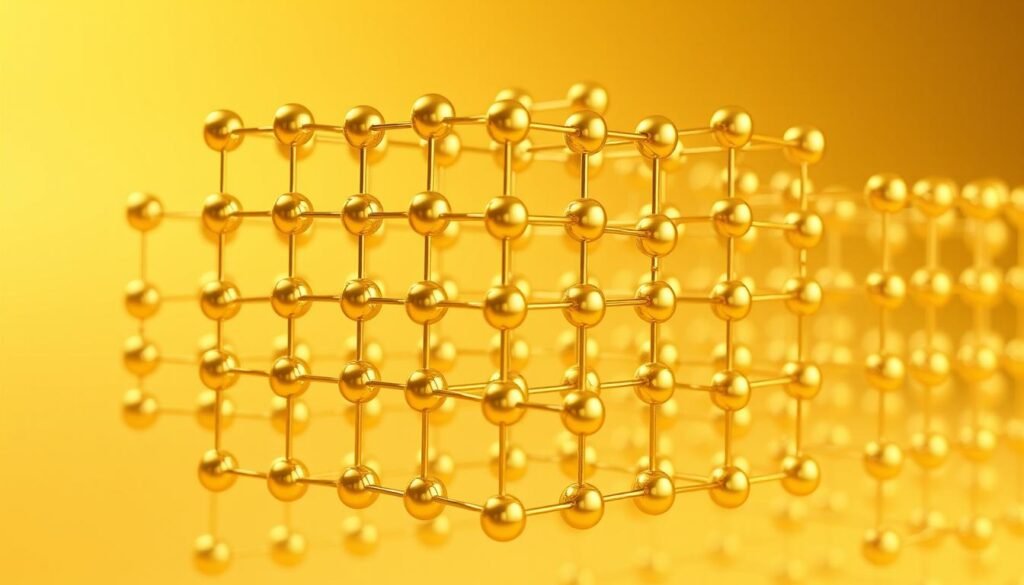
The electron configuration of gold is [Xe] 4f14 5d10 6s1. This setup is key to its chemical and physical traits. The way its electrons are arranged affects its ability to form compounds and its catalytic properties.
The Role of d-Orbitals in Gold’s Properties
The d-orbitals in gold are fully occupied. This makes gold noble and resistant to reacting with other elements. It also affects its ability to form compounds and its catalytic abilities.
| Property | Description | Influence of Atomic Structure |
|---|---|---|
| Chemical Reactivity | Low reactivity due to noble metal characteristics | Full d-orbitals contribute to low reactivity |
| Malleability | Highly malleable, can be beaten into thin sheets | Face-centered cubic crystal structure allows for easy deformation |
| Ductility | Highly ductile, can be drawn into thin wires | Atomic structure allows for significant plastic deformation |
Understanding gold’s atomic structure helps us see why it’s so unique. This makes it valuable for many uses, from jewelry to electronics.
Gold: The Element That Defies Corrosion
Gold doesn’t tarnish or oxidize like many other metals. This is because of its unique electrochemical nobility. It’s perfect for jewelry and industrial uses.
Why Gold Doesn’t Tarnish or Oxidize
Gold’s full outer energy level makes it chemically inert. This means it doesn’t easily react with oxygen or sulfur. These are common causes of tarnish and corrosion in other metals.
Key factors contributing to gold’s corrosion resistance include:
- Its noble nature, which reduces its reactivity
- A full outer energy level, making it chemically stable
- The absence of reactive surface sites that could initiate corrosion
Electrochemical Nobility of Gold
Gold’s electrochemical nobility shows its resistance to corrosion, even with an electric current. This is important for electrical contacts and connectors.
Comparing Gold’s Stability to Other Metals
Gold is much more stable than silver and copper. While silver and copper tarnish quickly, gold stays the same. This is why gold jewelry and coins last for centuries.
The unique combination of gold’s chemical inertness and electrochemical nobility makes it an exceptional material for applications requiring long-term durability.
The Extraordinary Malleability of Gold
Gold is incredibly malleable, which means it can be beaten into very thin sheets. It’s the most malleable metal out there. Just one gram of gold can be turned into a sheet of 1 square meter.
The Science Behind Gold Leaf Production
Making gold leaf involves beating gold into very thin layers. This is because of gold’s unique atomic structure. It lets its atoms slide past each other easily. This makes gold perfect for such delicate work.
Atomic Explanation for Extreme Malleability
Gold’s malleability comes from its electron configuration and atomic arrangement. Its face-centered cubic structure lets it deform easily without breaking. This structure is why gold is so versatile as a metal.
Industrial Applications of Gold’s Malleability
Gold’s malleability is great for many industrial uses, like in electronics and dentistry. Here are some examples:
- Electrical contacts and connectors
- Dental fillings and crowns
- Ornamental gilding
| Industry | Application | Benefit of Malleability |
|---|---|---|
| Electronics | Electrical contacts | Allows for precise shaping |
| Dentistry | Dental fillings | Enables easy molding |
| Ornamental | Gilding | Facilitates intricate designs |
Ductility: How Gold Stretches Beyond Imagination
Gold can be drawn into thin wires like no other metal. This property is key in many uses.
The Physics of Drawing Gold Into Wire
Drawing gold into wire shows off its ductility. Its special atomic structure lets it stretch a lot without breaking. This is because of its face-centered cubic crystal structure.
Quantifying Gold’s Remarkable Ductility
Gold can be made into a wire as thin as a single atom. It can stretch a lot before it breaks. This makes it very useful in tech and other fields.
Practical Applications in Technology
Gold’s ductility has many uses:
- Electronics: Gold wires are great in microelectronics because they conduct well and are reliable.
- Connectors: Gold is good in connectors and contacts because it doesn’t corrode and keeps conducting well.
- Medical Devices: Gold is safe for medical implants and devices because it’s biocompatible and ductile.
By using gold’s special properties, we can keep making new tech better.
The Science Behind Gold’s Distinctive Yellow Color
Gold’s yellow color is not just for show. It’s a result of its atomic structure and how it interacts with light. This is a complex scientific phenomenon.
Relativistic Effects on Gold’s Appearance
Gold’s color is influenced by relativistic effects. These effects are important in heavy elements like gold. They change the energy levels of gold’s electrons.
This change affects how light is absorbed and reflected. Gold looks yellow because it reflects yellow and red light. It absorbs blue and violet light.
The Physics of Light Interaction with Gold
When light hits gold, it excites the electrons. These electrons then oscillate. This is called plasma oscillation.
This oscillation happens at a frequency in the visible spectrum. It makes gold appear yellow.
How Impurities Affect Gold’s Color
Impurities in gold can change its color. For example, adding silver or copper can make it white or rose gold. The table below shows how different elements can alter gold’s color.
| Alloying Element | Resulting Color |
|---|---|
| Silver | White Gold |
| Copper | Rose Gold |
| Zinc | Pale Yellow |
Learning about gold’s color science helps us appreciate it more. It also shows how gold is used in many things, like jewelry and electronics.
Thermal and Electrical Conductivity Properties
Gold’s thermal and electrical conductivity make it very valuable in today’s technology. It conducts heat and electricity well, which is key for many uses.
Gold as an Exceptional Electrical Conductor
Gold is great at conducting electricity. It’s used a lot in electronics for parts like connectors and switches. Gold’s conductivity is superior in certain applications because it doesn’t tarnish or corrode, ensuring reliable performance over time.
| Property | Gold | Copper | Silver |
|---|---|---|---|
| Electrical Conductivity (S/m) | 4.5 x 10^7 | 5.9 x 10^7 | 6.3 x 10^7 |
| Thermal Conductivity (W/mK) | 314 | 386 | 429 |
Heat Transfer Capabilities
Gold is also good at transferring heat, which is important in many areas. Its heat transfer abilities are used in many technological and industrial processes.
Why Gold Outperforms Other Conductors in Certain Applications
Even though copper and silver are more conductive, gold’s resistance to corrosion gives it a unique advantage. In places where corrosive substances are a problem, gold is the better choice.
Exploring gold’s science, its conductivity is a major reason for its use in advanced tech. Whether in electronics or other fields, gold’s special properties make it essential.
Density and Weight: The Atomic Explanation
When you hold gold, you feel its weight. This is because of how its atoms are arranged. Gold has a density of 19.3 g/cm3, making it very dense.
Why Gold Is Denser Than Most Elements
Gold’s high density comes from its atomic structure. Gold atoms are packed closely in a face-centered cubic lattice. This tight arrangement leads to a high mass per unit volume, making gold dense.
Atomic packing is key to a metal’s density. In gold, the atoms fit together well, resulting in its high density.
Practical Implications of Gold’s High Density
The density of gold has big practical uses. It affects how gold is used and how its purity is measured. Density measurements help check if gold is real and pure.
Scientific Methods for Measuring Gold Purity
There are several ways to measure gold purity:
- Density measurements: By comparing a gold sample’s density to pure gold, its purity can be found.
- X-ray fluorescence: This method analyzes X-rays from a gold sample to learn about its composition.
These methods are vital in many fields, like jewelry making and bullion trading. They ensure gold products are accurate and genuine.
Gold’s Biocompatibility: A Scientific Analysis
Gold’s ability to work well with the body is key in medicine. It’s used in implants and tools because it doesn’t react much with the body. This makes it safe for use in medical settings.
Molecular Interactions with Biological Systems
Gold doesn’t react much with the body’s tissues and fluids. This is because of how it interacts at a molecular level. It’s this low reactivity that makes gold great for implants and other medical tools.
Medical Applications Based on Biocompatibility
Gold’s biocompatibility has led to its use in many medical areas. Some examples include:
- Dental implants and restorations
- Cardiovascular stents
- Diagnostic instruments
- Therapeutic agents in treatments
Recent Research in Gold-Based Therapeutics
Scientists are now looking into gold nanoparticles for new treatments. They’re interested in their ability to deliver drugs and fight cancer. Gold nanoparticles have special properties that make them good for these tasks.
Here’s a quick look at gold’s biocompatibility and its uses:
| Property | Description | Application |
|---|---|---|
| Inertness | Minimal reactivity with biological systems | Medical implants, diagnostic tools |
| Biocompatibility | Compatibility with bodily tissues and fluids | Dental restorations, cardiovascular stents |
| Nanoparticle properties | Unique optical and chemical properties | Targeted drug delivery, cancer treatment |
The Metallurgy of Gold Alloys
Gold alloys are made by mixing gold with other metals. This creates different colors and properties. You might know about white gold or rose gold, made this way.
The Science of Karatage and Purity Measurement
The purity of gold is measured in karats, with 24-karat being the purest. But pure gold is too soft for many uses. So, it’s mixed with other metals to make it stronger.
The karatage system shows how much gold is in an alloy. For example, 18-karat gold has 75% gold, and 14-karat has 58.3%. Knowing karatage is key when picking gold for jewelry or other uses.
How Alloying Elements Alter Gold’s Properties
Adding different metals to gold changes its properties. For example, silver or copper can change its color. Metals like zinc or nickel can make it stronger.
The choice of metals depends on what the final product needs. Here are some common metals and their effects:
- Copper: Adds strength and creates rose gold.
- Silver: Can produce green gold when combined in certain proportions.
- Nickel or Palladium: Used to create white gold by reducing gold’s yellow color.
- Zinc: Helps in strengthening the alloy.
Creating Colored Gold Through Alloying
Creating different colors in gold is fascinating. Rose gold is made by adding copper, and white gold by adding nickel or palladium. These colors are used in jewelry and decorations.
The art of creating colored gold is about finding the right mix of metals.
Understanding gold alloys shows how versatile gold is. It’s used in jewelry and even in electronics.
Optical and Reflective Properties of Gold
Gold’s interaction with light is truly unique. It has many practical uses. You might know gold is highly reflective. But let’s explore what makes its optical properties special.
Gold’s Unique Reflectivity Characteristics
Gold’s reflectivity stands out. It reflects light differently than other metals, giving it a unique luster. This is not just beautiful; it also has big scientific benefits.
- Gold reflects infrared radiation better than visible light.
- This makes gold very useful in many technologies.
- Gold’s reflectivity is used in spacecraft components and high-quality mirrors.
Infrared Reflection and Technological Applications
Gold’s ability to reflect infrared radiation is key. This opens up many tech uses, from thermal imaging to advanced electronics.
Gold’s Role in Optical Instruments
In optical tools, gold’s reflective traits are used to make mirrors and parts work better. This is true, mainly when infrared reflection is important.
By using gold’s optical and reflective traits, scientists and engineers create new solutions in many areas.
Gold at the Nanoscale: Quantum Properties
Exploring gold nanoparticles opens a world where quantum properties change how we see gold. At the nanoscale, gold shows unique properties that are different from its larger form.
Size-Dependent Properties of Gold Nanoparticles
Gold nanoparticles have size-dependent properties. This means their traits change with their size. Understanding this is key to using gold nanoparticles for various needs.
Color Changes and Surface Plasmon Resonance
Gold nanoparticles can change colors due to surface plasmon resonance. This happens when electrons on the surface move with light. They absorb some light and scatter others, causing color changes.
Applications in Nanotechnology and Medicine
The special traits of gold nanoparticles, like color changes and surface plasmon resonance, are vital in nanotechnology and medicine. They are used in:
- Drug delivery systems
- Imaging techniques
- Diagnostic tools
These uses show how gold nanoparticles can help in medical and technological advancements.
Crystallography and Lattice Structure of Gold
Exploring gold reveals its unique properties are tied to its crystal structure. Gold’s face-centered cubic (FCC) structure greatly affects its physical traits.
Face-Centered Cubic Arrangement
In the FCC setup, each gold atom sits at a cube corner and one at each face’s center. This design makes gold very malleable and ductile. It can be shaped and drawn into many forms without breaking.
How Crystal Structure Influences Physical Properties
The FCC structure of gold is key to its metal properties. It lets gold atoms move past each other under stress. This makes gold highly malleable and ductile, vital for many uses.
X-ray Diffraction Studies of Gold
Scientists study gold’s crystal structure with X-ray diffraction (XRD). XRD measures how X-rays interact with gold’s lattice. It gives insights into gold’s atomic arrangement and the science behind its properties.
Gold’s Chemical Reactivity and Exceptions
Gold is known for not corroding or reacting with many chemicals, except in a few cases. It’s interesting to note that gold can react under certain conditions. This makes gold both valuable and useful in many areas.
Resistance to Most Chemical Reactions
Gold doesn’t react with many things because its outer energy level is full. It doesn’t tarnish or corrode in air, water, or most acids. This is why gold is great for jewelry and coins, keeping its look over time.
The Chemistry of Aqua Regia and Gold Dissolution
Gold does react with aqua regia, a mix of nitric and hydrochloric acids. This reaction is complex. It involves gold being oxidized by nitric acid and then forming tetrachloroauric acid with hydrochloric acid. The process can be shown in the following equation:
| Chemical Reaction | Description |
|---|---|
| Au + HNO3 + 4HCl → HAuCl4 + NO + 2H2O | Gold dissolution in aqua regia |
Gold Compounds and Complexes
Gold creates many compounds and complexes, some with big uses. For example, gold complexes are used in catalysis. Some gold compounds are also being looked at for medical uses. Research into these compounds is growing, helping us learn more about gold’s unique properties.
The science characteristics of gold, like its reactivity and compound formation, show its value in tech, medicine, and more. Knowing these properties is key to using gold in new ways.
Advanced Scientific Applications Leveraging Gold’s Properties
Gold’s unique properties make it key in many high-tech fields, like electronics and medicine. It’s amazing how this precious metal is helping us innovate and live better every day.
Electronics and Computing Technologies
In electronics, gold shines because it conducts well and doesn’t corrode. It’s used in connectors and switches for its reliability and long life. Gold is perfect for fast computing needs.
Aerospace and Satellite Applications
The aerospace world also relies on gold, thanks to its infrared reflection. Satellites use gold to keep their parts safe from harsh temperatures. Gold’s science is vital for these systems’ success.
Medical Diagnostics and Treatment Innovations
In medicine, gold is helping create new diagnostic and treatment tools. Gold nanoparticles are being studied for cancer therapy. Gold’s safety makes it great for medical use.
Gold in Quantum Computing Research
Gold is also being looked at for quantum computing. Its unique nanoparticles might boost quantum computing. Gold could be key in future quantum breakthroughs.
Gold’s advanced uses show its importance in tech progress. By using gold’s science, we’re making new solutions in many fields.
Conclusion: The Enduring Scientific Significance of Gold
You’ve learned about the amazing world of gold science. You’ve seen how its unique properties make it valuable. These include its atomic structure, malleability, ductility, and color.
Gold’s properties are key in many areas. It’s used in electronics, computing, medical diagnostics, and aerospace. This shows how important gold is in our world.
Gold’s science ensures it stays vital in many fields. New uses for gold will come as research grows. Its special traits have amazed scientists and industries, pushing us forward.
Knowing the science of gold helps us see its big role. Gold is crucial for new tech and its beauty. As we keep exploring gold, its value will only grow, leading to more discoveries.